What Is Maintenance Margin? Liquidation Triggers and Risk Control Principles in 2026
Maintenance margin: minimum equity to keep a position open. Below it triggers liquidation. Learn margin ratio and liquidation price plus risk tips.
Maintenance margin: the minimum equity that must be maintained in your account after opening a position. If it falls below this level, the position may be automatically closed (liquidated). It is like a rental deposit—if it falls below the minimum threshold, the landlord can repossess the property. Understanding this line is the first step to using leverage well.
#What is Maintenance Margin?
Maintenance margin: the minimum equity requirement during a position. Unlike the initial margin paid when opening a position, it is an ongoing requirement: as long as the position remains open, the account equity must not fall below this value. Here, 'equity' refers to the total account equity (available balance + unrealized PnL), not just the margin balance.
Analogy: The margin paid when opening a position is like a rental deposit, and the maintenance margin is the minimum deposit threshold. If the deposit falls below the threshold, the landlord has the right to repossess the property.
Maintenance margin is the minimum equity that must be maintained throughout the life of a position. If it falls below this level, the exchange will trigger forced liquidation. Most platforms calculate this requirement as a certain percentage of the position's notional value, with the percentage tiered by asset and position size. Once the account equity falls below this amount, the system may automatically reduce or fully close the position.
#How is the maintenance margin ratio calculated?
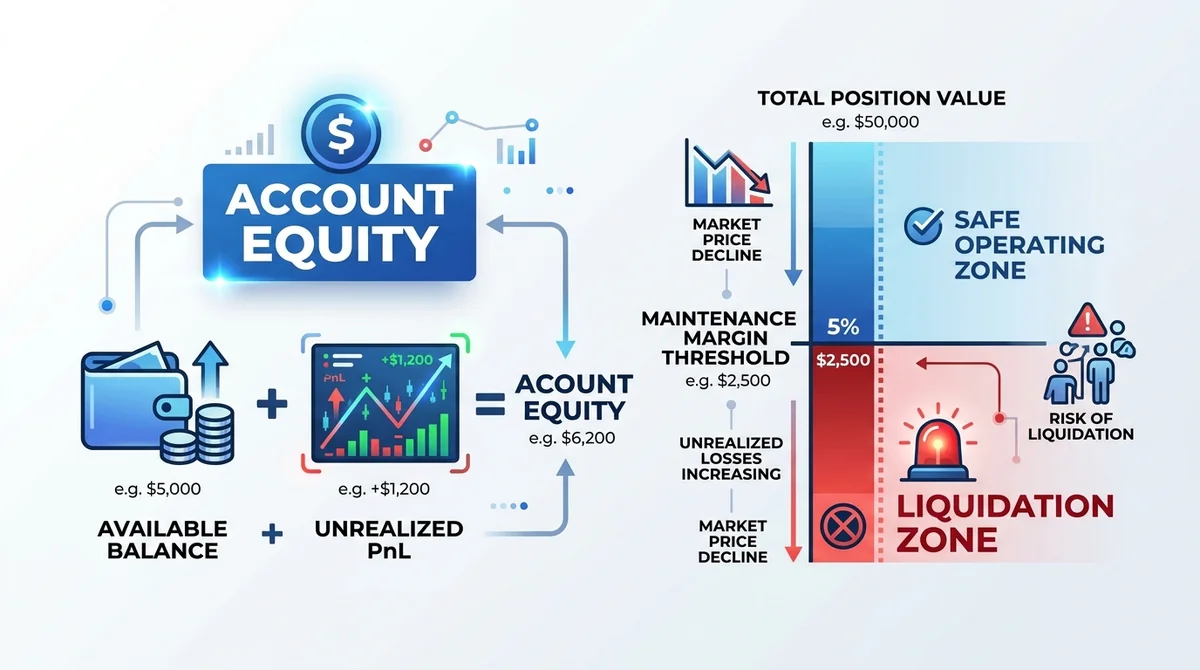
Formula: maintenance margin ratio (TRUMPUSDT perpetual futures margin requirements explained) = maintenance margin ÷ position value.
Exchanges set different maintenance margin ratio tiers for different assets and position sizes. High leverage magnifies position size, which may push the position into a higher maintenance margin ratio tier, increasing liquidation risk. Different assets have different maintenance margin ratios due to varying price volatility. For example, highly liquid assets like BTC typically have lower maintenance margin ratios than small-cap altcoins. For the same asset, the larger the notional position value, the higher the tier and the higher the required maintenance margin ratio. You can check the exact tier tables on the exchange's 'fee schedule' or 'risk limit' page.
The maintenance margin ratio is not a fixed value; it is tiered according to the notional position value: the larger the position and the higher the leverage, the higher the corresponding maintenance margin ratio may be. For the same asset, 10x leverage and 50x leverage correspond to different tiers; the latter may require a higher maintenance margin ratio, and the liquidation risk also increases.
The liquidation price is not a fixed number pre-set by the exchange; it is derived from the entry price, leverage, initial margin ratio, and maintenance margin ratio. For an isolated long position, a simplified formula is:
Liquidation price ≈ entry price × (1 - initial margin ratio + maintenance margin ratio) / (1 - maintenance margin ratio)
Actual platforms also consider funding fees, realized PnL, and other factors, so the precise value is based on the exchange's real-time calculation. Users can view the system's real-time liquidation price directly in the 'Positions' section of the trading page, without manual calculation.
#What is the difference between maintenance margin and initial margin?
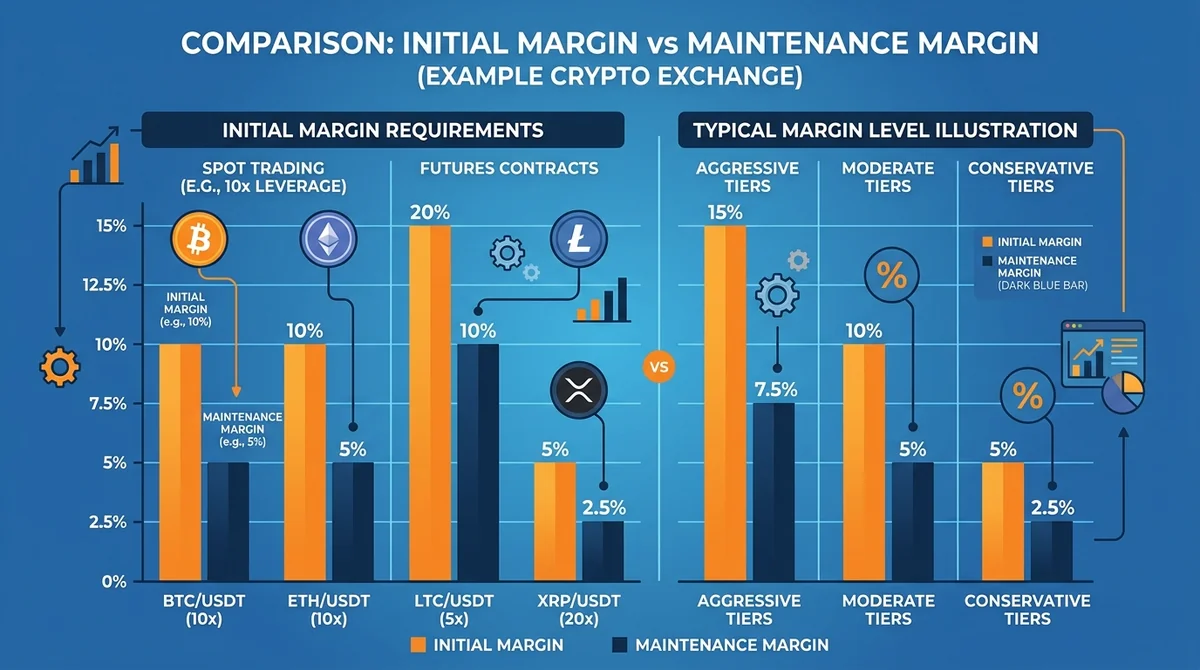
Initial margin determines whether you can open a position; maintenance margin determines whether you can keep it open. On most platforms, the maintenance margin requirement is lower than the initial margin requirement.
Example: On a given platform, the initial margin ratio required to open a position is usually higher than the maintenance margin ratio; the actual ratios vary by platform and asset, so please refer to the platform's published figures. Falling below the maintenance margin requirement may trigger liquidation.
#Common Beginner Misconceptions
Misconception 1: Thinking that maintenance margin is a fixed amount. In reality, the maintenance margin amount = maintenance margin ratio × position value, which changes with the position value; but the maintenance margin ratio remains fixed within a specific tier.
Misconception 2: Thinking that having enough funds when opening a position means you are always safe. Price fluctuations can erode account equity, potentially falling below the maintenance margin line.
Misconception 3: Thinking that the liquidation price is fixed. In reality, the liquidation price changes with margin additions, position adjustments, funding fee settlements, and needs continuous attention.
#How to Reduce Liquidation Risk?
- Control leverage: Do not use maximum leverage; leave sufficient margin buffer to avoid hitting the liquidation line on small price movements.
- Set stop-losses: In extreme market conditions, prices may gap and stop-loss orders may not always fill, but in normal volatility they can effectively limit losses.
- Monitor continuously: Keep an eye on the margin ratio and liquidation price in the positions panel; when the price approaches the liquidation price, add margin or reduce the position in a timely manner.
- Practice with a demo account: Familiarize yourself with the liquidation process and margin changes with a demo account before risking real money.
MSX Learn reminds you: Before live trading, beginners can use a demo account to experience the liquidation mechanism and understand the trigger conditions for margin calls and auto-deleveraging.
#Frequently Asked Questions (FAQ)
What is maintenance margin?
Maintenance margin is the minimum account equity that must be maintained while holding a position. If it falls below this level, the exchange may force liquidation. It differs from the initial margin paid when opening a position; it is an ongoing requirement.
How is the maintenance margin ratio calculated?
Maintenance margin ratio = maintenance margin ÷ position value. Different exchanges, assets, and position sizes have different tiers. High leverage magnifies position size, which may push the position into a higher maintenance margin ratio tier, increasing liquidation risk.
Below what maintenance margin level will liquidation occur?
When the account equity falls below the maintenance margin requirement, liquidation may be triggered. The exact threshold is set by the exchange and varies by asset and leverage tier. The liquidation price is influenced by the entry price, leverage, and maintenance margin ratio, but the precise calculation must refer to the platform's rules.
How is the liquidation price calculated?
Simplified formula: liquidation price ≈ entry price × (1 - initial margin ratio + maintenance margin ratio) / (1 - maintenance margin ratio). Actual platforms consider funding fees and other factors; users can check the real-time liquidation price in the positions section of the trading page without manual calculation.
What is the difference between initial margin and maintenance margin?
Initial margin is used to open a position; maintenance margin is used to keep it open. On most platforms, the maintenance margin requirement is lower than the initial margin requirement. Meeting the initial margin requirement is sufficient to open a position, but you must continuously meet the maintenance margin requirement while holding it.
How can beginners avoid liquidation?
Fully understand the maintenance margin rules, keep a sufficient margin buffer, and avoid excessive leverage. Monitor price movements and promptly add margin or reduce positions. Be aware of digital asset volatility; this article is not investment advice.
How can I check the maintenance margin ratio of my position?
On the exchange's trading page, go to the 'Positions' or 'Holdings' tab to see each position's maintenance margin ratio, liquidation price, and margin balance. Interfaces vary by platform, but real-time display is generally available.
Maintenance margin is the 'lifeline' of leveraged trading. Understanding how it is calculated and what triggers liquidation can help traders manage risk more rationally. Regardless of how much leverage you use, remember that leverage magnifies both gains and losses; always keep a buffer and avoid running your position naked.
Related reading: What's the difference between spot and perpetual futures?
FAQ
What is maintenance margin?
Maintenance margin is the minimum account equity that must be maintained while holding a position. If it falls below this level, the exchange may force liquidation. It differs from the initial margin paid when opening a position; it is an ongoing requirement.
How is the maintenance margin ratio calculated?
Maintenance margin ratio = maintenance margin ÷ position value. Different exchanges, assets, and position sizes have different tiers. High leverage magnifies position size, which may push the position into a higher maintenance margin ratio tier, increasing liquidation risk.
Below what maintenance margin level will liquidation occur?
When the account equity falls below the maintenance margin requirement, liquidation may be triggered. The exact threshold is set by the exchange and varies by asset and leverage tier. The liquidation price is influenced by the entry price, leverage, and maintenance margin ratio, but the precise calculation must refer to the platform's rules.
What is the difference between initial margin and maintenance margin?
Initial margin is used to open a position; maintenance margin is used to keep it open. On most platforms, the maintenance margin requirement is lower than the initial margin requirement. Meeting the initial margin requirement is sufficient to open a position, but you must continuously meet the maintenance margin requirement while holding it.
How can beginners avoid liquidation?
Fully understand the maintenance margin rules, keep a sufficient margin buffer, and avoid excessive leverage. Monitor price movements and promptly add margin or reduce positions. Be aware of digital asset volatility; this article is not investment advice.
Related Terms
Want to see the real data for this concept?
After you sign up, you can view live prices, funding rates, and fees for the related assets.
View live prices and fees →