How to Buy Bitcoin on Margin
Learn how to buy Bitcoin on margin using collateral to borrow funds. Explore margin mechanics, margin ratio calculation, short selling, and liquidation risks.
Quick Answer: Buying Bitcoin on margin refers to depositing a certain proportion of collateral assets (margin) into an exchange to borrow additional funds and purchase more Bitcoin. This mechanism magnifies capital efficiency and potential profits, but it also proportionately magnifies losses and involves borrowing interest and liquidation risks.
#What Is Margin and Margin Trading?
#What Is the Core Definition of Margin?
Margin: Collateral assets or performance guarantees deposited by traders onto an exchange platform.
Similar to a security deposit when renting or borrowing, the trading platform holds these assets as collateral, allowing users to borrow extra capital for trading. In leverage trading mechanisms, what is margin directly determines a user's maximum borrowing capacity and position risk tolerance threshold.
#What Is the Difference Between Margin Trading and Spot Trading?
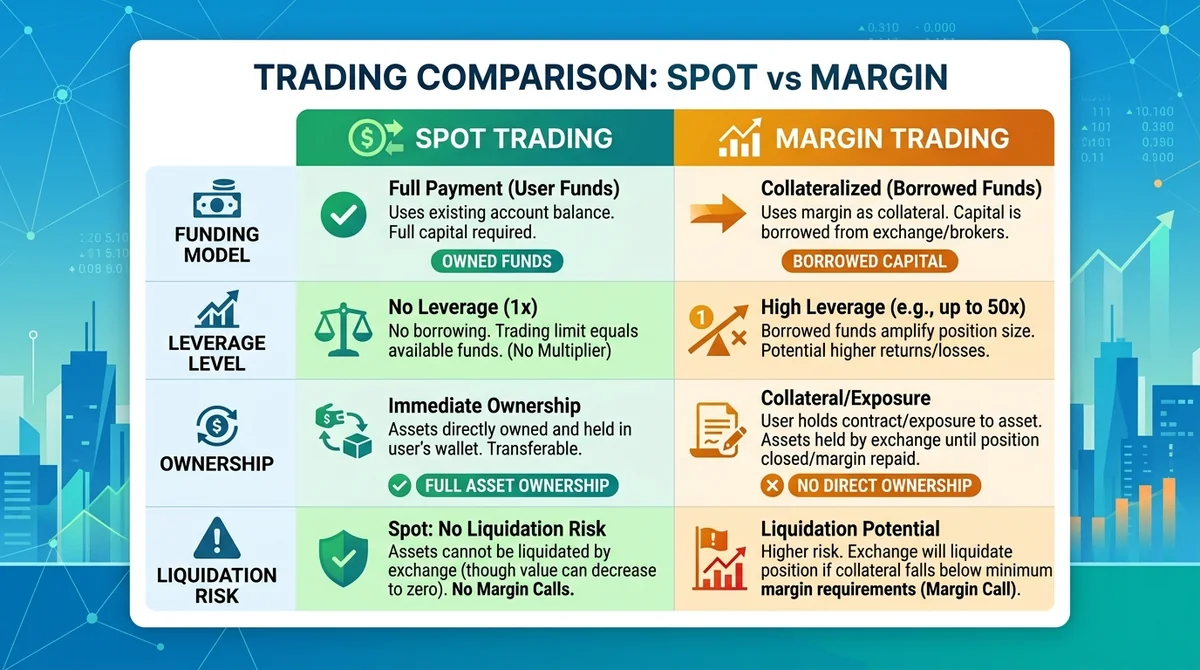
The core of what is spot trading is purchasing assets with the exact amount of available principal. It settles in full without creating debt liabilities.
Core Comparison:
- Spot Trading: 100% fully funded. Traders own the underlying asset outright. As long as the position is not sold voluntarily, the platform will not forcibly liquidate it even if the price drops.
- Margin Trading: Funded through a combination of personal collateral and platform-borrowed capital, creating leverage. When the market experiences adverse volatility, the position may hit risk control thresholds, resulting in the total loss of the deposited collateral.
#How to Buy Bitcoin on Margin? Basic Mechanics Explained
#Step-by-Step Workflow of Margin Buying
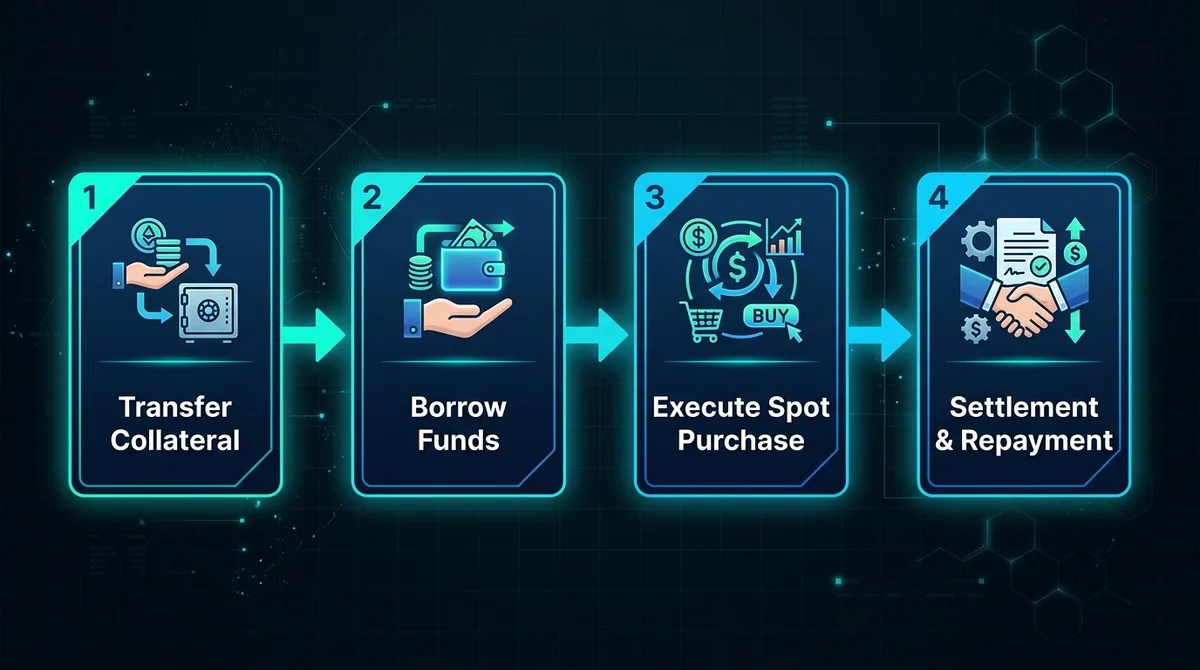
Buying crypto on margin functions similarly to collateralized borrowing and trading:
- Transfer Collateral: Move personal assets (e.g., USDT, BTC) into the margin account as initial margin.
- Borrow Funds: Based on the collateral value and chosen leverage multiplier, borrow trading funds (such as stablecoins or fiat) from the platform.
- Execute Spot Purchase: Use the borrowed funds to purchase the target amount of Bitcoin in the market.
- Settlement and Repayment: After closing the position by selling Bitcoin, repay the borrowed principal along with accrued interest. The remainder constitutes net profit or loss.
#Profit and Loss Example of Margin Buying (Theoretical Model)
Suppose the current price of Bitcoin is $50,000, and a trader has $10,000 in capital:
- The trader deposits $10,000 as margin and borrows $40,000, using the total $50,000 to buy 1 BTC (equivalent to 5x leverage exposure).
- Bullish Scenario: If Bitcoin rises to $60,000, the trader sells the position and repays the $40,000 loan (excluding interest for simplicity), leaving $20,000. The return on equity (ROE) is 100%.
- Bearish Scenario: If Bitcoin drops to $40,000, the total position value shrinks to $40,000—exactly equal to the outstanding loan amount. At this point, the trader's entire $10,000 principal is lost.
#What Is Margin Ratio? How Does It Affect Account Safety?
#Basic Calculation Logic of Margin Ratio
The margin ratio (a core metric similar to how TRUMPUSDT perpetual futures margin requirements explained) measures the financial risk level of a borrowed account. It is dynamically calculated based on the ratio of total account assets to total liabilities:
$$\text{Margin Ratio} \approx \frac{\text{Total Account Asset Value}}{\text{Borrowed Principal} + \text{Accrued Interest}}$$
When the price of the purchased underlying asset rises, total assets increase, raising the margin ratio and strengthening account safety. Conversely, when the price falls, total assets shrink, reducing the margin ratio and increasing risk exposure.
#Maintenance Margin and Liquidation
Trading platforms typically establish warning thresholds and liquidation levels:
- Margin Call: When the margin ratio drops to the platform's warning threshold, the system triggers what is a margin call, prompting the user to add collateral or reduce position size.
- Liquidation: If additional margin is not provided in time and the asset price breaches what is liquidation price, the system triggers a forced liquidation process, automatically selling the position assets to prioritize debt repayment.
#How to Sell Crypto Using Margin Mechanisms?
#Mechanics of Margin Shorting
Margin trading supports both bullish positions (longs) and bearish positions (shorts) through coin borrowing:
- Deposit Collateral: Deposit stablecoins or other accepted collateral.
- Borrow Coins: Borrow the asset you expect to decline (e.g., borrowing 1 BTC).
- Sell at High: Sell the borrowed tokens immediately on the open market for stablecoin cash.
- Repurchase at Low & Repay: When the market price falls, buy back the same quantity of tokens at a lower price and return them to the platform, capturing the price spread minus interest costs as net profit.
#Margin Shorting vs. Regular Spot Selling
Regular spot selling only allows users to sell tokens they physically hold to cash out and exit the market. Margin shorting establishes short exposure during market downtrends via borrowing. Note that if the asset price surges unexpectedly after shorting, theoretical losses are uncapped.
#What Risks Should Beginners Watch Out for in Margin Trading?
#Leverage Amplifying Losses and Liquidation Risk
Leverage is a double-edged sword. While it magnifies potential upside, minor adverse price movements can rapidly erode the initial principal, leading to total loss.
#Borrowing Interest and Volatility Costs
- Accrued Interest: Borrowed funds in margin trading accrue interest on an hourly or daily basis. The longer the position is held, the higher the capital cost.
- Liquidity and Slippage Risks: During sharp, one-sided market fluctuations, forced liquidations may encounter severe slippage, executing at far worse prices than anticipated.
Beginners should first familiarize themselves with market dynamics through non-leveraged spot trading. High leverage should never be used without a comprehensive understanding of interest calculation, liquidation mechanisms, and risk control rules.
Disclaimer: This article is for educational purposes regarding digital asset trading mechanics and does not constitute financial or investment advice.
FAQ
Can I be liquidated when buying Bitcoin on margin?
Yes. If the price of Bitcoin drops and causes your margin ratio to fall below the required maintenance margin level without timely collateral additions, the system will execute a forced liquidation to ensure the loan is repaid.
How is interest calculated when buying Bitcoin on margin?
Interest is typically calculated on an hourly or daily basis depending on the borrowed amount, the platform's real-time interest rate, and the duration of the loan. Interest accumulates continuously until repayment and is deducted upon position closure.
Can beginners short Bitcoin using margin trading?
Mechanically, yes, but it carries extreme risk. Shorting requires borrowing assets and selling them high; if the asset price rallies exponentially, the potential loss is theoretically unlimited. Beginners should exercise extreme caution.
Related Terms
Want to see the real data for this concept?
After you sign up, you can view live prices, funding rates, and fees for the related assets.
View live prices and fees →