Margin
Margin is the collateral you put up to cover potential losses, not a fee. Learn initial vs maintenance margin, cross vs isolated margin, and leverage risks.
Margin: the collateral you provide to cover potential losses on a position, not a fee.
#What Is Margin?
Margin is like a rental deposit. You put up money to prove you can cover potential losses.
When trading, you don't pay the full amount. You only deposit margin to control a larger position.
What's the difference between margin and fees?
Fees are service charges paid to the platform and are non-refundable. Margin is a deposit, returned after closing the position (minus losses).
Why do trades require margin?
Because leveraged trades can lose more than your principal, the platform requires you to put up margin first so it can deduct losses.
#What's the Difference Between Initial Margin and Maintenance Margin?
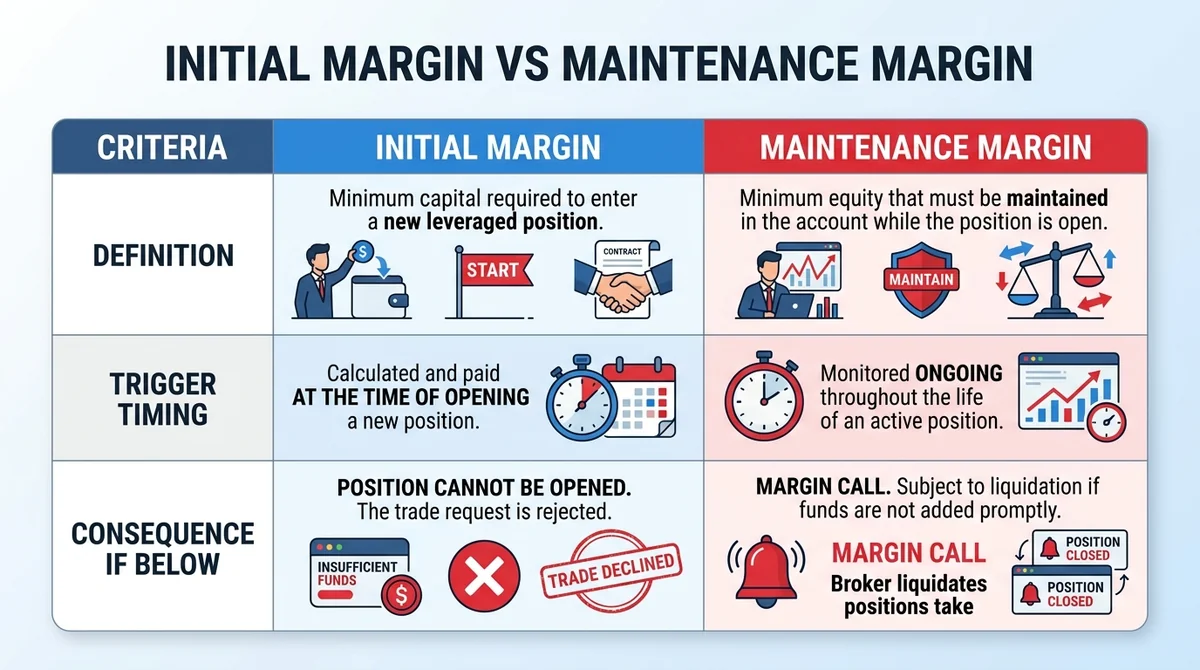
Initial margin: the minimum funds you must deposit to open a position. Maintenance margin: the minimum funds your account must maintain while holding a position.
If your account equity falls below the maintenance margin, liquidation is triggered.
Analogy: Initial margin is the key to open the door; maintenance margin is the minimum threshold that keeps the door from closing.
How is initial margin calculated?
Usually as a percentage of the position value. For example, at 10x leverage, initial margin is 10% of the position value.
Below what maintenance margin level triggers liquidation?
Below the maintenance margin rate set by the exchange. It varies by coin and leverage.
| Comparison | Initial Margin | Maintenance Margin |
|---|---|---|
| Definition | Minimum deposit to open | Minimum funds while holding |
| Trigger timing | At position opening | During holding |
| Consequence if below | Cannot open position | Forced liquidation |
One-sentence summary: Initial margin determines whether you can enter the market; maintenance margin determines whether you can stay in it.
#What's the Difference Between Cross Margin and Isolated Margin?
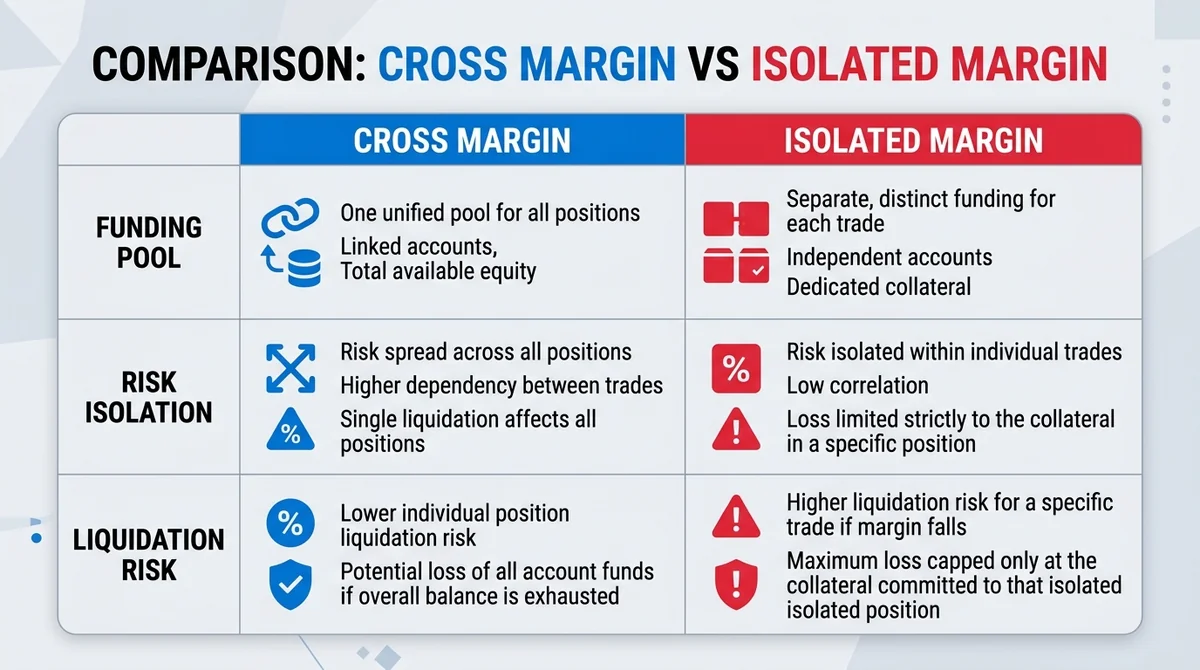
Cross margin: All funds in the account are shared; losses on one position can be covered by other funds. Isolated margin: Each position has its own allocated margin; losses are limited to that position's funds.
Cross margin spreads risk but can affect all funds; isolated margin isolates risk but triggers liquidation more easily.
Analogy: Cross margin is like a family sharing one wallet; isolated margin is like each person having their own wallet.
| Comparison | Cross Margin | Isolated Margin |
|---|---|---|
| Funding pool | Entire account balance | Each position independent |
| Risk isolation | No | Yes |
| Liquidation risk | Can affect all funds | Only lose that position's margin |
One-sentence summary: Cross margin uses the entire account to bear risk; isolated margin uses a single position to bear risk.
#What Are the Risks of Margin Trading?
Leverage amplifies both gains and losses.
When market volatility is high, margin can quickly become insufficient, leading to liquidation.
After liquidation, your deposited margin may be completely lost.
Risk warning: Margin trading is extremely risky and not suitable for beginners. This article is not investment advice.
#A Simple Margin Example
Suppose you use $100 margin to open a 10x leveraged position.
You can control a $1,000 position.
If the price drops 10%, your position loses $100, which equals your entire margin.
That's liquidation.
Example note: The higher the leverage, the smaller the price move needed to liquidate you.
#How to Avoid Insufficient Margin?
- Lower leverage: The lower the leverage multiple, the larger the margin buffer.
- Set stop-loss: Set a loss limit in advance to prevent losses from spiraling.
- Keep sufficient margin: Don't trade with your entire balance; leave room.
- Start small for beginners: Use small positions to learn the mechanics first, then gradually increase.
#FAQ
Q: What's the difference between margin and fees?
A: Margin is a deposit, returned after closing (minus losses); fees are platform service charges and are non-refundable. Margin covers potential losses, not a cost.
Q: What's the difference between initial margin and maintenance margin?
A: Initial margin is the minimum deposit to open a position; maintenance margin is the minimum funds you must maintain while holding. Falling below maintenance margin triggers liquidation.
Q: Which is riskier, cross margin or isolated margin?
A: Cross margin spreads risk across the entire account but can lose all funds; isolated margin isolates risk but individual positions are more easily liquidated. There's no absolute better choice; it depends on risk preference.
Q: How does leverage amplify losses?
A: Leverage lets you control a larger position with less margin. When prices move against you, losses are calculated on the full position size, so your margin loss percentage is multiplied.
Q: How to avoid insufficient margin?
A: Lower leverage, set stop-loss, keep sufficient margin, avoid trading with your entire balance. Beginners should start with small positions to learn the mechanics.
Q: Is margin trading suitable for beginners?
A: No. Margin trading is extremely risky. Beginners should first learn the basics and practice with small positions in simulation or live trading.
Q: Can I get my margin back after liquidation?
A: After liquidation, losses are deducted from margin first, and the remainder is returned. If losses exceed margin, you may incur a negative balance loss.
Q: Is a higher margin ratio safer?
A: Yes. A higher margin ratio means stronger resistance to volatility and lower liquidation risk. But capital efficiency is also lower.
This article is provided by MSX Learn. For more content, see msxfi.
FAQ
What's the difference between margin and fees?
Margin is a deposit, returned after closing (minus losses); fees are platform service charges and are non-refundable. Margin covers potential losses, not a cost.
What's the difference between initial margin and maintenance margin?
Initial margin is the minimum deposit to open a position; maintenance margin is the minimum funds you must maintain while holding. Falling below maintenance margin triggers liquidation.
Which is riskier, cross margin or isolated margin?
Cross margin spreads risk across the entire account but can lose all funds; isolated margin isolates risk but individual positions are more easily liquidated. There's no absolute better choice; it depends on risk preference.
How does leverage amplify losses?
Leverage lets you control a larger position with less margin. When prices move against you, losses are calculated on the full position size, so your margin loss percentage is multiplied.
How to avoid insufficient margin?
Lower leverage, set stop-loss, keep sufficient margin, avoid trading with your entire balance. Beginners should start with small positions to learn the mechanics.
Related Terms
Want to see the real data for this concept?
After you sign up, you can view live prices, funding rates, and fees for the related assets.
View live prices and fees →