Non-Custodial
Explore non-custodial crypto storage: learn how self-custody works, key differences with custodial models, and essential security best practices.
Non-custodial refers to a digital asset management model where users maintain full control over their private keys and asset ownership without relying on third-party intermediaries.
Everyday Analogy: Non-custodial storage is like keeping cash in a physical safe at home where only you hold the key. In contrast, custody is like depositing money in a bank, where the bank safeguards and accounts for your funds.
#What Is Non-Custodial?
In underlying blockchain architecture, asset data is recorded on a distributed ledger rather than stored inside specific client software. Users use their corresponding private keys to prove ownership and authority over assets tied to a specific crypto address.
The core principle of non-custodial systems is "keys equal ownership." The industry adage "Not your keys, not your coins" precisely reflects this distribution of control. When initiating transfers or smart contract interactions, users do not rely on approvals or endorsements from centralized institutions—they execute peer-to-peer transactions directly on the blockchain network.
#What Is the Difference Between Non-Custodial and Custodial Models?
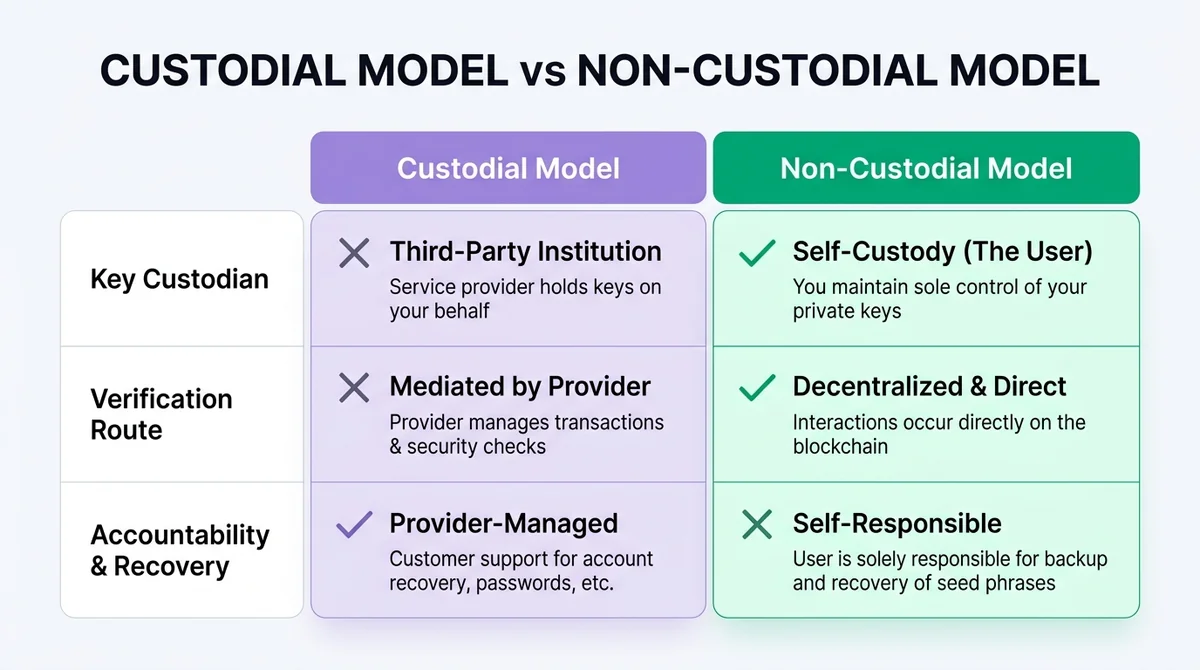
The fundamental distinction lies in who controls the private keys and who holds the security responsibility:
- Private Key Custodian: Custodial models rely on centralized platforms to hold private keys; non-custodial models require users to generate and store their private keys or seed phrases locally.
- Transaction Verification Route: Internal transfers in custodial setups are typically ledger adjustments in a platform database, whereas non-custodial operations require local user signing and on-chain node broadcast for confirmation.
- Accountability and Recovery: Custodial platforms offer password resets and customer support intervention; in non-custodial setups, losing private keys means no third party can assist in recovery.
To learn more about specific wallet implementations, read our comprehensive guide on what is a non-custodial wallet.
#How Does the Non-Custodial Mechanism Work?
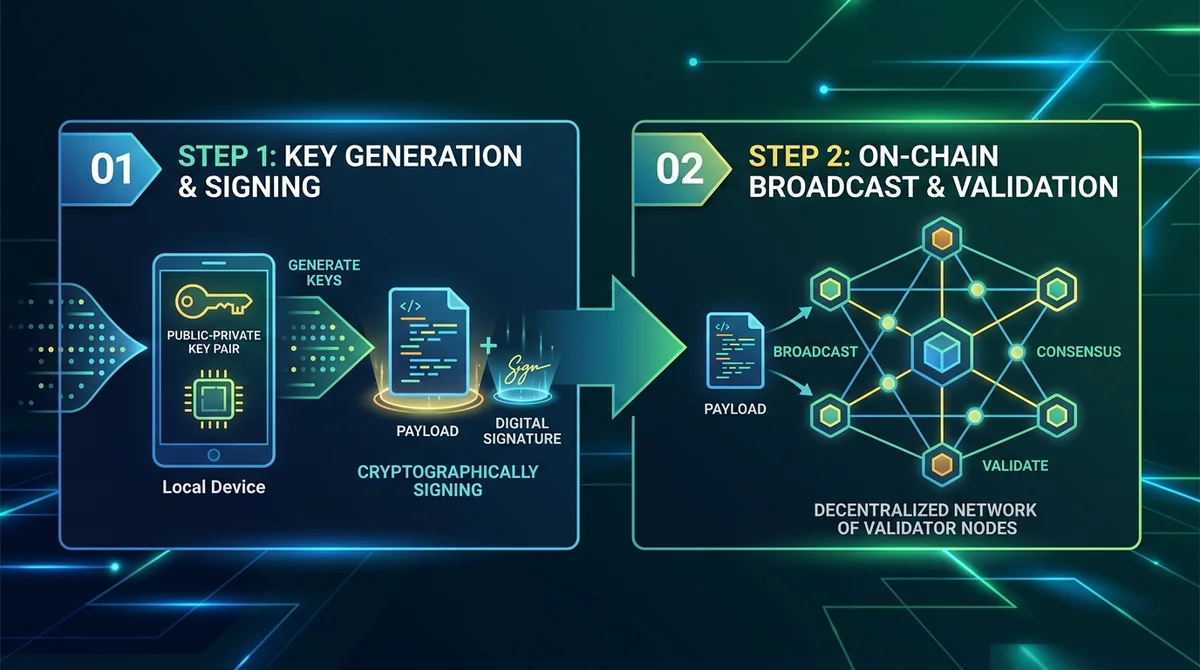
The underlying interaction of non-custodial tools (such as on-chain wallets) primarily involves two core steps:
- Local Offline Generation: When a user creates an account, wallet software generates the keypair and seed phrase offline on the local client device without transmitting private key data to any remote server.
- Local Signing and On-Chain Broadcast: When initiating a transaction, the client cryptographically signs the transaction data using the local private key, then broadcasts the signed payload to the blockchain network for validators to include in a block.
Throughout the entire lifecycle, private keys remain strictly in the local environment, preventing external developers or intermediaries from accessing or controlling the user's on-chain assets.
#Why Do Many Users Prefer Non-Custodial Solutions?
Compared to traditional centralized custody, non-custodial models offer several key advantages:
- Mitigated Counterparty Risk: Assets are stored independently at on-chain addresses, eliminating systemic risks from centralized platform mismanagement, bank runs, or unauthorized fund misappropriation.
- Censorship Resistance and Autonomous Transfers: As long as the blockchain network is active, users can initiate transactions anytime without waiting for institutional approvals or business hours.
- Privacy and Data Protection: Interacting with non-custodial applications and smart contracts generally requires no Know Your Customer (KYC) identity verification, minimizing exposure to centralized data breaches.
If you want to transfer your funds into a self-controlled on-chain environment, check out our step-by-step guide on how to withdraw from an exchange to a non-custodial wallet.
#What Risks and Limitations Come with Non-Custodial Tools?
Complete asset sovereignty means assuming full responsibility for security. Using non-custodial tools involves the following risks:
- Irreversible Loss of Keys or Seed Phrases: Non-custodial systems offer no centralized reset channels. If a seed phrase is lost or compromised, access to on-chain assets is lost permanently.
- Phishing and Malicious Approvals: Exposing seed phrases to phishing sites or granting unlimited token allowances to malicious smart contracts can lead to immediate asset theft.
- Irreversible Operational Errors: Blockchain transactions cannot be reversed. Mistyping a recipient address or selecting the wrong network cannot be intercepted or refunded by customer service.
Disclaimer: This article is for informational and educational purposes regarding blockchain mechanics and asset management models, and does not constitute investment advice or product endorsement.
FAQ
Are non-custodial and decentralized the same thing?
While related, they describe different dimensions. Non-custodial specifically refers to individual ownership and control of private keys and assets, whereas decentralized describes a network or protocol governance structure with no single point of control.
What should I do if I forget my non-custodial wallet password?
If you only forget the local app unlock password, you can restore your funds in any compatible wallet using your backed-up seed phrase or private key. If the seed phrase is also lost, the assets cannot be recovered.
Should beginners choose custodial or non-custodial storage?
Both models serve specific needs. Custodial solutions offer lower entry barriers and password recovery options, while non-custodial setups provide true asset ownership and censorship resistance but require independent key management skills.
Want to see the real data for this concept?
After you sign up, you can view live prices, funding rates, and fees for the related assets.
View live prices and fees →