What Is Order Book Depth? How to Read Bid/Ask Orders and Liquidity in 2026
Order book depth is how many orders sit at each price level, showing liquidity. Thick depth limits price impact; thin depth leads to slippage.
Order book depth is simply how many buy and sell orders are queued at each price level. The thicker the depth, the less likely large orders are to push prices up or down when filled. For beginners just learning to read the order book, understanding this "queue list" is more practical than studying complex indicators.
#What Is Order Book Depth?
The order book is a public list of buy and sell orders. Buyers place the prices and quantities they want to buy; sellers place the prices and quantities they want to sell. Depth is how densely these orders are distributed across different price levels.
Analogy: the order book is like the number of people queuing in front of a market stall. The more people in line, the less likely your large purchase alone will drive up the price. Conversely, if only one or two people are at the stall, buying ten pounds of cabbage might prompt the vendor to raise the price immediately.
Order book depth is usually visualized with a "market depth chart": the horizontal axis is price, the vertical axis is cumulative order quantity, and the left and right sides represent buy and sell orders respectively. The "thicker" the chart, the better the liquidity.
#How Does Order Book Depth Work?
Exchanges match trades based on "price priority, then time priority." When you place a market order, the system first consumes the current best ask price, then continues filling at higher price levels.
Thick depth: many price levels have substantial orders, so your large order gets absorbed evenly, and the fill price stays close to the current market price. Thin depth: orders run out after just one or two price levels, and the price can be pushed up quickly—that's slippage.
Example: you want to market buy 5 BTC. If the best ask has 10 BTC, your entire order fills at that single price. If the best ask has only 1 BTC and the next ask also has only 1 BTC, you'll have to eat through five price levels, and your average fill price keeps rising. Clearly, depth directly determines the execution cost of large orders.
Further reading: What's the difference between spot and perpetual contracts?
#Examples of Good Depth vs. Poor Depth
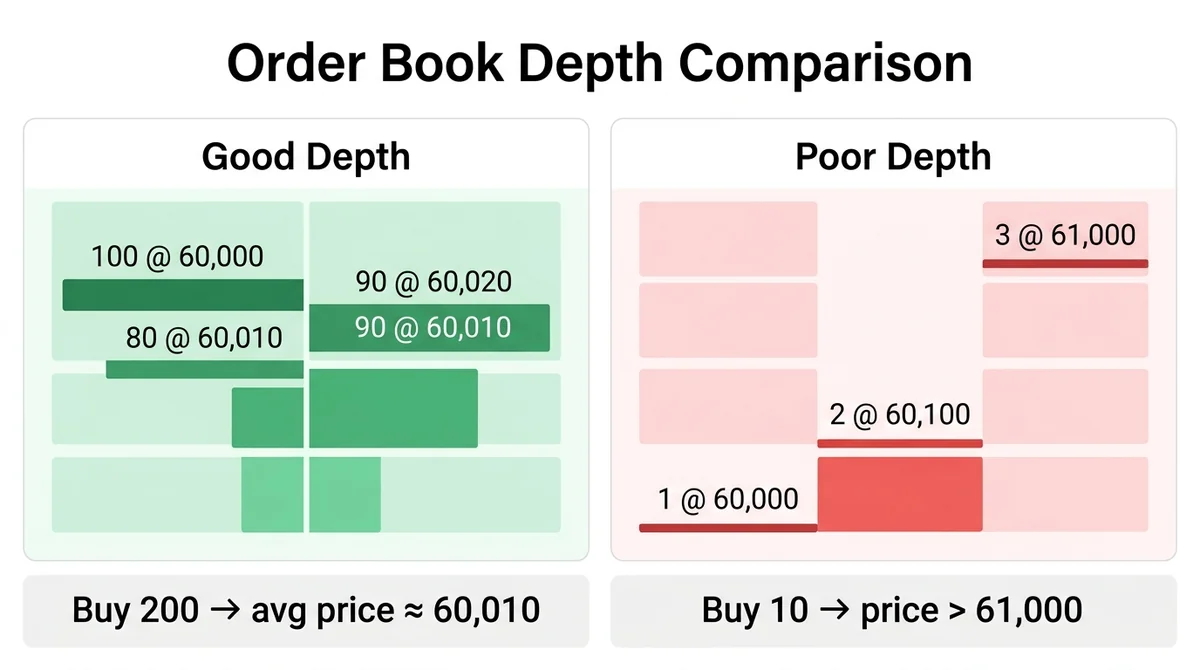
- Good depth: suppose an asset has 100 coins at 60,000, 80 at 60,010, and 90 at 60,020. Buying 200 coins gives an average price of about 60,010.
- Poor depth: only 1 coin is available at 60,000 and 2 at 60,100. Buying 10 coins could push the price above 61,000.
These are simplified examples; real markets are far more complex. Professional traders typically combine order book depth with volume distribution to gauge absorption strength, rather than looking only at the best bid and ask.
#How to Read an Order Book Depth Chart?
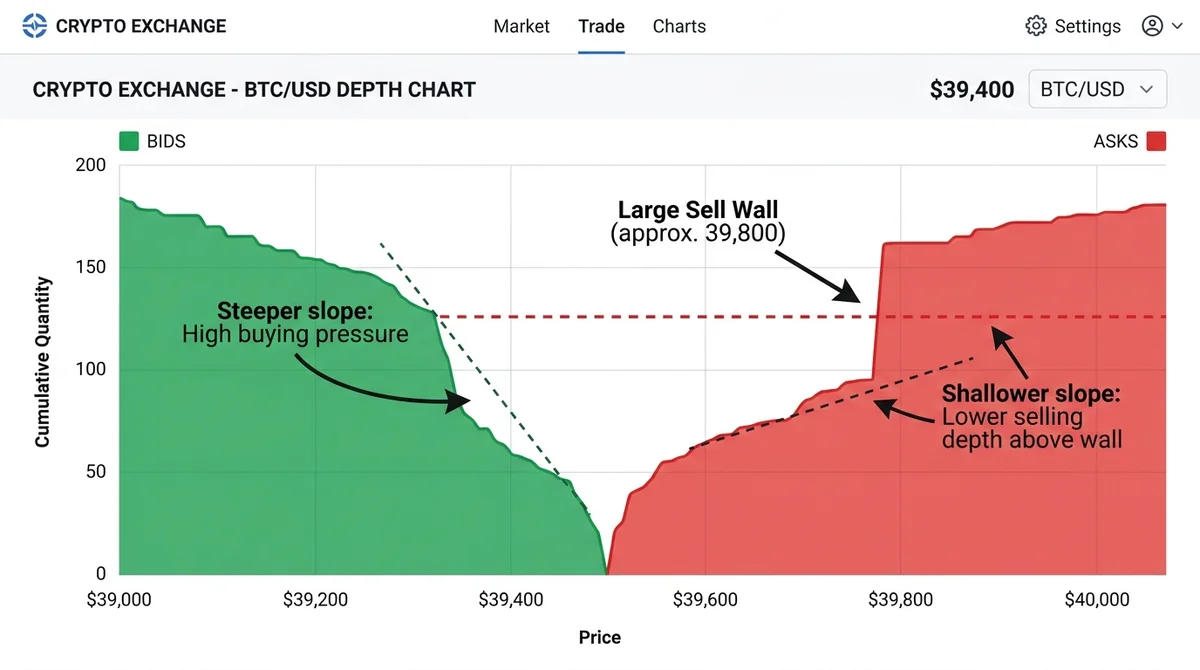
On major exchanges, the depth chart usually has two colored areas: the left side (often green) is cumulative buy orders, and the right side (often red) is cumulative sell orders. The horizontal axis is price, the vertical axis is cumulative quantity.
Here are a few practical tips for reading depth charts:
- Watch for "walls": A massive order appears at a certain price but doesn't get filled for a long time—it could be a large player supporting or suppressing the price, or it could be pulled at any moment.
- Watch the slope: A steep chart means poor depth and sparse orders; a gentle slope means good depth and evenly distributed orders.
- Watch buy/sell imbalance: If total buy orders significantly exceed total sell orders, the short-term bias may be bullish, but confirm with trading volume.
Note that depth charts are static snapshots. Order books change very quickly—especially for small-cap altcoins, depth can look completely different within seconds.
#Why Is It Important? What Are the Risks?
Large traders care most about depth because slippage can directly eat into profits. Regular users should also avoid placing large market orders when depth is thin. Depth can be faked: some traders place spoof orders and cancel them before they fill, while others use iceberg orders to hide their true size. Depth is only a static snapshot and can change at any time.
Good depth does not mean the price won't fall. Digital assets are high-risk, and this article is not investment advice. For more beginner-friendly guides, visit MSX Learn.
#Common Misconceptions
- A small bid-ask spread means good depth? Not necessarily. A tight spread might just mean both prices have only small orders. True depth requires looking at five, ten, or even deeper levels.
- Large depth means the price won't fall? Depth only reflects current orders and cannot predict trends. When large sell orders hit the market, depth can vanish instantly.
- Only looking at total volume? You need to consider the structure of orders—whether they're evenly distributed or concentrated at one price level, because the risk is completely different.
#Frequently Asked Questions (FAQ)
Q: What does order book depth mean?
A: Order book depth is the density of orders across different price levels in the order book. It reflects market liquidity. Thick depth means there are plenty of buy and sell orders at various price levels, so large trades are less likely to cause violent price swings.
Q: How can you tell if order book depth is good or bad?
A: Check whether order quantities at each bid and ask level are sufficient. If orders are dense and large between nearby price levels, depth is good; if orders are sparse and spreads are wide, depth is poor. In markets with good depth, execution slippage is usually smaller.
Q: What happens when depth is insufficient?
A: With insufficient depth, a large market order will quickly eat through orders at multiple price levels, causing the fill price to deviate from the current market price and producing high slippage and higher trading costs. In extreme cases, it can cause sudden, violent price fluctuations.
Q: Can order book depth be faked?
A: Yes. Some traders place fake large orders to attract followers, then cancel them before execution; others use iceberg orders to hide their true size. Therefore, depth is only a reference and should not be fully relied upon.
Q: Are limit orders affected by depth?
A: Limit orders only fill at the specified price or better, so they don't eat through price levels like market orders. As a result, they're less likely to incur extra slippage due to poor depth. However, poor depth may cause limit orders to remain unfilled for a long time.
FAQ
What does order book depth mean?
Order book depth is the density of orders across different price levels in the order book. It reflects market liquidity. Thick depth means there are plenty of buy and sell orders at various price levels, so large trades are less likely to cause violent price swings.
How can you tell if order book depth is good or bad?
Check whether order quantities at each bid and ask level are sufficient. If orders are dense and large between nearby price levels, depth is good; if orders are sparse and spreads are wide, depth is poor. In markets with good depth, execution slippage is usually smaller.
What happens when depth is insufficient?
With insufficient depth, a large market order will quickly eat through orders at multiple price levels, causing the fill price to deviate from the current market price and producing high slippage and higher trading costs. In extreme cases, it can cause sudden, violent price fluctuations.
Can order book depth be faked?
Yes. Some traders place fake large orders to attract followers, then cancel them before execution; others use iceberg orders to hide their true size. Therefore, depth is only a reference and should not be fully relied upon.
Related Terms
Want to see the real data for this concept?
After you sign up, you can view live prices, funding rates, and fees for the related assets.
View live prices and fees →