What Is a Smart Contract ABI? Interface Standard and Calling Mechanism in Crypto Development
A smart contract ABI (Application Binary Interface) defines contract functions, parameters, and return values for external apps to call contracts.
A smart contract ABI is an interface standard that describes contract functions and parameter formats, allowing external applications to call contracts correctly.
#What Is a Smart Contract ABI?
ABI stands for Application Binary Interface and is usually described in JSON format. It lists what functions a contract has, what parameters each function requires, and what data it returns. Think of it like a restaurant menu: you don't need to go into the kitchen; you just order from the menu to get the result.
#How Does a Smart Contract ABI Work?
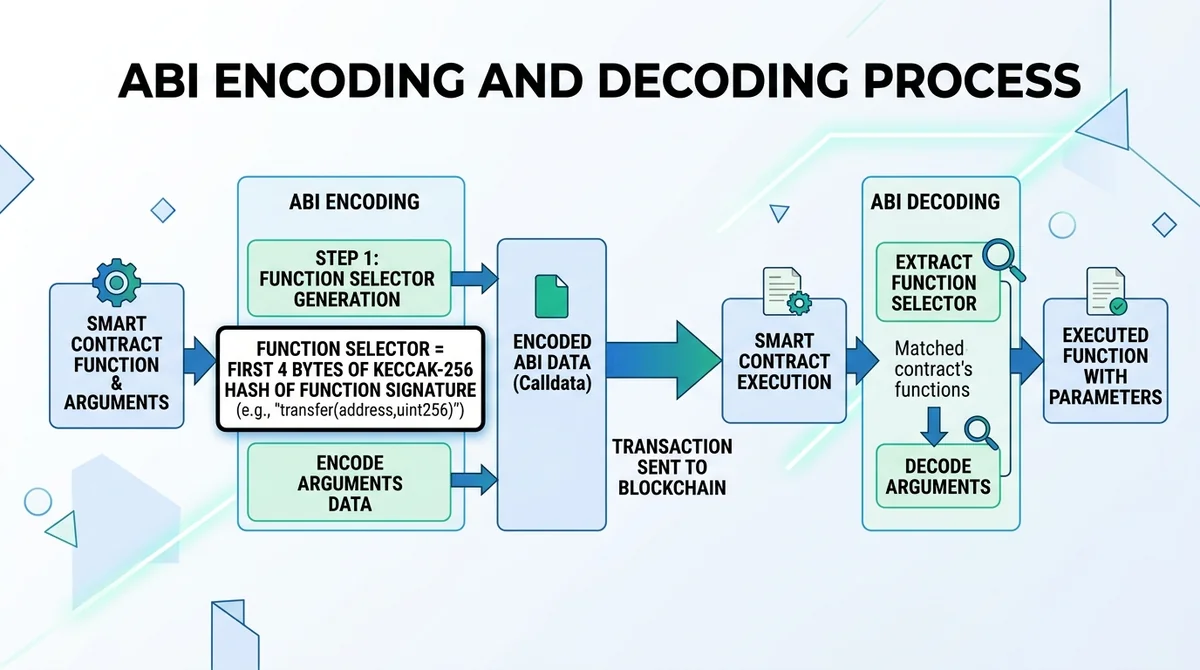
When an external program calls a contract, it uses the ABI to encode the function name and parameters into binary data. First, it calculates the Keccak-256 hash of the function signature and takes the first 4 bytes as the function selector, then encodes the parameters according to the ABI specification. After the contract executes, the returned data is also decoded using the ABI. DApp development on Ethereum relies on this mechanism. See How Decentralized Apps (DApps) Work?.
#Common ABI Examples and How to Obtain Them
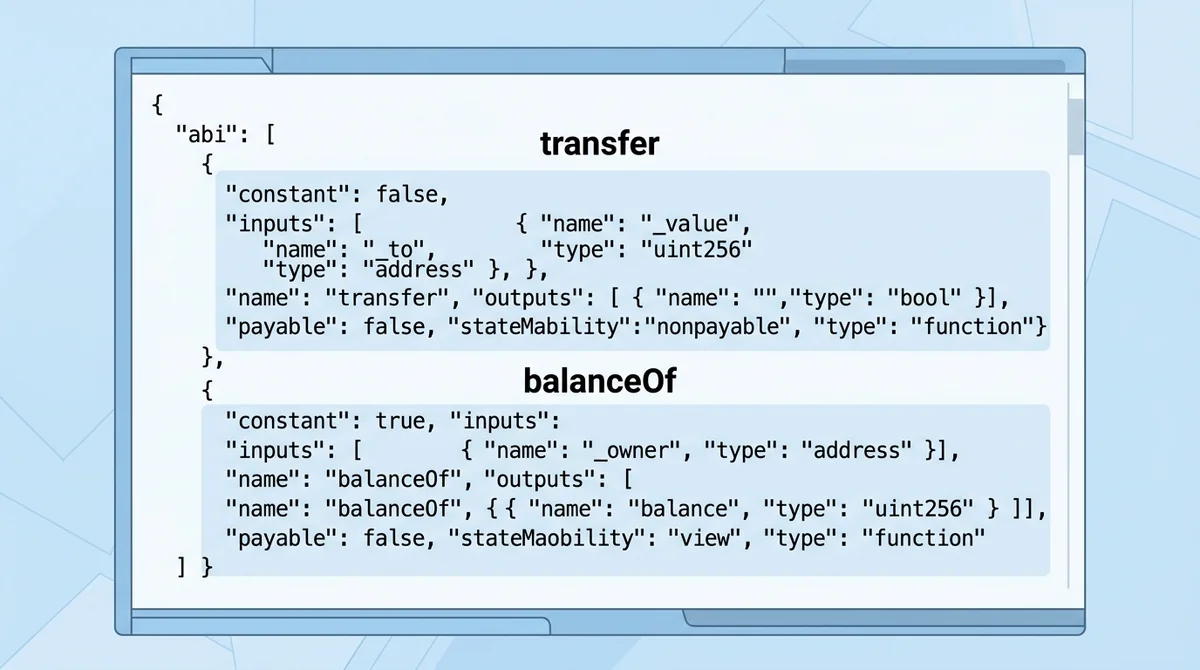
The ABI of an ERC-20 token contract defines standard functions such as transfer and balanceOf. Developers can obtain the ABI from the verified contract page on a block explorer, or have it automatically generated by development tools like Remix and Hardhat.
#Why Is ABI Important? What Are the Misconceptions?
ABI allows wallets, exchanges, and DApps to interact without reimplementing contract logic, lowering the development barrier. Note: ABI does not contain the contract code. Using the wrong ABI can cause transaction failure or loss of funds, so always obtain it from a trusted source.
FAQ
What is the full name of ABI?
ABI is short for Application Binary Interface. It is a JSON file that describes a smart contract's functions, parameters, and return value formats, allowing external programs to correctly encode call data and interact with the contract.
What is the difference between ABI and a traditional API?
A traditional API is an interface between humans and software, while ABI is a low-level interface between programs. In blockchain, ABI specifically describes the binary interface of smart contracts, enabling external applications to interact correctly with on-chain contracts.
Can you call a smart contract without an ABI?
Theoretically, you can manually construct transaction data, but it is very difficult and error-prone. Without an ABI, you need to calculate the function selector and encode parameters yourself, which can easily lead to transaction failure or loss of funds.
What are the risks of using the wrong ABI?
Using the wrong ABI can cause a transaction to revert or send funds to the wrong function, potentially resulting in asset loss. Always obtain the ABI from a trusted source, such as the verified contract page on a block explorer or from official development tools.
Related Terms
Want to see the real data for this concept?
After you sign up, you can view live prices, funding rates, and fees for the related assets.
View live prices and fees →