Tokenized Assets
Tokenized assets represent real-world stocks, bonds and gold as blockchain tokens. Learn how tokenized stocks, bonds and gold work, plus issuer and redemption risks.
Tokenized assets represent real-world assets such as stocks, bonds and gold in the form of blockchain tokens. Each token corresponds to some real asset or right, rather than being a crypto token conjured out of thin air.
#What Are Tokenized Assets? RWA Tokenized Asset Features
Core idea: A tokenized asset is an on-chain "claim ticket" for a real asset. What you receive is an on-chain certificate that corresponds to something off-chain.
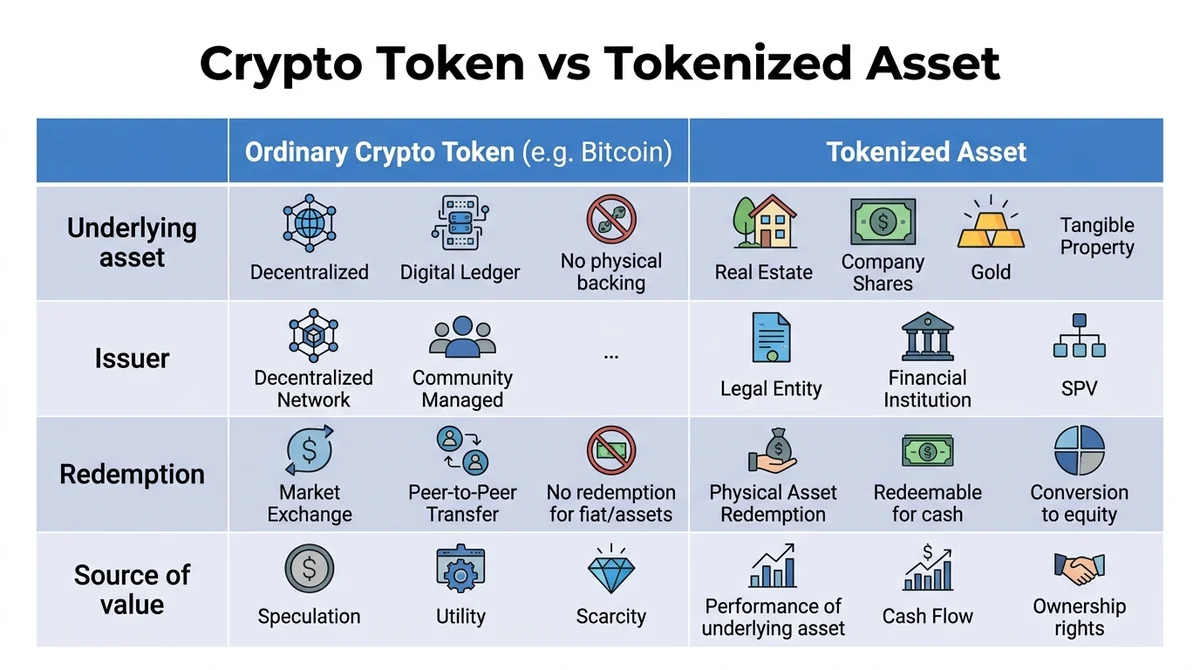
The difference from an ordinary crypto token is whether there is an underlying asset. Bitcoin has no issuer and does not correspond to a stock or gold; a tokenized asset is anchored to a real asset by its issuer.
Analogy: Think of the ticket from a supermarket locker. The ticket itself is worthless; what has value is what is inside the locker. A tokenized asset is that ticket, provided there really is something in the locker.
RWA (real-world assets) is the broader term, and tokenized assets are the result of RWA going on-chain. The two are often used interchangeably, but RWA emphasizes the asset class while tokenization emphasizes the technical form. For a systematic overview of this asset category, see our glossary entry on what RWA is.
One-line conclusion: The value of a tokenized asset does not come from the token itself but from the real asset behind it that is held in custody and redeemable; the key to telling real from fake is whether the underlying asset exists, can be verified, and can be redeemed.
#Common Types: Stocks, Bonds, Gold
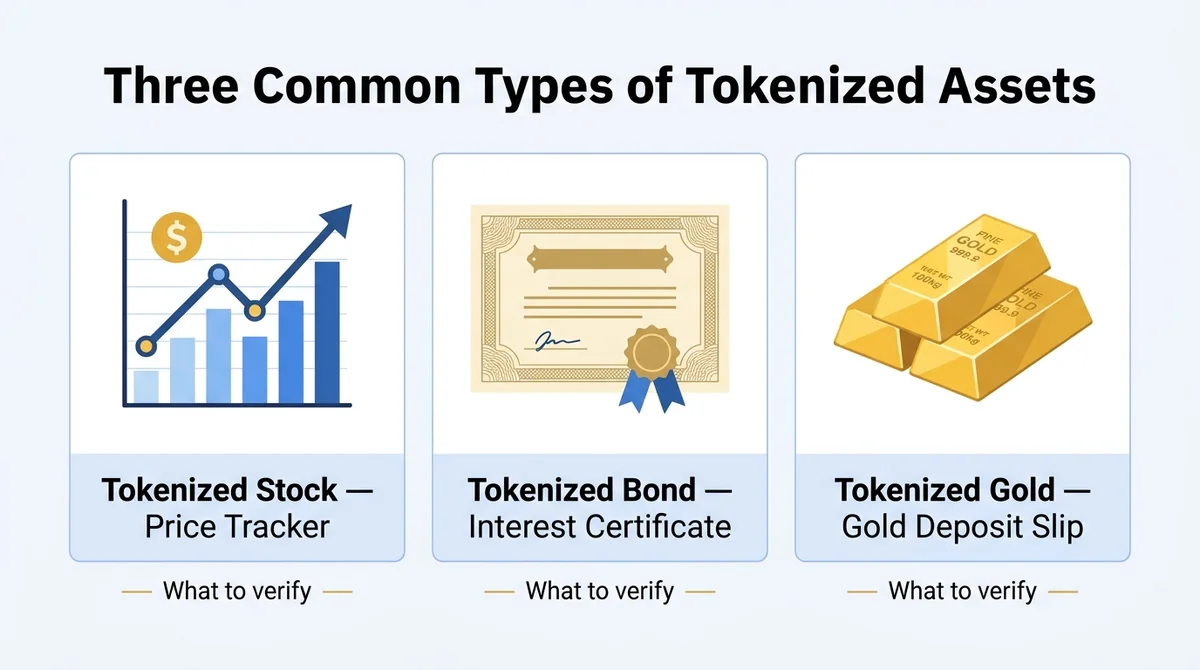
PLTR tokenized stock: Maps the price of US stocks onto the chain. Whether the token represents actual stock ownership depends on the issuer's custody structure. Holding the token does not necessarily mean you are on the shareholder register.
One-line conclusion: Most PLTR tokenized stock offers price exposure rather than shareholder status; whether you receive dividends and voting rights depends on how the issuer's terms are written.
Tokenized bond: Registers and transfers the principal and interest rights of a bond in token form. A tokenized bond that anchors a short-term treasury bond still earns yield from the underlying treasury bond's interest.
One-line conclusion: A tokenized bond essentially moves principal-and-interest cash flows onto the chain; the source of yield is still the underlying bond's interest, not the token generating yield by itself.
Tokenized commodities: Usually claimed to be pegged 1:1 to physical gold. The price peg depends on the issuer's reserves and redemption mechanism, so reserve audits and redemption terms deserve attention.
One-line conclusion: Whether tokenized commodities are "backed by gold" depends on reserve audits and redemption arrangements; some only support cash settlement and cannot deliver physical metal directly.
Analogy: A tokenized stock is like a "price tracker," a tokenized bond is like an "interest certificate," and tokenized gold is like a "gold deposit slip." All three are on-chain, but the rights differ.
#How Do Tokenized Assets Work?
Usually in three steps:
- The issuer packages the real asset into tokens.
- A custodian holds the underlying real asset.
- A redemption mechanism lets tokens be exchanged back for the asset.
Compliance and auditing are the foundation of trust. Without transparent reserves and clear redemption terms, the token and the underlying asset can become decoupled.
One-line conclusion: If any of the three steps is missing, tokenization degenerates into "tokens only, no asset," so the issuer, custodian and redemption channel must be checked item by item.
To judge whether a tokenized asset is sound, you can run through this checklist yourself:
- Who issues it: Who is the issuer, which country regulates it, and is there public entity information.
- Who holds custody: Which custodian holds the underlying asset, and is it segregated from the issuer's own assets.
- How it is audited: Are reserves periodically audited or disclosed by a third party, and are the reports publicly available.
- How it is redeemed: Redemption thresholds, fees, settlement time, and whether physical delivery is supported.
- What rights it carries: Do token holders have ownership, a right to yield, or merely price exposure.
If even one of these five items cannot be explained clearly, there is a hidden risk of decoupling between the token and the underlying asset.
#Risk Warning
The risks of tokenized assets mainly come from issuer credit, reserve transparency and redemption restrictions.
"Pegged" does not equal "guaranteed." The token price may deviate from the underlying asset, and redemption may have thresholds or limits. For a closer look at risks such as issuer default and insufficient reserves, see our note on issuer risk.
One-line conclusion: Tokenized assets shift credit risk from "on-chain code" back to "off-chain institutions"; understanding the issuer and redemption terms matters more than watching the on-chain price.
This article covers concepts only and is not investment advice. Digital assets carry risk; please understand the terms and rights before participating. This article was prepared by MSX Learn for conceptual education only and does not encourage any trading.
Note: This article does not involve the fees, yields or product recommendations of any specific platform; for trading tools, please refer to official disclosures and compliance documents.
#FAQ
What is the difference between tokenized assets and ordinary crypto tokens? Tokenized assets correspond to real assets or rights, such as stocks, bonds and gold; ordinary crypto tokens have no underlying asset, and their value is mainly determined by market supply and demand. Tokenized assets depend on the issuer and custodian structure, while ordinary tokens do not.
Must a tokenized asset have a real asset behind it? By definition it should, but in practice it depends on custody and auditing. A tokenized asset should by definition anchor some real asset or right; in practice you need to verify whether the issuer actually holds and keeps custody of the underlying asset and whether it is audited periodically. A "tokenization" without underlying support is not what it claims to be.
Are RWA and tokenized assets the same thing? Not exactly. RWA refers to the broad category of real-world assets, while tokenized assets are the token form of RWA after going on-chain. RWA emphasizes the asset class and tokenization emphasizes the technical implementation; the two are often used interchangeably but have different emphases.
Is there real gold behind tokenized commodities? Issuers usually claim to be pegged to physical gold, but you need to check reserve audit reports and redemption terms. Not all tokenized commodities can be exchanged for physical metal at any time; some only support cash settlement.
What risks should I watch for when dealing with tokenized assets? The main risks include issuer credit risk, opaque reserves, restricted redemption, and on-chain prices deviating from the underlying asset. Before participating, understand the terms and confirm what rights the token carries; this is not investment advice.
FAQ
What is the difference between tokenized assets and ordinary crypto tokens?
Tokenized assets correspond to real assets or rights, such as stocks, bonds and gold; ordinary crypto tokens have no underlying asset, and their value is mainly determined by market supply and demand. Tokenized assets depend on the issuer and custodian structure, while ordinary tokens do not.
Must a tokenized asset have a real asset behind it?
By definition, a tokenized asset should correspond to some real asset or right. But in practice you need to check whether the issuer actually holds and keeps custody of the underlying asset and whether it is audited periodically. A "tokenization" without underlying asset support is not what it claims to be.
Are RWA and tokenized assets the same thing?
Not exactly. RWA refers to the broad category of real-world assets, while tokenized assets are the token form of RWA after going on-chain. RWA emphasizes the asset class and tokenization emphasizes the technical implementation; the two are often used interchangeably but have different emphases.
Is there real gold behind tokenized commodities?
Issuers usually claim to be pegged to physical gold, but you need to check reserve audit reports and redemption terms. Not all tokenized commodities can be exchanged for physical metal at any time; some only support cash settlement.
What risks should I watch for when dealing with tokenized assets?
The main risks include issuer credit risk, opaque reserves, restricted redemption, and on-chain prices deviating from the underlying asset. Before participating, understand the terms and confirm what rights the token carries; this is not investment advice.
Related Terms
Want to see the real data for this concept?
After you sign up, you can view live prices, funding rates, and fees for the related assets.
View live prices and fees →