Delivery Contracts and Tokenized Bonds
Delivery contracts have expiry dates; tokenized bonds are blockchain bonds. Combining them enables on-chain auto-settlement and lower counterparty risk, but watch smart contract and liquidity risks.
Delivery contracts: derivative contracts with a fixed expiration date, where buyers and sellers must deliver the underlying asset as agreed at expiry. Tokenized bonds: traditional bond rights recorded on a blockchain, issued and traded as tokens.
Combining delivery contracts with tokenized bonds essentially merges the forward delivery mechanism of traditional finance with asset tokenization technology on the blockchain. Smart contracts automatically execute delivery, reducing counterparty risk, improving trading efficiency, and enabling a transparent on-chain settlement process.
#What Are Delivery Contracts?
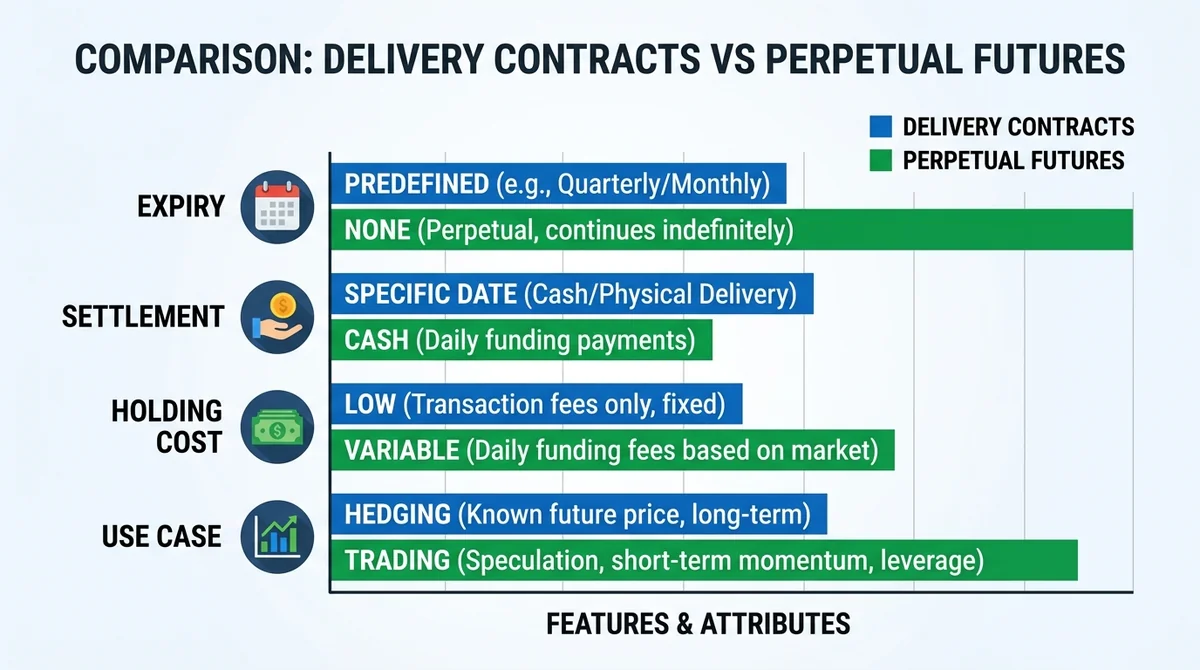
Delivery contracts are derivative contracts with a fixed expiration date. At expiry, both parties must deliver the underlying asset at the agreed price and quantity. Unlike perpetual futures, delivery contracts do not auto-renew; the contract terminates at expiration.
#What Is the Difference Between Delivery Contracts and Perpetual Futures?
| Comparison | Delivery Contracts | Perpetual Futures |
|---|---|---|
| Expiry | Fixed expiration date | No expiration date |
| Settlement | Delivery or cash settlement at expiry | perpetual futures funding rate settlement schedule maintains price |
| Holding Cost | No funding rate | Regular funding fee paid/received |
| Use Case | Hedging, physical delivery needs | Speculation, long-term holding |
#How Do Delivery Contracts Settle?
At expiry, you can choose physical delivery (actually delivering the underlying) or cash settlement (paying the price difference). Physical delivery is common in commodity futures, while crypto delivery contracts mostly use cash settlement to avoid the complexity of transferring tokens.
#What Are Tokenized Bonds?
Tokenized bonds record traditional bond rights (such as interest and principal) on a blockchain, issued and traded as tokens. Each token represents a fraction of the bond's ownership, and holders enjoy the corresponding rights.
#How Do Tokenized Bonds Differ from Traditional Bonds?
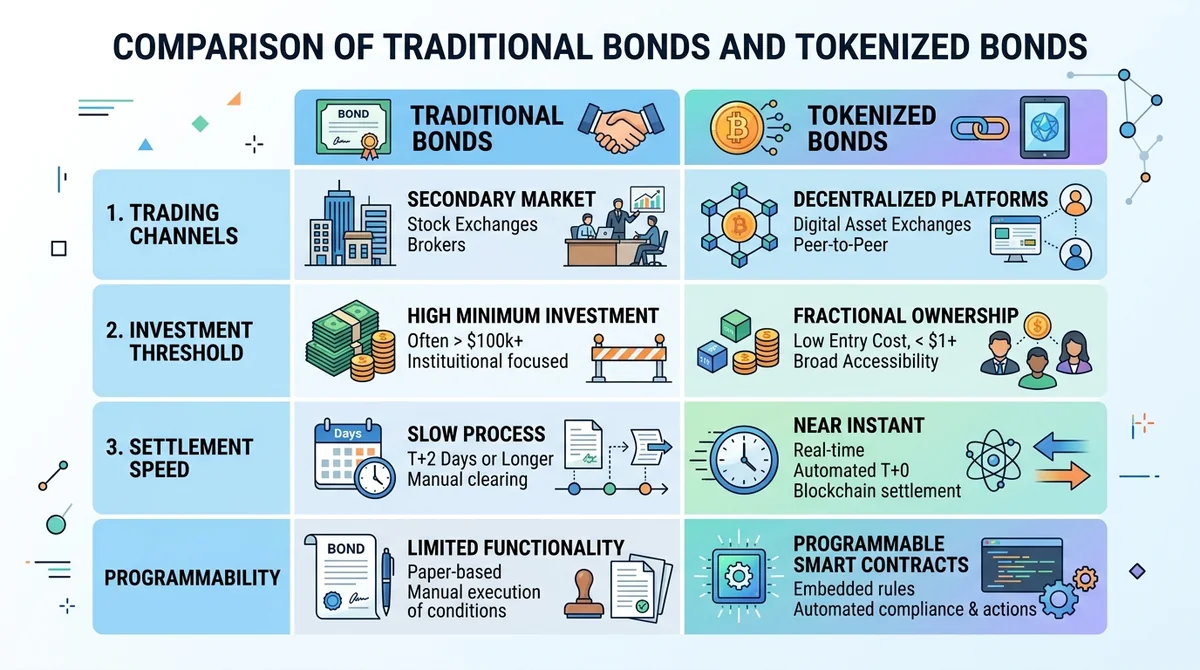
| Comparison | Traditional Bonds | Tokenized Bonds |
|---|---|---|
| Trading Channels | Banks, brokers | Blockchain platforms |
| Investment Threshold | Relatively high | Can be fractionalized, low threshold |
| Settlement Speed | T+2 or longer | Instant on-chain settlement |
| Programmability | None | Automatic interest payments, condition triggers |
#How Do Tokenized Bonds Work?
The issuer writes bond terms into a smart contract and generates tokens. After investors buy tokens, interest and principal are paid automatically per the contract. For example, a company issues tokenized bonds with 5% annual interest, and interest is automatically distributed to token holders' wallets every quarter.
#What Is the Relationship Between Delivery Contracts and Tokenized Bonds?
Combining the two allows trading tokenized bonds using delivery contracts. At expiry, smart contracts automatically execute delivery without manual intervention. This model is already practiced in decentralized finance (DeFi), such as Ethereum-based bond tokenization projects.
#How to Trade Tokenized Bonds with Delivery Contracts
- Choose a platform that supports delivery contracts for tokenized bonds, such as MSX and other compliant exchanges.
- Buy or sell contracts, agreeing on the delivery price and quantity at expiry.
- At expiry, smart contracts automatically transfer tokens and funds to complete delivery.
#What Are the Advantages of This Combination?
- On-chain settlement, transparent and verifiable, with all transaction records publicly auditable.
- Automated execution reduces counterparty risk, no need to trust intermediaries.
- Improves trading efficiency, reduces intermediaries, and lowers transaction costs.
#What Are the Risks of Delivery Contracts and Tokenized Bonds?
Any investment carries risk; here we focus on two main types.
#What Is Smart Contract Risk?
Smart contracts are code and may contain vulnerabilities. If exploited, funds may be lost. In 2023, multiple DeFi protocol vulnerability attacks caused losses exceeding $1 billion. Therefore, choosing audited contract platforms is crucial.
#How Does Liquidity Risk Affect Trading?
If market depth is insufficient, you may not be able to trade at the desired price, or even close your position. The tokenized bond market is still in its early stages, and liquidity may be far lower than mainstream cryptocurrencies.
Risk warning: Digital assets are highly volatile. This article only explains concepts and does not constitute investment advice.
#FAQ
FAQ:
- Do delivery contracts require physical delivery? Not necessarily. Many platforms support cash settlement, paying the price difference at expiry without actually delivering the underlying asset.
- Do tokenized bonds pay interest? Yes, tokenized bonds usually write interest payment terms into smart contracts, automatically distributing interest to token holders at maturity.
- Are delivery contracts suitable for beginners? It is not recommended for beginners to directly trade delivery contracts. Contract trading involves leverage and expiry risk; it is advisable to first learn spot trading and basic concepts.
- Are there real-world examples of combining delivery contracts and tokenized bonds? Some projects have attempted to tokenize U.S. Treasury bonds and launch corresponding delivery contracts, but overall it is still in an early stage.
- How to reduce smart contract risk? Choose contracts audited by reputable security firms, and monitor community feedback and vulnerability disclosures.
FAQ
Do delivery contracts require physical delivery?
Not necessarily. Many platforms support cash settlement, paying the price difference at expiry without actually delivering the underlying asset.
Do tokenized bonds pay interest?
Yes, tokenized bonds usually write interest payment terms into smart contracts, automatically distributing interest to token holders at maturity.
Are delivery contracts suitable for beginners?
It is not recommended for beginners to directly trade delivery contracts. Contract trading involves leverage and expiry risk; it is advisable to first learn spot trading and basic concepts.
Related Terms
Want to see the real data for this concept?
After you sign up, you can view live prices, funding rates, and fees for the related assets.
View live prices and fees →