What Are Tokenized Commodities? Gold, Oil, and Blockchain Explained
Tokenized commodities are blockchain tokens representing physical goods like gold or oil. Learn how they work, their benefits and risks, and how they compare to traditional trading in 2026.
Tokenized commodities are digital tokens on a blockchain that represent direct ownership of a specific quantity and quality of a real-world physical good, such as gold or oil. They turn illiquid, hard-to-transport assets into liquid, easily transferable digital assets, enabling 24/7 trading without physical delivery.
Key Takeaways:
- Tokenized commodities are a type of real-world asset (RWA) that represents verifiable claims on tangible assets.
- They are backed by physical commodities held in custody by trusted third parties, with smart contracts managing transfers.
- Benefits include increased liquidity, fractional ownership, transparency, and regulatory clarity.
- Risks include custody failure, oracle errors, regulatory uncertainty, and smart contract vulnerabilities.
- Tokenized commodities differ from traditional commodity trading by offering direct ownership and near-instant settlement on blockchain.
#What Are Tokenized Commodities in Crypto?
Tokenized commodities are digital tokens on a blockchain representing ownership of a physical commodity. Unlike traditional commodity investments such as futures or ETFs, these tokens provide direct ownership of the underlying asset. For example, one token could represent legal title to one gram of investment-grade gold held in a secure vault. As a type of real-world asset (RWA), they represent verifiable claims on tangible assets, distinct from derivatives like futures contracts. The purpose of tokenization is to transform illiquid, hard-to-transport physical goods into highly liquid, easily transferable digital assets, allowing a barrel of oil or a bushel of wheat to be traded with the efficiency of a digital currency.
#How do tokenized commodities differ from traditional commodity investments?
Traditional commodity investment often involves purchasing physical assets, trading futures contracts, or buying commodity-focused funds, which come with operational complexity, limited accessibility, and reliance on intermediaries. Tokenized commodities remove these barriers by enabling direct peer-to-peer ownership transfer on a blockchain, with 24/7 trading and near-instant settlement. They function similarly to digital warehouse receipts, benefiting from regulatory frameworks that emphasize custodianship and physical asset transparency rather than complex securities regulations.
#How Do Tokenized Commodities Work?
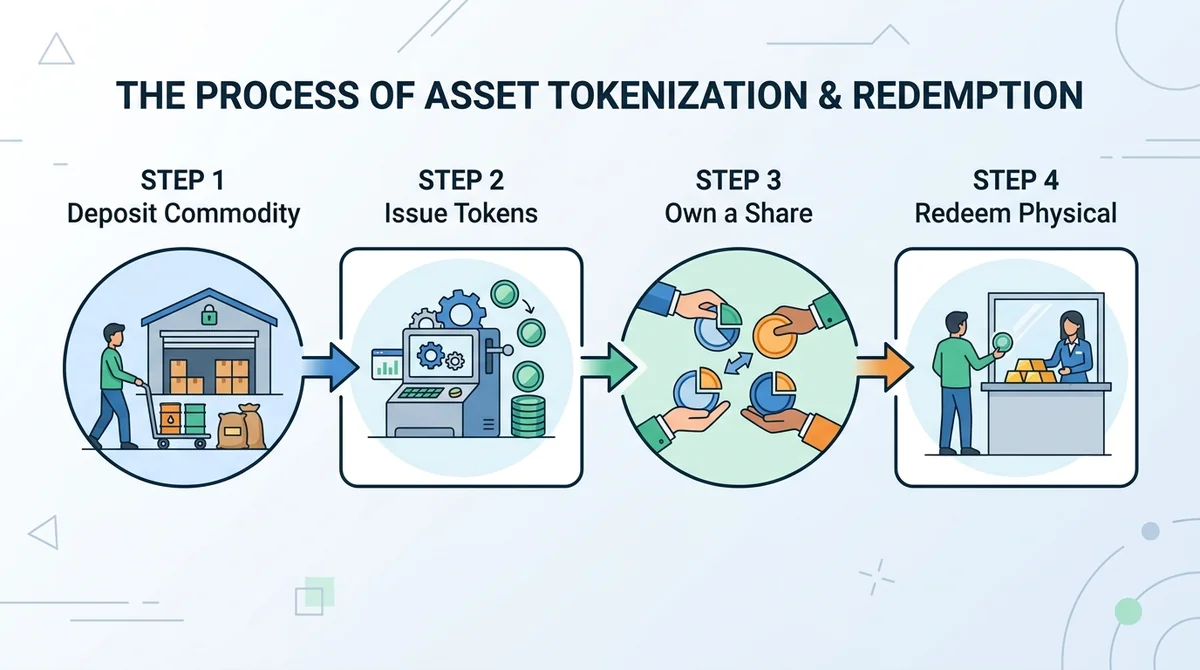
Tokenized commodities work by combining physical custody with blockchain infrastructure. The underlying commodity is purchased and securely stored by a custodian, vault operator, or trusted third party. The issuer then creates blockchain-based tokens representing ownership of a corresponding amount of that commodity. Smart contracts record ownership, process transfers, and may allow redemption for the underlying commodity if supported. Regular audits, reserve attestations, and custodians prove that every token is fully backed. Oracles provide live pricing data so dApps and exchanges can accurately value the tokens.
#What role do custodians and smart contracts play?
Custodians are critical for securely storing the physical commodity and ensuring that each token is backed by real assets. Smart contracts automate the issuance, transfer, and redemption of tokens, reducing the need for intermediaries and increasing efficiency. They also enable features like fractional ownership and programmatic compliance.
#How do oracles ensure accurate pricing?
Oracles are third-party services that feed real-world price data to the blockchain. They ensure that tokenized commodities are valued accurately in decentralized applications and exchanges. Without reliable oracles, tokens could be mispriced, leading to financial losses for traders.
#What Are Examples of Tokenized Commodities?
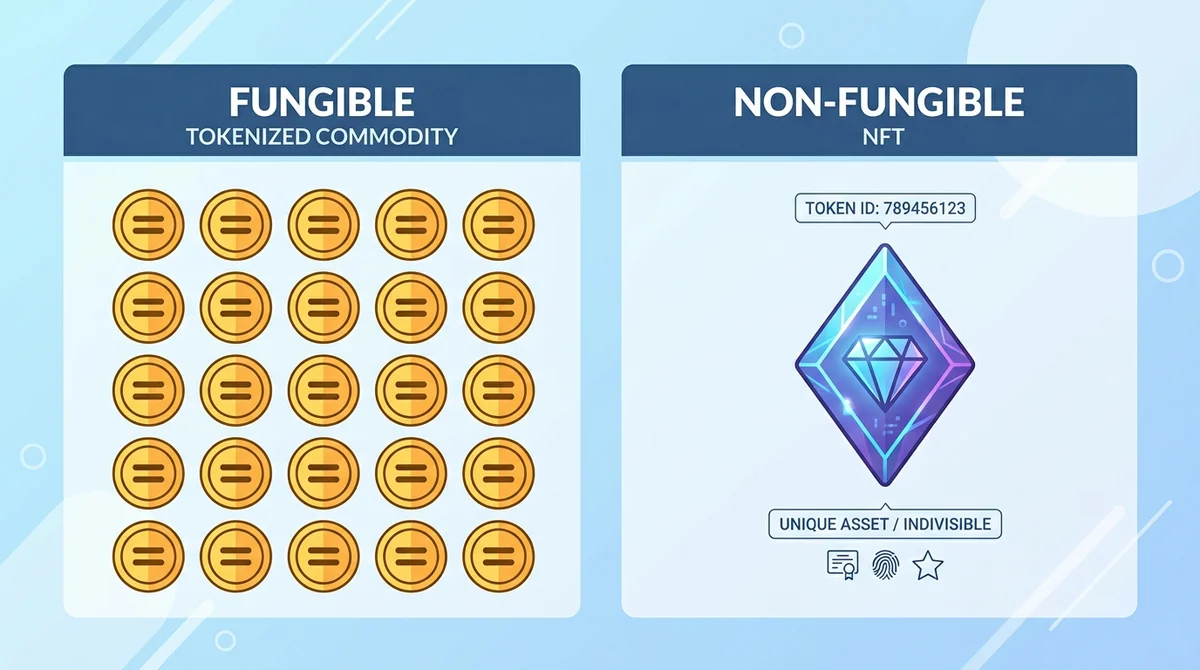
Tokenized commodities span various asset classes. Precious metals like gold, silver, and platinum are the most popular choices, enabling fractional ownership without physical storage. Energy resources such as oil and natural gas can be tokenized to allow trading without logistical friction. Agricultural products like wheat and coffee are emerging in tokenized form. Carbon credits and industrial metals are also being explored. PAX Gold is a notable example, with each token representing one troy ounce of gold stored in Brink's vaults.
#Which commodities are most commonly tokenized?
Gold is the most commonly tokenized commodity due to its universal value and established custody infrastructure. Silver, platinum, oil, and carbon credits are also gaining traction. The market is expanding to include a wider range of assets as tokenization technology matures.
#How does tokenized gold work?
Tokenized gold typically involves a custodian storing physical gold in a secure vault. Each token represents a specific amount of gold, such as one troy ounce. Token holders can trade their tokens on digital platforms, and some issuers allow redemption for physical gold. This provides the benefits of gold ownership without the hassle of storage and security.
#What Are the Benefits of Tokenized Commodities?
Tokenized commodities offer several advantages over traditional commodity investments. They increase liquidity by making physical commodities easily transferable digital assets that can be traded 24/7. Fractional ownership allows investors to own a fraction of a gold bar or barrel of oil, lowering investment barriers. Blockchain provides a transparent and immutable ownership registry. Reduced logistical friction means no need to physically move the asset with each transaction. Regulatory clarity is another benefit: many commodities are not securities, so tokenization often avoids complex securities regulations, functioning like digital warehouse receipts under frameworks like the U.S. Commodity Exchange Act and the EU's MiCA.
#How does tokenization improve liquidity and accessibility?
Tokenization enables fractional ownership and 24/7 trading on global digital platforms, making commodity markets accessible to a broader range of investors. It removes barriers such as high minimum investments and complex logistics, allowing anyone with an internet connection to participate.
#Why do tokenized commodities have regulatory advantages?
Because commodities are generally not considered securities, tokenized commodities often face less stringent regulatory requirements than tokenized stocks or bonds. They are treated as digital warehouse receipts, which simplifies compliance and reduces legal costs for issuers.
#What Are the Risks and Challenges of Tokenized Commodities?
Despite their benefits, tokenized commodities carry risks. Custody risk arises from reliance on third-party custodians to securely store the physical asset; fraud or mismanagement could lead to loss. Regulatory uncertainty across jurisdictions could impact token issuance and trading. Oracle risk involves inaccurate price feeds leading to mispricing and financial loss. Liquidity risk may occur if some tokenized commodities have limited trading volume, making it hard to buy or sell. Redemption limitations mean not all tokens allow physical delivery of the underlying asset. Smart contract vulnerabilities could be exploited by bugs or hacks.
#What are the custody and security risks?
Custody risk is a primary concern, as the physical commodity must be stored securely by a trusted third party. If the custodian fails or commits fraud, token holders could lose their investment. Security risks also include hacking of smart contracts or exchanges where tokens are traded.
#How does regulatory uncertainty affect tokenized commodities?
Regulatory uncertainty can hinder the growth of tokenized commodity markets. Different jurisdictions may have conflicting rules, making it difficult for issuers to operate globally. Changes in regulations could affect token issuance, trading, and redemption, creating uncertainty for investors.
#Tokenized Commodities vs. Traditional Commodity Trading
Traditional commodity trading involves physical delivery, futures contracts, or commodity-focused funds, often with high barriers and intermediaries. Tokenized commodities offer direct ownership of the underlying asset via blockchain, enabling peer-to-peer transfer without intermediaries. Settlement is near-instant on blockchain, versus days or longer in traditional markets. Tokenized commodities can be traded 24/7, while traditional exchanges have limited hours. However, traditional markets are more established with deeper liquidity, while tokenized commodity markets are still emerging.
#How do tokenized commodities compare to futures and ETFs?
Futures and ETFs provide exposure to commodity prices without direct ownership, and they are subject to expiration dates, management fees, and counterparty risk. Tokenized commodities represent actual ownership of the asset, with no expiration and lower fees. They can be traded directly between peers, while futures and ETFs require intermediaries.
#What are the key differences in ownership and settlement?
Tokenized commodities offer direct ownership of the underlying commodity, whereas futures and ETFs are derivative instruments. Settlement in tokenized markets is near-instant on blockchain, while traditional markets may take days. This difference in settlement speed and ownership structure is a key advantage of tokenization.
FAQ
What are tokenized commodities?
Tokenized commodities are digital tokens on a blockchain that represent direct ownership of a physical commodity like gold or oil. They enable these assets to be traded with the speed and transparency of digital assets.
How do tokenized commodities work?
The underlying commodity is stored by a custodian, and tokens representing ownership are issued on a blockchain. Smart contracts manage transfers, and oracles provide real-time pricing data.
What are the benefits of tokenized commodities?
Benefits include increased liquidity, fractional ownership, transparency, reduced logistical friction, and regulatory clarity compared to traditional commodity investments.
What are the risks of tokenized commodities?
Risks include custody failure, oracle errors, regulatory uncertainty, liquidity issues, and smart contract vulnerabilities.
How do tokenized commodities differ from traditional commodity trading?
Tokenized commodities offer direct ownership and near-instant settlement on blockchain, with 24/7 trading, while traditional trading relies on futures, ETFs, and intermediaries with limited hours and slower settlement.
What commodities can be tokenized?
Precious metals like gold and silver, energy resources like oil and natural gas, agricultural products like wheat and coffee, and even carbon credits can be tokenized.
Related Terms
Want to see the real data for this concept?
After you sign up, you can view live prices, funding rates, and fees for the related assets.
View live prices and fees →