Binance vs OKX Fees: A 2026 Guide to Calculating Spot and Perpetual Trading Costs for Regular Users with Equal Capital
Compare Binance and OKX fees in August 2026. Calculate spot and USDT perpetual costs on 10,000 USDT, including Binance BNB discounts.
#Binance vs OKX Fees: A 2026 Guide to Calculating Spot and Perpetual Trading Costs for Regular Users with Equal Capital
As of August 2026, OKX charges regular users a lower spot maker fee than Binance for maker-only trading: 0.08% versus 0.10%. The two exchanges have the same standard spot taker and USDT-margined perpetual fees. If Binance's BNB fee discount applies, its spot fee can fall to 0.075%.
#Key Takeaways / TL;DR
- Maker trades, which provide liquidity to the order book, and taker trades, which immediately consume order book liquidity, must be calculated separately. Placing a limit order does not guarantee that it will be charged the maker fee.
- As of August 2026, Binance charges regular users 0.10% for both spot maker and taker trades, while OKX charges 0.08%/0.10%, respectively.
- Binance and OKX have the same standard USDT-margined perpetual fees for regular users: 0.02% for makers and 0.05% for takers.
- Based on a notional value of 10,000 USDT per trade, a maker-only spot round trip costs 16 USDT on OKX and 20 USDT on Binance.
- When fees are paid with BNB on Binance, spot fees are typically discounted by 25%, while perpetual fees are typically discounted by 10%. The fee payment feature must be enabled, and the account must have a sufficient BNB balance.
This article calculates fixed trading fees only. It excludes price movements, spreads, slippage, funding fees, and liquidation losses. Perpetual trading involves leverage risk, and lower fees do not mean lower overall risk.
#What Should You Confirm Before Calculating Binance and OKX Fees?
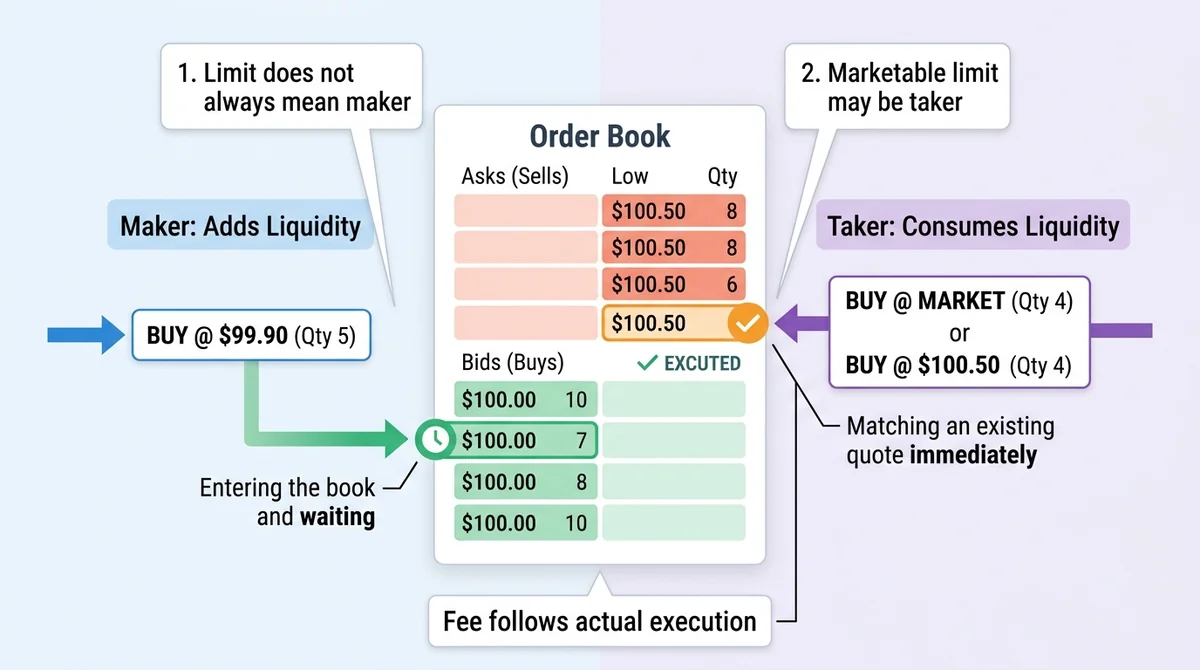
When comparing Binance and OKX fees, use the same regular-user tier, trade notional value, and maker or taker classification, and separate fixed trading fees from other costs.
#What Assumptions Apply to Standard Regular-User Fees?
This article uses the standard regular-user fees provided in the input data as of August 2026 and does not mix them with VIP rates. Comparing trading costs with equal capital means using the same trade notional value, order classification, and number of round trips on both exchanges—not merely comparing the amount deposited into each account.
The following conditions must be standardized before calculating:
- Same account tier: Both exchanges are calculated using standard regular-user fees.
- Same notional value: Each trade has the same value on both exchanges.
- Same execution path: Maker-only, maker-plus-taker, and taker-only paths are compared separately.
- Same number of executions: Spot trading includes two executions, one buy and one sell; perpetual trading includes two executions, one to open and one to close the position.
- Same discount conditions: Standard fees and fees after the BNB discount are shown separately.
#How Should Maker and Taker Orders Be Distinguished?
A maker order enters the order book before execution and provides liquidity. A taker order executes immediately against an existing quote in the order book and consumes liquidity. The final fee should be based on the actual execution classification recorded by the exchange, not simply on whether the order was labeled a limit or market order.
Think of the order book as a store shelf: a maker places a quote on the shelf and waits for someone else to accept it, while a taker directly accepts an existing quote from the shelf. Perpetual fees are also calculated on the position's notional value—similar to charging based on an item's total price—rather than solely on the margin posted upfront.
Common ways to identify the execution type include:
- A limit order that enters the order book and waits to be filled may generally result in a maker execution.
- A marketable limit order may immediately consume an existing quote and therefore be charged as a taker execution.
- A market order usually matches quotes in the order book immediately and is therefore a taker execution.
- If an order is filled in multiple parts, each fill may need to be checked against the actual execution records.
For a deeper explanation of spot order fees, see Binance Spot Maker and Taker Fee Structure Explained.
#Which Costs Should Not Be Confused with Fixed Trading Fees?
Fixed trading fees are only one part of the total cost. The spread is the difference between the best bid and best ask; slippage is the difference between the expected execution price and the actual execution price; and the funding rate determines periodic payments between long and short perpetual traders to help anchor the contract to the spot price.
The formulas in this guide do not include:
- Profits or losses caused by increases or decreases in the underlying asset's price;
- The spread between bid and ask prices;
- Slippage caused by insufficient market depth;
- Funding fees incurred while holding a perpetual position;
- The effects of leverage, insufficient margin, or liquidation;
- Other fees related to deposits, withdrawals, or on-chain transfers.
#Step 1: How Do You Prepare an Equal-Capital Fee Calculation for Binance and OKX?
The equal-capital model uses one-way fee = trade notional value × fee rate. Add the fees for the buy and sell, or for opening and closing the position, to calculate the round-trip cost.
At the same notional value, the round-trip fee equals the fee for the first execution plus the fee for the second execution. Perpetual fees are calculated on the execution's notional value, not solely on margin.
#What Are the Formulas for One-Way and Round-Trip Spot Fees?
A spot purchase and sale each produce one execution, so a complete round trip requires two fee calculations. To exclude the effect of price changes, this article assumes that the purchase and sale have the same trade notional value.
The formulas are:
- Buy fee = buy trade notional value × buy execution fee rate
- Sell fee = sell trade notional value × sell execution fee rate
- Spot round-trip fee = buy fee + sell fee
- Fixed equal-value model round-trip rate = buy rate + sell rate
For example, if both executions have a notional value of 10,000 USDT and the buy and sell fee rates are both 0.10%, the one-way fee is 10 USDT and the round-trip fee is 20 USDT. This example only demonstrates the formula and does not represent the actual account result after accounting for price changes.
#What Are the Fees for Opening and Closing a Perpetual Position?
Trading fees for both opening and closing a perpetual position are charged on the execution's notional value. The notional value is the contract value represented by the position and is not the same as the margin actually posted by the user. After leverage is applied, you cannot calculate the fee by multiplying only the margin by the fee rate.
The calculation steps are:
- Opening fee = opening trade notional value × opening fee rate
- Closing fee = closing trade notional value × closing fee rate
- Perpetual round-trip fee = opening fee + closing fee
If both the opening and closing notional values are 10,000 USDT and both are maker executions charged at 0.02%, the one-way fee is 2 USDT and the round-trip fee is 4 USDT. If the closing notional value changes because of price or position changes, use the actual execution value for each calculation.
#How Do You Calculate the Cost of Mixed Maker and Taker Executions?
A mixed execution path means one trade is charged the maker fee and the other is charged the taker fee. For spot trading, this could mean buying as a maker and selling as a taker. For perpetuals, it could mean opening as a maker and closing as a taker. If the two executions have the same notional value, you can add the two fee rates directly.
The three common paths are:
- Maker-only round-trip rate = maker rate × 2
- Maker-plus-taker round-trip rate = maker rate + taker rate
- Taker-only round-trip rate = taker rate × 2
Spot and perpetual products differ in how positions are held, how leverage works, and what additional costs apply. See Perpetual Futures vs Spot Trading: A Complete Comparison for further comparison.
#Step 2: How Should Regular Users Choose Between Binance and OKX?
At standard rates, OKX's 0.08% spot maker fee is lower than Binance's 0.10%. The two exchanges have the same spot taker and USDT-margined perpetual fees.
As of August 2026, without an exchange-token fee discount, the OKX spot maker fee is 0.08%, compared with 0.10% on Binance. Both exchanges charge a 0.10% spot taker fee.
#Binance vs OKX Standard Trading Fees for Regular Users in 2026
| Exchange and fee basis | Spot maker fee | Spot taker fee | USDT-margined perpetual maker fee | USDT-margined perpetual taker fee |
|---|---|---|---|---|
| Binance standard regular-user fees, as of August 2026 | 0.10% | 0.10% | 0.02% | 0.05% |
| OKX standard regular-user fees, as of August 2026 | 0.08% | 0.10% | 0.02% | 0.05% |
The table compares only the four shared categories available for both exchanges in the input data. It does not include VIP tiers, funding rates, spreads, slippage, or exchange-token discounts. Because no verifiable official fee-page URLs were provided for this article, the figures above are presented as supplied in the input data. Before placing an order, check the actual fee displayed in your account at that time.
#How Do Binance and OKX Standard Spot Fees Differ?
Maker-only spot trading is the clearest area in which the two exchanges' standard fees differ. OKX charges 0.08%, while Binance charges 0.10%, a one-way difference of 0.02 percentage points. If both the purchase and sale are maker executions, the round-trip difference is 0.04 percentage points.
For spot taker trades, both exchanges charge regular users 0.10%. If both the purchase and sale are taker executions, the standard round-trip rate is 0.20% on either exchange, so there is no difference in fixed trading fees. Actual total costs may still be affected by execution prices, spreads, and slippage.
#Are Binance and OKX Standard Perpetual Fees the Same?
As of August 2026, Binance and OKX have the same standard USDT-margined perpetual fees for regular users: 0.02% for makers and 0.05% for takers. Therefore, fixed opening and closing fees are identical when the notional value and execution classification are the same.
This does not mean that the actual total cost of perpetual trading will necessarily be identical. Funding rate settlements, order execution quality, and slippage must be checked separately. When evaluating exchanges, see How to Compare Exchange Fees, Liquidity, and Compliance.
#How Does Binance's BNB Fee Discount Affect the Choice?
According to the input data, paying Binance fees with BNB typically provides a 25% discount on spot fees, reducing 0.10% to 0.075%. USDT-margined perpetual fees typically receive a 10% discount, reducing the maker rate from 0.02% to 0.018% and the taker rate from 0.05% to 0.045%.
Before applying the discount, confirm that:
- BNB fee payment is enabled for the account;
- The BNB balance is sufficient to pay the applicable fee;
- The discount shown in the account is still valid;
- The standard rate has not been multiplied by the discounted rate twice;
- No OKX exchange-token discount was provided in the input data, so this article does not calculate a corresponding discount for OKX.
#Step 3: How Do You Calculate Round-Trip Spot and Perpetual Fees?
For two executions of equal value, an OKX maker-only spot round trip costs 0.16%, compared with 0.20% on Binance. The two exchanges have identical standard perpetual round-trip rates.
At standard rates, both exchanges charge 0.04% for a maker-only perpetual round trip, 0.07% for a maker-plus-taker round trip, and 0.10% for a taker-only round trip.
#Round-Trip Fee Rates at the Same Trade Notional Value in 2026
| Trading scenario and calculation basis | Binance regular-user round-trip rate | OKX regular-user round-trip rate | Standard-rate guidance |
|---|---|---|---|
| Maker-only spot, same value for both executions | 0.20% | 0.16% | OKX is lower by 0.04 percentage points |
| Spot maker plus taker, same value for both executions | 0.20% | 0.18% | OKX is lower by 0.02 percentage points |
| Taker-only spot, same value for both executions | 0.20% | 0.20% | Fixed rates are the same |
| Maker-only USDT-margined perpetual, same opening and closing values | 0.04% | 0.04% | Fixed rates are the same |
| USDT-margined perpetual maker plus taker, same opening and closing values | 0.07% | 0.07% | Fixed rates are the same |
| Taker-only USDT-margined perpetual, same opening and closing values | 0.10% | 0.10% | Fixed rates are the same |
#Equal-Capital Trading Cost Example Using 10,000 USDT
The table below assumes a notional value of 10,000 USDT for each execution. Spot trading includes one calculation for the purchase and another for the sale, while perpetual trading includes one calculation for opening and another for closing the position. The results exclude position profit or loss, funding fees, spreads, and slippage.
| Trading scenario and notional-value basis | Binance standard fee | OKX standard fee | Fee difference |
|---|---|---|---|
| Maker-only spot round trip, 10,000 USDT per execution | 20 USDT | 16 USDT | OKX costs 4 USDT less |
| Spot maker-plus-taker round trip, 10,000 USDT per execution | 20 USDT | 18 USDT | OKX costs 2 USDT less |
| Taker-only spot round trip, 10,000 USDT per execution | 20 USDT | 20 USDT | 0 USDT |
| Maker-only perpetual round trip, 10,000 USDT per execution | 4 USDT | 4 USDT | 0 USDT |
| Perpetual maker-plus-taker round trip, 10,000 USDT per execution | 7 USDT | 7 USDT | 0 USDT |
| Taker-only perpetual round trip, 10,000 USDT per execution | 10 USDT | 10 USDT | 0 USDT |
#How Do Binance Round-Trip Rates Change When Paying with BNB?
After applying the 25% BNB discount to Binance spot fees, the one-way maker and taker rates are both 0.075%, so all three round-trip paths cost 0.15%. At 10,000 USDT per execution, the round-trip fee is 15 USDT.
The results for Binance perpetuals after applying the 10% BNB discount are:
| Binance BNB discount scenario, as of August 2026 | Discounted one-way rate | Discounted round-trip rate | Round-trip cost at 10,000 USDT per execution |
|---|---|---|---|
| Maker-only USDT-margined perpetual round trip | Maker 0.018% | 0.036% | 3.6 USDT |
| USDT-margined perpetual maker plus taker | Maker 0.018% + taker 0.045% | 0.063% | 6.3 USDT |
| Taker-only USDT-margined perpetual round trip | Taker 0.045% | 0.09% | 9 USDT |
The figures after the BNB discount should not automatically be treated as the final bill. If the BNB balance is insufficient, the payment feature is disabled, or the account's promotion changes, the exchange may charge the actual rate displayed in the account. For more on comparing time-based pricing with fixed fees, read Exchange Temporal Pricing vs Fixed Fees.
#Step 4: How Do You Verify the Results and Avoid Common Fee Mistakes?
To verify the results, check the execution notional value, actual maker or taker classification, discount settings, and funding rate schedule, and assess leverage risk separately.
#Why Is It Wrong to Calculate Perpetual Fees Using Margin Alone?
Perpetual fees are calculated on the execution's notional value, not solely on margin. If the margin posted by the user differs from the position's notional value, multiplying only the margin by 0.02% or 0.05% will underestimate the fee. The correct method is to obtain the notional value from the execution records and calculate the opening and closing costs separately.
A recommended verification sequence is:
- Check the actual execution quantity and price for each opening and closing trade;
- Confirm the corresponding execution notional value;
- Check whether the execution was recorded as maker or taker;
- Apply the actual rate displayed in the account at the time;
- Add the opening and closing fees.
#Why Does a Limit Order Not Always Receive the Maker Fee?
A limit order only specifies an acceptable price; it does not guarantee that the order will enter the order book and wait. If the limit price can immediately match an existing quote, the order consumes liquidity directly and may be recorded as a taker execution. Only the portion that first enters the order book and waits for another order to match it may qualify for the maker fee.
A single limit order may also be filled in multiple parts. When calculating fees, do not assume that the entire order was executed as a maker. Check the liquidity classification and actual fee for each fill.
#How Do You Check Funding Fees and Trading Fees?
Funding fees are not included in the trading fees charged for opening and closing a position and must be checked separately. To calculate total cost, first add the fee for each execution, then determine whether any funding fees were incurred during the holding period. Do not treat the maker or taker figures in a fee table as the entire cost of holding a position.
This article was not provided with a verifiable official settlement-schedule page, so it does not make additional claims about fixed settlement intervals on Binance or OKX. Refer to the relevant contract page and account records for the actual schedule, rate, and deductions.
#What Should Beginners Check Before Trading Perpetuals for the First Time?
Before trading perpetuals for the first time, beginners should confirm the position's notional value, margin, leverage risk, and liquidation risk, and then check the applicable maker or taker fee. Lower fees do not mean a lower maximum loss. Price volatility, slippage, and funding fees can all make the actual cost higher than the examples in this article.
If you only want to compare fixed exchange fees, begin with an equal-notional-value model that excludes the effects of leverage. Do not assume that the fee on a 10,000 USDT position is calculated only on the margin.
#FAQ: Binance and OKX Spot and Perpetual Fees
#Is Binance or OKX Cheaper for Spot Trading?
At standard rates, OKX's 0.08% spot maker fee is lower than Binance's 0.10%, while both exchanges charge takers 0.10%. If the Binance BNB discount specified in the input data applies, Binance's spot maker and taker fees can fall to 0.075%. Always verify the actual rate shown in your account.
#Is Binance or OKX Cheaper for Perpetual Trading?
Without discounts, both exchanges have the same regular-user fees for USDT-margined perpetuals: 0.02% for makers and 0.05% for takers. The maker-only, maker-plus-taker, and taker-only round-trip rates are 0.04%, 0.07%, and 0.10%, respectively. Funding fees and slippage must be calculated separately.
#What Are Binance's Fees After the BNB Discount?
According to the input data, paying Binance spot fees with BNB typically provides a 25% discount, reducing both maker and taker fees to 0.075%. Perpetual fees typically receive a 10% discount, reducing the maker rate to 0.018% and the taker rate to 0.045%. The discount requires BNB fee payment to be enabled, a sufficient balance, and the relevant offer to remain available in the account.
#How Do You Calculate Fees for Opening and Closing an ETHUSDT Perpetual Position?
Use opening notional value × opening fee rate + closing notional value × closing fee rate. If both executions have a notional value of 10,000 USDT and both are makers, the round-trip fee is 4 USDT at the standard 0.02% rate on Binance or OKX.
#How Much Does It Cost to Open and Close an ETHUSDT Perpetual Position as a Taker?
If both the opening and closing ETHUSDT executions have a notional value of 10,000 USDT and are charged the standard 0.05% taker rate, the one-way fee is 5 USDT and the round-trip fee is 10 USDT. Funding fees, slippage, and position profit or loss are excluded.
#What Should You Confirm Before Opening a Perpetual Position on OKX?
Before opening a position on OKX, confirm that you are trading a USDT-margined perpetual product, check the position's notional value, determine whether the execution will be classified as maker or taker, and verify the actual account fee. According to the input data, regular-user rates are 0.02% for makers and 0.05% for takers. Leverage, funding fees, and liquidation risk must be assessed separately.
#What Should You Confirm Before Opening a Perpetual Position on Binance?
Before opening a position on Binance, check the position's notional value, whether the order will execute immediately, the actual account fee, and the BNB discount status. The standard maker and taker rates are 0.02% and 0.05%, respectively. If the BNB discount applies, the discounted rates provided in the input data are 0.018% and 0.045%.
#Is the Funding Rate Included in Perpetual Trading Fees?
No. Opening and closing fees are calculated using the execution notional value and the maker or taker rate, while funding fees must be checked separately during the holding period. Because this article does not have a corresponding official source for settlement schedules, it does not list a fixed interval. Refer to the contract page and account records for actual data.
#How Can You Check Whether an Order Was a Maker or Taker?
Check the exchange's actual execution records rather than relying only on the order type. The portion that enters the order book and waits to be filled may be classified as maker, while the portion that immediately matches an existing quote may be classified as taker. A partially filled order may also need to be reviewed fill by fill.
#Does the Fee Formula Change When Trading Different Cryptocurrencies?
The basic formula in this model remains the same: trade notional value × actual fee rate. What changes is the execution value, execution classification, and account fee for each order. For BTCUSDT, ETHUSDT, or any other trading pair, use the actual records for each execution.
#Why Can't an Equal-Capital Comparison Use Deposit Amounts Alone?
Fixed trading fees are calculated on trade notional value, and the amount deposited into an account may not equal the value of each trade. For a fair Binance versus OKX comparison, use the same account tier, notional value per execution, maker or taker path, and number of executions.
#Why Is OKX's Standard Fee Lower for Maker-Only Spot Trading?
According to the input data as of August 2026, OKX charges spot makers 0.08%, while Binance charges 0.10%. With two maker executions of 10,000 USDT each, the OKX round-trip fee is 16 USDT and the Binance fee is 20 USDT, a difference of 4 USDT.
#Is Binance's BNB Fee Discount Always Available?
Not necessarily. The account must have BNB fee payment enabled, maintain a sufficient BNB balance, and continue to display the applicable offer. If any of these conditions are not met, the discounted rate may not apply. Check the account display before calculating rather than relying solely on this article's examples.
#Can You Trade on Binance or OKX in Your Region?
The input data does not provide region-specific access rules, product restrictions, or compliance conclusions, so it cannot determine whether Binance or OKX is available in a particular jurisdiction. Users should check local rules and the service coverage published by each exchange for their region rather than choosing solely on the basis of fees.
#Do Lower Fees Mean Lower Perpetual Trading Risk?
No. Fees are only one part of the total cost of perpetual trading. Price volatility, spreads, slippage, funding fees, leverage, and liquidation can all increase losses. Beginners should understand the difference between position notional value and margin before deciding whether to trade perpetuals.
The choice between Binance and OKX fees can be summarized in three scenarios: OKX has the lower standard rate for maker-only spot trading; the standard rates are the same for taker-only spot trading and USDT-margined perpetuals on both exchanges; and if Binance's BNB discount applies, costs must be recalculated using the discounted rates. Final calculations should always use the actual execution classification, account fee, and trade notional value.
FAQ
Is Binance or OKX cheaper for spot trading?
At standard rates, OKX's 0.08% spot maker fee is lower than Binance's 0.10%, while both exchanges charge takers 0.10%. If Binance's BNB discount applies, its spot maker and taker fees can fall to 0.075%.
Is Binance or OKX cheaper for perpetual trading?
Without discounts, both exchanges have the same regular-user fees for USDT-margined perpetuals: 0.02% for makers and 0.05% for takers. The maker-only, mixed, and taker-only round-trip rates are 0.04%, 0.07%, and 0.10%, respectively.
What are Binance's fees after the BNB discount?
Paying Binance spot fees with BNB typically provides a 25% discount, reducing both maker and taker fees to 0.075%. Perpetual fees typically receive a 10% discount, reducing the maker rate to 0.018% and the taker rate to 0.045%. BNB fee payment must be enabled, and the account must maintain a sufficient balance.
How do you calculate fees for opening and closing an ETHUSDT perpetual position?
Use opening notional value × opening fee rate + closing notional value × closing fee rate. If both executions have a notional value of 10,000 USDT and both are makers, the round-trip fee is 4 USDT at the standard 0.02% rate on Binance or OKX.
Is the funding rate included in perpetual trading fees?
No. Opening and closing fees are calculated on the execution notional value, while funding fees are settled separately according to a schedule. Binance typically settles every eight hours, and OKX defaults to every eight hours, although both exchanges may adjust the schedule depending on circumstances.
Related Terms
Want to see the real data for this concept?
After you sign up, you can view live prices, funding rates, and fees for the related assets.
View live prices and fees →