How Does a Stop Loss Order Work
A stop loss order triggers a sell or close order at a preset price to cap losses. Learn how stop loss orders work, how to set them, and why fills can slip.
A stop loss order is an order with a preset trigger price. When the market price reaches that price, the system automatically submits a sell or close order to limit losses on a position.
#What is a stop loss order?
One-line definition: A stop loss order is an "automatic brake" for your position. When the price falls to the level you set, it submits a sell order for you automatically.
Analogy: It's like setting an automatic braking point for a car. When the speed (price) drops to a certain point, the brake is applied for you, so you don't have to watch the screen constantly.
#What's the difference between a stop loss order and a regular order?
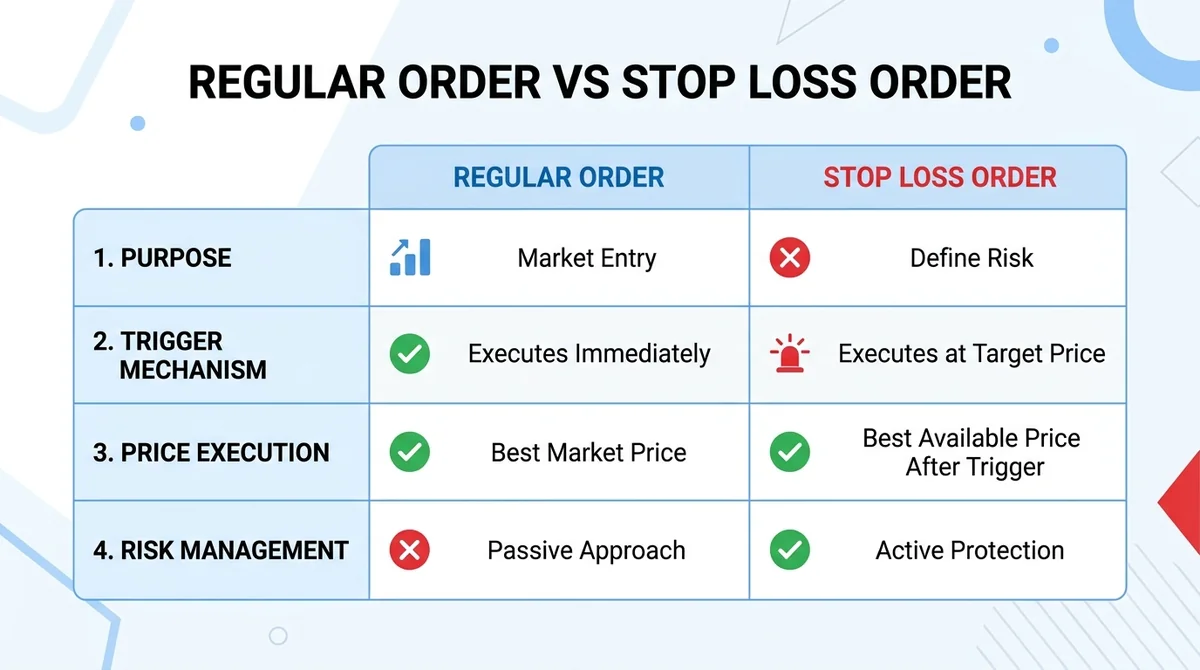
A regular order goes straight into the market and waits to be filled. A stop loss order adds a "trigger price" — until the price reaches that trigger, it does not enter the market. In other words, a regular order is "placed now," while a stop loss order is "placed only when the condition is met." To learn how regular pending orders work, see the limit order explanation.
#Can a stop loss order guarantee I won't lose money?
No. A stop loss order only guarantees that an order is submitted automatically once the price is reached. It does not guarantee the fill price, and it does not guarantee a fill at all.
#How does a stop loss order work?
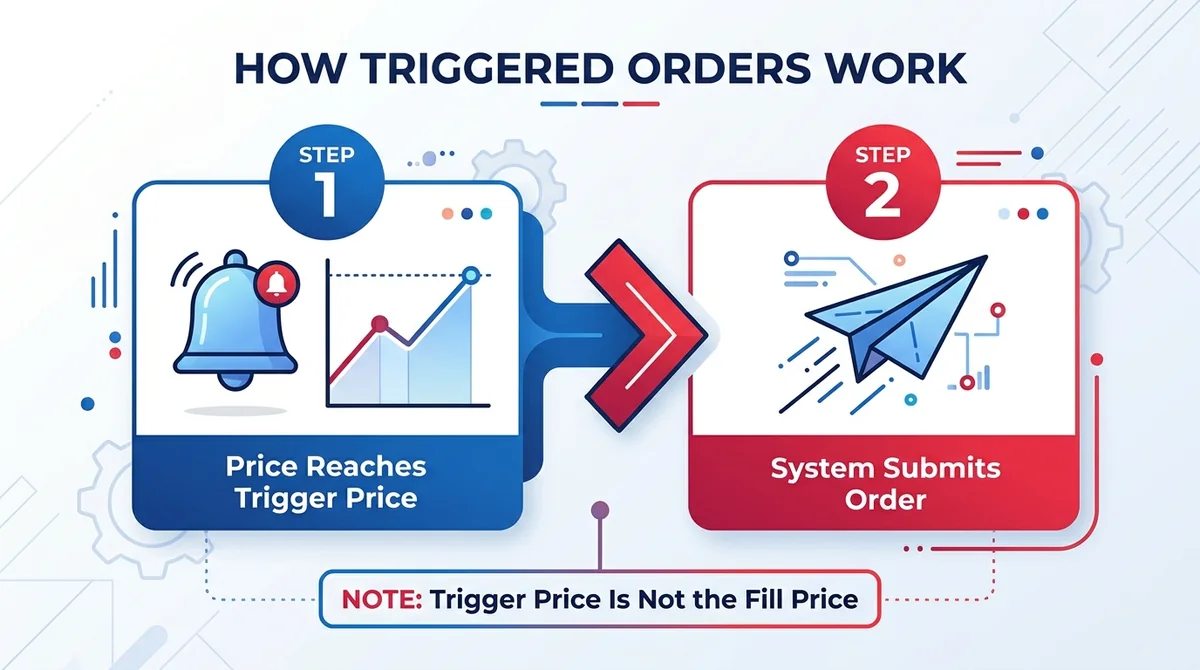
In one sentence: It happens in two steps — trigger first, then fill.
#What does trigger price mean?
The trigger price is a start condition, not a fill price. When the price touches the trigger, the system only begins submitting the order. As a result, the trigger price and the final fill price often differ. The trigger price only decides "when to act," not "at what price the order fills" — the two should not be confused.
#What happens after the trigger?
The system sends your order to the market according to the order type you chose:
- Stop market order: prioritizes execution; the price is set by the market
- Stop limit order: prioritizes price; it may not fill
#What's the difference between a stop market order and a stop limit order?
A market order pursues "getting filled as fast as possible," while a limit order pursues "a specified price." You can't guarantee both at once.
- Stop market order: once triggered, it fills immediately at the best price available in the current market. The advantage is a high probability of execution; the disadvantage is that in violent volatility the fill price may deviate significantly from the trigger price.
- Stop limit order: once triggered, it places an order at your specified limit price. The advantage is that the fill price won't be worse than the limit; the disadvantage is that if the price jumps past it quickly, it may never fill, making the stop loss effectively useless.
Which to choose depends on whether you care more about "definitely getting out" or "definitely getting a good price." For a detailed comparison of these two order types, see the stop market vs. stop limit comparison.
#How to set stop loss and take profit in crypto futures
Follow these 5 steps in order:
- First decide the maximum loss this position can take
- Work backward from the loss amount to the trigger price
- Choose the order type: market or limit
- Enter the order quantity to match your position size
- Confirm and submit; before triggering, you can generally modify or cancel it
⚠️ Digital assets are highly volatile. Start with a small position to get familiar with the process, and assess the risks yourself.
#How should I choose the trigger price?
Set your loss limit first, then work backward to the price. Don't look at the price first and then figure out how much you can lose. For example, first decide clearly how much loss this position can tolerate, then convert that loss amount into a price level — that gives you the trigger price. Doing it the other way around makes it easy to keep widening your stop loss under emotional pressure.
#How should I fill in the order quantity?
The quantity should match your position size. Partial closes are also possible, but you need to understand the risk of the remaining position. If you only close part of it, the rest is still exposed to price swings — the stop loss hasn't really ended.
#Can I modify or cancel it after setting it?
Before it triggers, you can usually modify or cancel it. Once triggered and sent to the market, whether it can be withdrawn depends on the specific exchange's rules, and withdrawal is generally not guaranteed.
#What are the limitations and risks of stop loss orders?
Core risk: The trigger price is not the fill price.
#Why can the actual fill price differ from the trigger price?
In violent market moves, the price can jump past the trigger price. The actual fill price will deviate — this is called slippage. The size of the slippage depends on the liquidity and volatility at the time; the more violent the market, the more obvious the deviation tends to be.
#Do stop loss orders fail during violent market moves?
They can. During gaps or insufficient liquidity, a stop loss order may fill at a price significantly away from the trigger, or it may not fill at all. A stop loss order is an execution tool, not price insurance — it cannot lock in a fill price for you.
#What should I watch out for before using a stop loss order?
A stop loss is one risk management tool, not a way to guarantee profits.
#What scenarios is a stop loss order suitable for?
It suits positions with a clear loss limit where you're willing to execute automatically. It is not suitable as a tool for "betting on a rebound."
#How does a stop loss order relate to position management?
A stop loss controls the size of a single loss, while position size determines the base on which that loss is calculated. The two must be used together. The larger the position, the larger the loss from the same price move — a stop loss order cannot replace position sizing. For more on position sizing, see the position management explanation.
#FAQ
#Can a stop loss order guarantee I won't lose money?
No. A stop loss order only guarantees that an order is submitted automatically once the price reaches the trigger. It does not guarantee the fill price, and it does not guarantee a fill at all. During gaps or insufficient liquidity, the actual fill price may deviate significantly from the trigger price.
#Is the trigger price the same as the fill price?
No. The trigger price is only a start condition — the system begins submitting the order only when the price touches it. The final fill price is determined by the market and may be higher or lower than the trigger price.
#What's the difference between a stop market order and a stop limit order?
A stop market order fills at market price once triggered, prioritizing execution over price certainty. A stop limit order places a limit order once triggered, prioritizing price but possibly not filling at all.
#Can I cancel a stop loss order after setting it?
Before it triggers, you can usually modify or cancel it. Once it triggers and enters the market, whether it can be withdrawn depends on the specific exchange's rules, and withdrawal is generally not guaranteed.
#How does a stop loss order relate to position management?
A stop loss order controls the size of a single loss, while position management controls the base of that loss. Only by using them together can you manage risk effectively — a stop loss order cannot replace position sizing.
This article covers concepts only and is not investment advice. Digital assets are highly volatile; please assess the risks yourself. This article was compiled by MSX Learn for educational purposes only.
FAQ
Can a stop loss order guarantee I won't lose money?
No. A stop loss order only guarantees that an order is submitted automatically once the price reaches the trigger. It does not guarantee the fill price, and it does not guarantee a fill at all. During gaps or insufficient liquidity, the actual fill price may deviate significantly from the trigger price.
Is the trigger price the same as the fill price?
No. The trigger price is only a start condition — the system begins submitting the order only when the price touches it. The final fill price is determined by the market and may be higher or lower than the trigger price.
What's the difference between a stop market order and a stop limit order?
A stop market order fills at market price once triggered, prioritizing execution over price certainty. A stop limit order places a limit order once triggered, prioritizing price but possibly not filling at all.
Can I cancel a stop loss order after setting it?
Before it triggers, you can usually modify or cancel it. Once it triggers and enters the market, whether it can be withdrawn depends on the specific exchange's rules, and withdrawal is generally not guaranteed.
How does a stop loss order relate to position management?
A stop loss order controls the size of a single loss, while position management controls the base of that loss. Only by using them together can you manage risk effectively — a stop loss order cannot replace position sizing.
Related Terms
Want to see the real data for this concept?
After you sign up, you can view live prices, funding rates, and fees for the related assets.
View live prices and fees →