How to Calculate Crypto Contract Margin and Leverage? 2026 Isolated vs Cross Margin Practical Tutorial
Crypto margin is funds deposited before trading; leverage amplifies positions. Isolated margin isolates risk; cross margin shares balance. Key differences.
Answer: Contract margin is the funds you must deposit before trading to cover potential losses; leverage is the multiple that amplifies position size. In isolated margin mode, each position's margin is calculated independently, isolating risk; in cross margin mode, all available balance in the account is shared, so risks are linked. Understanding these three concepts is the foundation for grasping contract trading risks.
#1. Contract Margin: The “Deposit” for Trading
Margin is the funds you must deposit before trading a contract, similar to a rental deposit. The platform determines the margin percentage required based on your chosen leverage multiple. For example, if you want to hold a contract position worth $1,000 and choose 10x leverage, you would theoretically need to provide $100 as initial margin. The margin rate is the ratio of margin to position value, equal to 1 divided by leverage. (For detailed margin requirements, see TRUMPUSDT perpetual futures margin requirements explained.) Additionally, the platform sets a minimum maintenance margin rate; when the margin ratio falls below that level, the platform will force-liquidate. We won't discuss the exact liquidation calculation here, only emphasize that margin ensures you can absorb losses.
Initial margin is the minimum funds required to open a position, while maintenance margin is the minimum level that must be maintained while holding it. The difference between them provides a buffer, and price movements continuously erode this buffer until reaching the maintenance margin line.
#2. Leverage: The Double-Edged Sword That Amplifies Positions
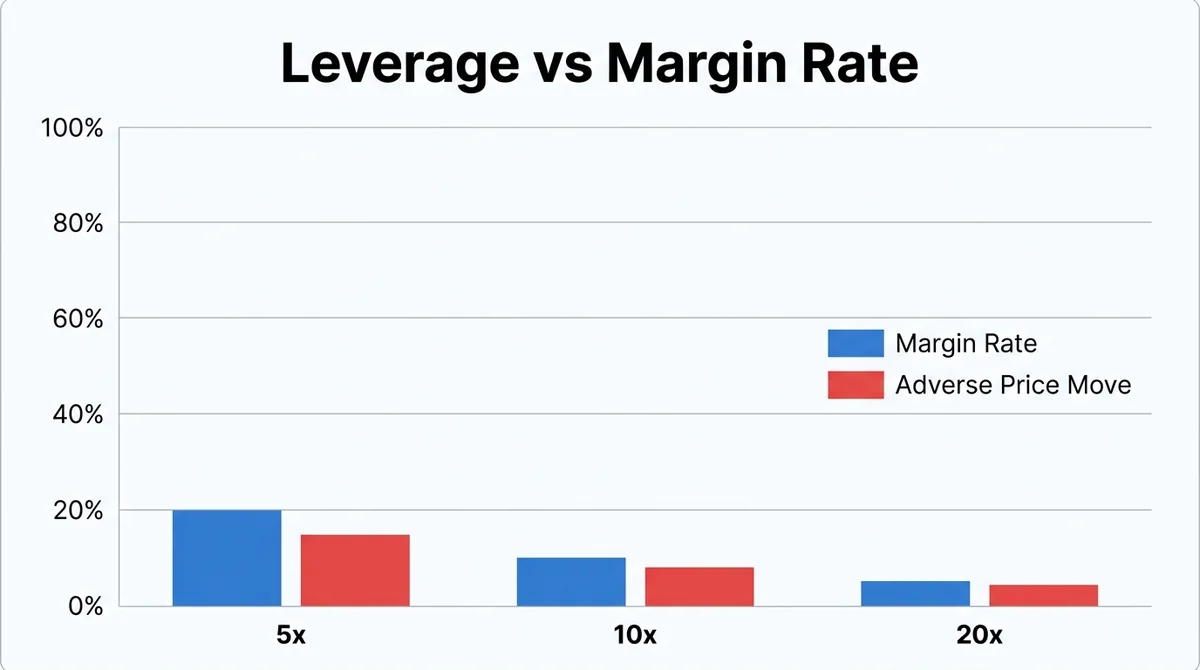
Leverage is the multiple relationship between the transaction amount and the actual capital invested. 10x leverage means $1 can control $10 of position. The higher the leverage, the more both potential gains and losses are amplified. For example, with the same $100 margin, 10x leverage controls a $1,000 position, while 20x leverage controls a $2,000 position. The table below shows the margin rate corresponding to different leverage multiples and the loss that an adverse price move could cause:
| Leverage Multiple | Corresponding Margin Rate | Adverse Price Move That Loses All Margin |
|---|---|---|
| 5x | 20% | 20% |
| 10x | 10% | 10% |
| 20x | 5% | 5% |
Leverage itself is neither good nor bad; it depends on the user's risk control ability. Beginners often only see amplified gains and overlook that losses are amplified equally.
#3. Isolated vs Cross Margin: Two Margin Allocation Modes
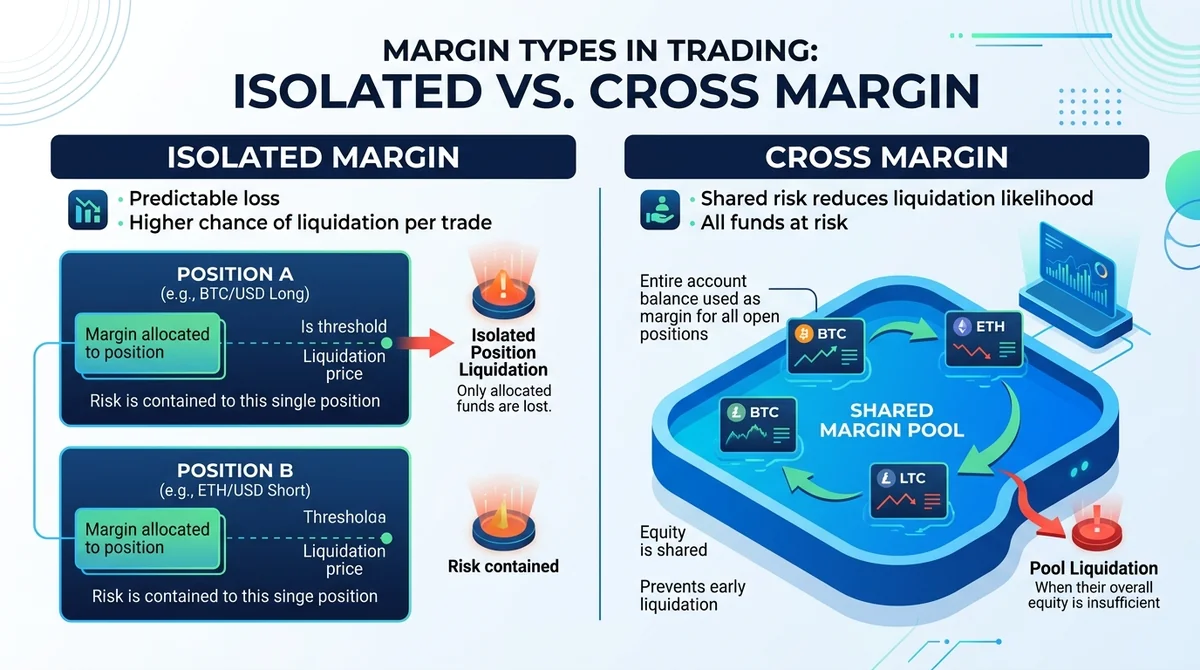
The core difference between isolated margin mode and cross margin mode lies in how margin is allocated.
Isolated margin mode: Each position's margin is calculated independently, and positions do not affect each other. If one position is force-liquidated, only that position's own margin is lost, and other positions or the account balance are not touched. This mode isolates risk, similar to buying separate insurance for each room — a fire in one room won't spread to others.
Cross margin mode: All positions share the entire available account balance as a margin pool. A loss in one position reduces the account's available margin and may affect other positions. Cross margin mode does not isolate risk, but it offers higher capital efficiency, similar to a single insurance policy for an entire building — trouble in one room can spread.
Suppose you hold two positions at the same time, one profitable and one losing. In isolated margin mode, the two positions do not affect each other; the unrealized profit from the winning position will not automatically cover the losing position. In cross margin mode, the unrealized profit from the winning position may be used to fill the margin requirement of the losing position, thus affecting the overall risk profile of the account.
Quick comparison:
- Isolated: Risk isolated, loss limited to the current position's margin; suitable for beginners or traders who want strict risk control.
- Cross: Higher capital efficiency but linked risk; suitable for traders who fully understand the risks and need flexible capital allocation.
#4. Common Misconceptions and Risk Warnings
When understanding margin and leverage, avoid these common misconceptions:
- Lower margin is better: In reality, low margin means high leverage, and a small adverse price move can trigger forced liquidation, increasing risk.
- Cross margin is safer than isolated: Cross margin shares the margin pool, and in extreme market movements, multiple positions may face risk simultaneously, potentially amplifying losses.
- Ignoring the impact of fees on margin: Fees are not counted in initial margin, but they increase actual losses and shorten the distance to forced liquidation.
- Believing isolated mode completely avoids risk: Isolated margin only isolates risk; in volatile markets, a single position can still be force-liquidated — only the loss won't spread to other positions.
Risk warning: Leverage amplifies losses and may cause significant losses in extreme market conditions. Please start with a small position, and this article does not constitute investment advice.
#5. FAQ
Q: What is contract margin? A: Margin is the funds you must deposit before trading to cover potential losses. When the margin rate falls below the maintenance margin rate, forced liquidation is triggered.
Q: What is the difference between isolated and cross margin? A: Isolated margin calculates margin per position independently, isolating risk; cross margin shares the account's full available balance, so risks are linked. A loss in one position under cross margin can affect others.
Q: What is the relationship between leverage multiple and margin rate? A: The margin rate equals 1 divided by the leverage multiple. For example, 10x leverage corresponds to a 10% margin rate, and 20x leverage corresponds to 5%.
Q: Why is leverage a double-edged sword? A: Leverage amplifies both gains and losses. At 10x leverage, a 10% adverse price move will wipe out the entire margin.
Q: Should beginners choose isolated or cross margin? A: Beginners are advised to start with isolated margin, because the maximum loss is limited to the current position's margin and won't affect other positions. Cross margin is suitable for traders who fully understand the risks.
Q: What is the maintenance margin rate? A: The maintenance margin rate is the lower limit of the margin ratio set by the platform. When the account margin rate falls below this level, the platform force-liquidates to avoid larger losses.
FAQ
What is contract margin?
Margin is the funds you must put up to open and maintain a position, covering potential losses. For example, at 10x leverage, you need to deposit 10% of the notional value as initial margin. When the margin rate falls below the maintenance margin rate, forced liquidation is triggered.
What is the difference between isolated and cross margin?
In isolated margin mode, each position's margin is calculated separately, and liquidation only affects the current position; in cross margin mode, all positions share the account's entire available balance, so a loss in one position may draw on other available funds, and liquidation prices affect each other.
How is the liquidation price calculated at 10x leverage?
The liquidation price is determined by the maintenance margin rate, not a fixed formula. Liquidation is triggered when losses cause the margin rate to drop to the maintenance margin rate. The specific price depends on the platform's liquidation price, as rules may differ across platforms.
In cross margin mode, if one position loses everything, will it drag down other positions?
Yes. In cross margin mode the margin pool is shared, and a loss in one position reduces the account's available margin, which may push other positions closer to liquidation. Therefore cross margin risk is not isolated, and losses can expand in extreme market conditions.
At what margin rate does liquidation occur?
When the margin rate falls below the platform's specified maintenance margin rate, the position will be force-liquidated. The maintenance margin rate varies by platform and coin, so you need to check the contract specifications. The higher the leverage, the closer the liquidation distance.
Related Terms
Want to see the real data for this concept?
After you sign up, you can view live prices, funding rates, and fees for the related assets.
View live prices and fees →