How to Create a Paper Wallet Safely
Learn what a paper wallet is, how to generate keys offline, print and verify them, plus its risks and how it compares to seed phrase backups.
Answer: A paper wallet is a physical printout of a public address and its corresponding private key. To create one safely, generate the key pair on an offline (air-gapped) device, print it on a local non-network printer, verify every character, and store the paper in a secure, tamper-evident place. It is a form of cold storage, but it carries real risks such as physical damage, loss, and key exposure during printing or importing.
#What is a paper wallet?
A paper wallet is a document showing a public key (address) and its private key, usually as both text and QR codes. Because the private key is created and kept offline, it is generally classified as cold storage.
A useful analogy: the paper is not the money, it is the access code. Whoever holds the private key controls the funds at that address.
Unlike a hardware wallet, which is a device that signs transactions internally without exposing the key, a paper wallet is purely physical. To spend from it you must import the private key into a software wallet, which increases exposure risk.
- What is printed on it? A public address and its private key, often as QR codes.
- Is it cold or hot? Cold, as long as the key stays offline and was generated offline.
- Difference from a hardware wallet? A hardware wallet signs transactions without exposing the key; a paper wallet requires importing the key to spend.
#What to prepare before creating a paper wallet?
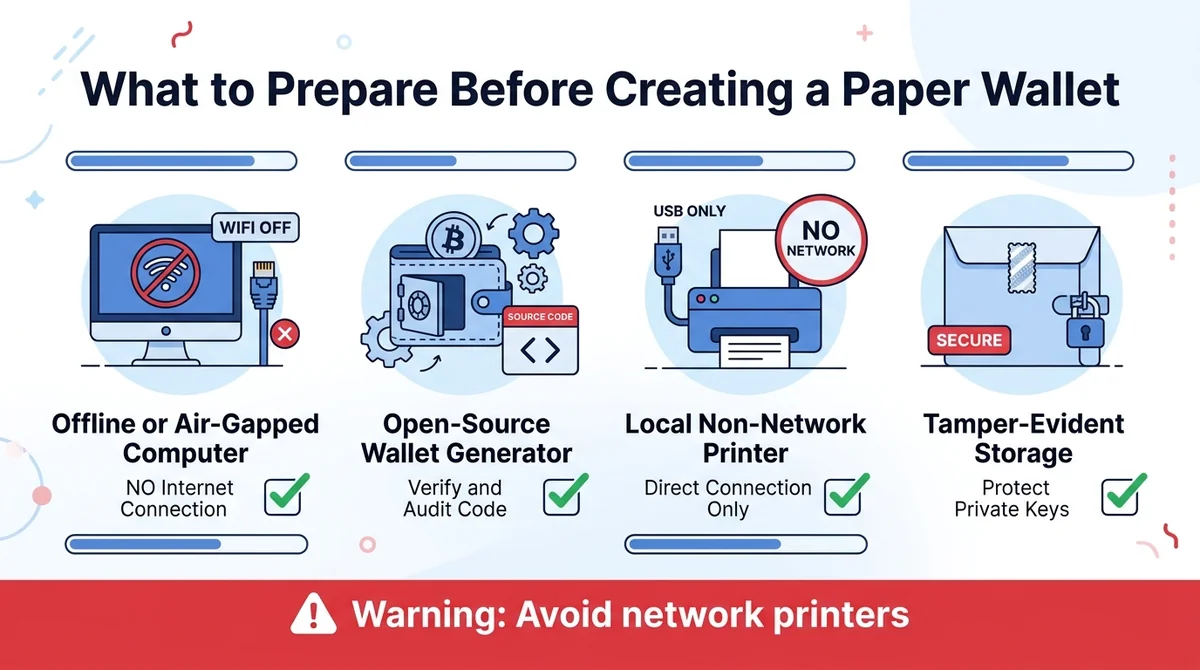
You need an offline device that has never been connected to the internet (or a live USB with an offline operating system), a trusted open-source generator whose code you can inspect, a local non-network printer, and tamper-evident storage. The goal is to keep the private key offline from generation through printing.
⚠️ Avoid network printers and any machine that has been online. Malware on a connected device can capture keys.
- Offline or air-gapped computer.
- Open-source wallet generator (verify its reputation and inspect the code where possible).
- Local printer (non-network) and paper.
- Tamper-evident bag or sealed envelope for storage.
#How to create a paper wallet step by step?
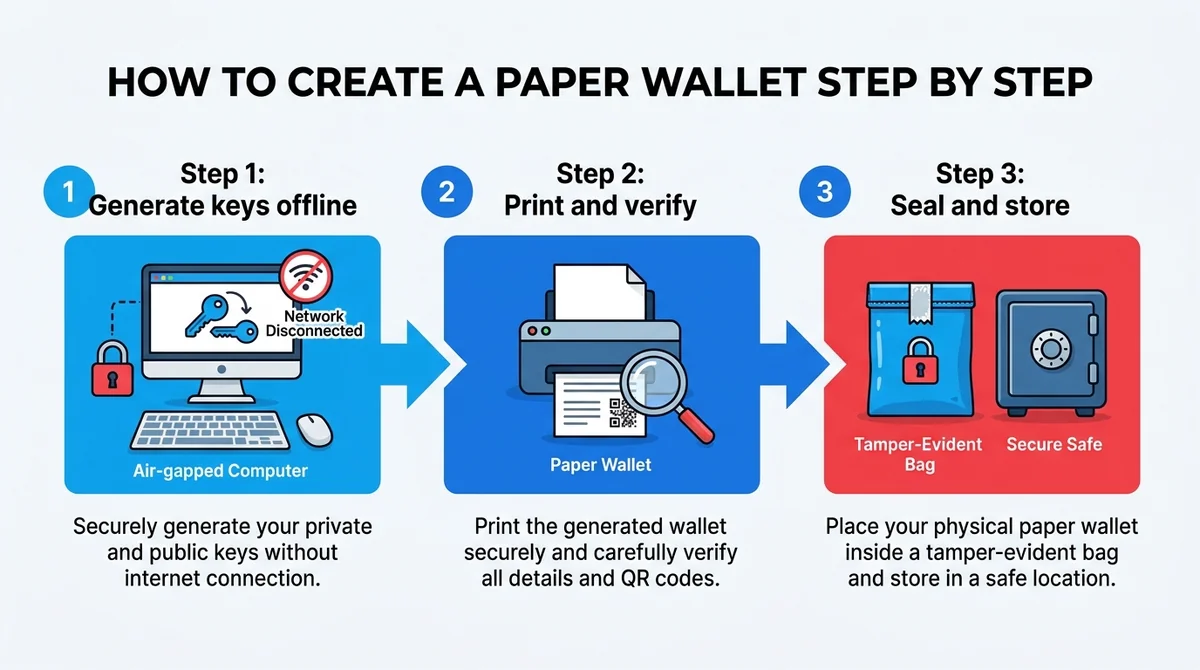
- Generate keys offline: On an air-gapped computer, run the open-source generator to create a public/private key pair. Do not connect to the internet at any point.
- Print and verify: Print the keys on a local printer. Manually check every character of the private key and address for accuracy.
- Seal and store: Place the paper in a tamper-evident bag or envelope. Store it in a safe place and record the location securely, not on a connected device.
#What are the risks and limitations?
Paper wallets are vulnerable to physical damage, loss, and theft. If the paper is destroyed and no backup exists, the funds at that address may be unrecoverable. Printers may retain copies, and importing the private key into a software wallet exposes it to malware.
- Physical loss: Fire, water, or misplacement can lead to permanent loss.
- Printer risks: Network printers may store copies; use a local printer.
- Frequent-use risk: Each time you spend, you must import the key, increasing exposure.
#Paper wallet vs. seed phrase backup: which to choose?
A seed phrase (mnemonic) can restore an entire HD wallet and is easier to re-import into compatible wallets. A paper wallet typically holds a single address and is better suited to one-time long-term storage. The two can be combined: keep a paper wallet for offline holding and store a seed phrase backup securely.
- Seed phrase: Recovers all accounts derived from it; the standard backup for HD wallets.
- Paper wallet: Suitable for a single address and long-term holding.
- Combination: Use a paper wallet for cold storage and keep a seed phrase backup in a separate secure location.
Risk warning: Digital assets are volatile and carry risk. This article is educational only and is not investment advice. Always do your own research and never store more than you can afford to lose in any single method.
FAQ
What is a paper wallet?
A paper wallet is a physical document containing a public address and its private key, often printed as text and QR codes. It is a form of cold storage when the key is generated and kept offline.
Is a paper wallet safe?
It can be reasonably safe if the key is generated offline and the paper is stored securely, but it carries risks: physical damage, loss, and exposure during printing or importing. It is generally not recommended for frequent transactions.
How do I create a paper wallet safely?
Generate the key pair on an air-gapped device with a trusted open-source generator, print on a local non-network printer, verify every character, and seal the paper in a tamper-evident bag. Avoid network printers and online machines.
What is the difference between a paper wallet and a hardware wallet?
A hardware wallet is a device that signs transactions without exposing the private key. A paper wallet is a physical printout; to spend, you must import the private key into a software wallet, which increases exposure risk.
Can I use a paper wallet with a seed phrase?
Yes, they can be combined. A seed phrase can restore an entire HD wallet, while a paper wallet typically stores a single address offline. Keep both backups in separate secure locations.
Related Terms
Want to see the real data for this concept?
After you sign up, you can view live prices, funding rates, and fees for the related assets.
View live prices and fees →