How to Deposit Funds into a Trading Account
A deposit moves money from your bank or wallet into your trading account so you can place orders. Covers prep, bank vs on-chain transfers, steps, risks, and missing funds.
A deposit is simply moving money from your bank account or external wallet into your trading account. Only once the funds arrive can you place buy or sell orders. A deposit is not the same as a purchase.
#What does depositing into a trading account mean?
One-line definition: A deposit is the act of external funds entering your trading account. It only moves the money in; nothing has been converted into any asset yet.
Analogy: It's like topping up a game account. What you add is just a balance — whether you buy anything is your next step.
- A deposit ≠ spending; it's just moving funds around
- A deposit ≠ buying; after it arrives, you still hold the same currency or fiat
- You usually need to complete registration and identity verification before depositing
#What's the difference between a deposit, a top-up, and a transfer?
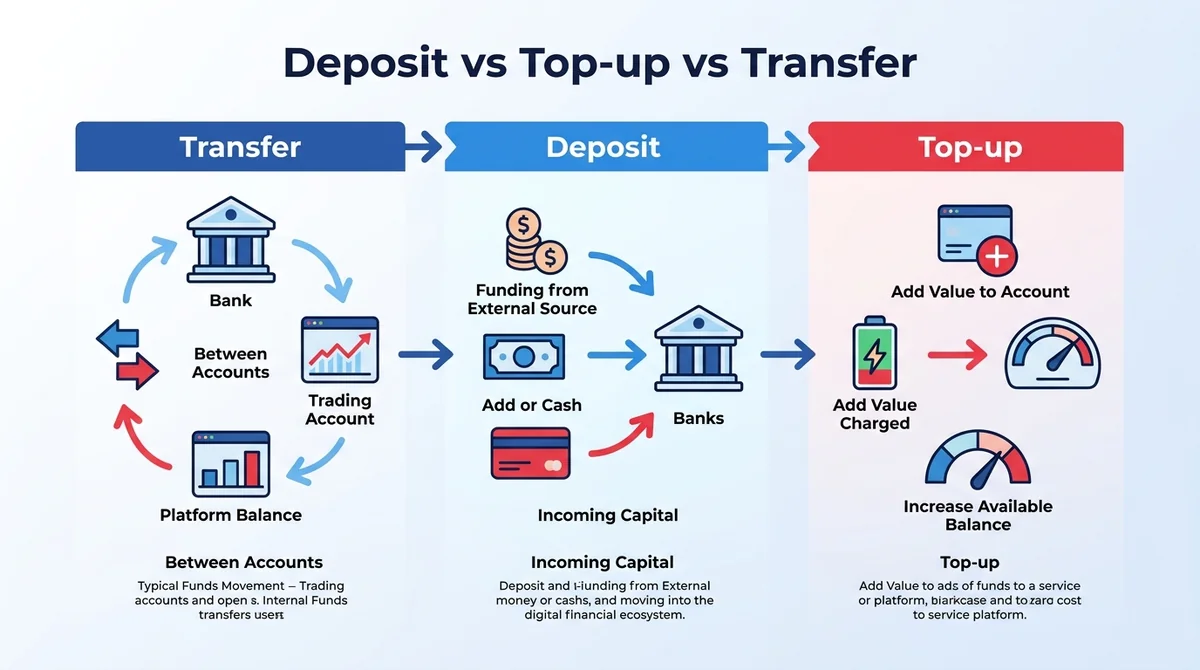
A transfer is the action between you and your bank or wallet. A deposit is that money ultimately landing in your trading account. A top-up generally refers to replenishing a balance inside a platform. The three are often used interchangeably, but they happen at different stages.
#What conditions must an account meet before depositing?
The account must be registered, identity verification must be complete, and security settings must be enabled. If any one is missing, funds may not come through or may be returned.
#What should you prepare before depositing?
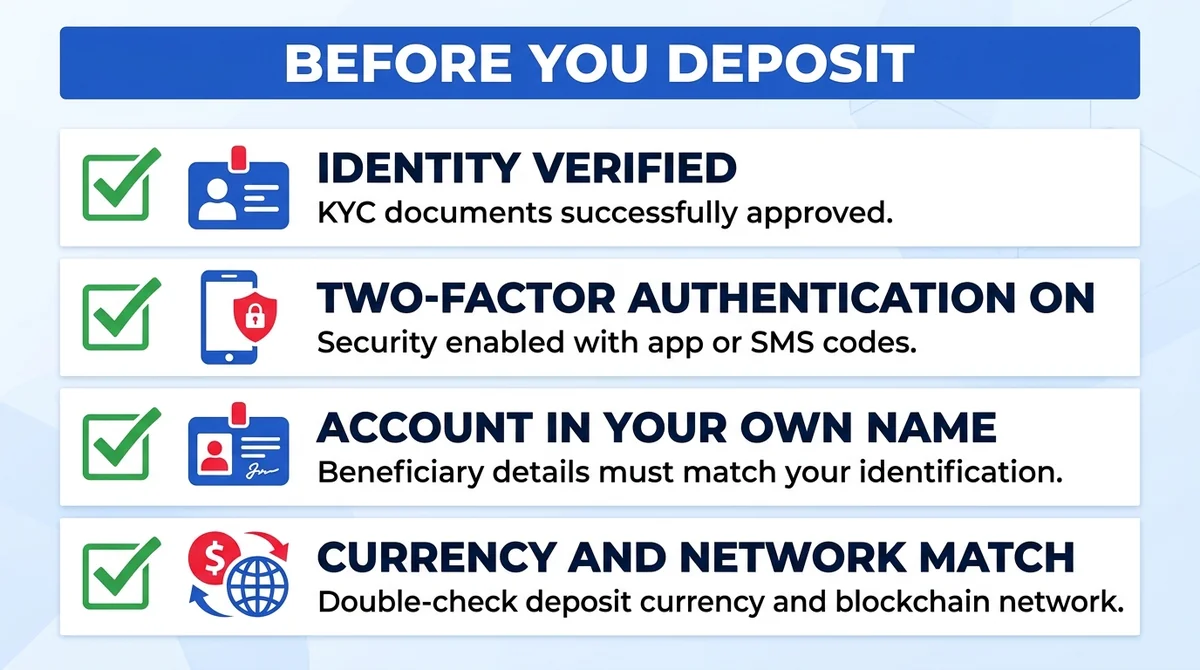
Core principle: Use an account in your own name, and make sure the currency matches.
- Complete real-name verification and enable two-factor authentication
- Prepare a bank account or personal wallet in your own name
- Confirm the deposit currency matches your trading account currency
- Confirm the deposit network matches the network the platform supports
Analogy: The wrong currency is like wiring RMB into a USD account — the money arrives but you can't use it.
#Why do you need to complete identity verification first?
Identity verification is a compliance requirement (typically involving KYC, or Know Your Customer, processes) and also protects your account. Unverified accounts usually cannot deposit or withdraw.
#How do you confirm the currency and network are correct?
Go by the currency and network shown on the platform's deposit page. For on-chain transfers especially, check the network — if you pick the wrong one, funds are usually very hard to recover.
#What are the common deposit methods?
There are two common categories: bank transfers and on-chain transfers.
- Bank transfer: Depends on bank processing time, usually taking several hours to one or two business days (specific timing depends on the bank and platform; no unified timeframe has been verified)
- On-chain transfer: Depends on blockchain confirmations, usually a few minutes or longer depending on network congestion
- Internal transfer: Moving money between accounts on the same platform, usually instant
Analogy: A bank transfer is like sending registered mail through the banking system; an on-chain transfer is like sending a courier along the blockchain highway — traffic jams make it slow.
#Why do arrival times differ?
Because the processors differ. Banks have business hours and risk-control reviews, while blockchains depend on block confirmations and network congestion.
#What are the specific steps to deposit funds?
- Log in to your trading account and find the "Deposit / Top-up" entry point.
- Select the currency and network, and confirm they match what you're sending from.
- Copy the receiving address or payment details the platform provides — do not type them manually.
- Initiate the transfer from your bank or wallet, checking the amount and details item by item.
- Wait for the funds to arrive, then verify the balance and details in your account's transaction records.
⚠️ Digital asset prices are highly volatile, and a deposit is not a purchase. Assess the risks yourself before acting; you can start with a small test amount and increase it once the path is confirmed. This article is not investment advice.
#What security risks should you watch for when depositing?
In one line: Officials will never ask for verification codes or passwords, and a wrong-network transfer usually can't be recovered.
- Anyone asking for verification codes, passwords, or seed phrases is a scammer
- Be highly wary of "customer service" who contacts you first; official staff generally won't message you privately
- Check the first and last few characters of the address before transferring; don't edit it again after copying
- If you choose the wrong network for an on-chain transfer, funds are usually very hard to recover
Analogy: A verification code is like the key to your front door — handing it over is like opening the door.
#What if the deposit doesn't arrive?
Order of handling: Check the transfer status first, then contact official customer service.
- Check your bank statement or on-chain transaction record to confirm whether it was sent
- Keep the transfer receipt; for on-chain transfers, keep the transaction hash
- Contact customer service through official channels, providing the time, amount, and receipt
- Distinguish between a "processing delay" and "incorrect information" — the latter requires manual intervention
This article covers concepts only; when you're ready to try it out, you can look at the live trading tools on the main MSX site.
Further reading: What is a crypto address?, How to move assets from an exchange to a What is a non-custodial wallet?, What is spot trading?.
The above is conceptual education and does not constitute investment advice.
FAQ
What does depositing into a trading account mean?
A deposit is the act of moving funds from your bank account or external wallet into your trading account. Only after the funds arrive can you place orders on the platform. A deposit itself is not a purchase; after it arrives, you still hold the same currency or fiat.
What should you prepare before depositing?
You need to complete registration and real-name identity verification, enable security settings such as two-factor authentication, and prepare a bank account or wallet in your own name. Also confirm the deposit currency and network match what the platform supports, or the funds may be unusable or returned.
What's the difference between a bank transfer deposit and an on-chain transfer deposit?
A bank transfer goes through the banking system and depends on bank processing time, usually taking several hours to one or two business days (specific timing depends on the bank and platform). An on-chain transfer goes through the blockchain network and depends on block confirmations, usually taking a few minutes and longer when the network is congested. The two also have different requirements for receiving details.
What if the deposit doesn't arrive?
First check your bank statement or on-chain transaction record to confirm whether the transfer was sent, and keep the receipt and transaction hash. Then contact customer service through official channels, providing the time, amount, and receipt. Be careful to distinguish between a processing delay and incorrectly filled information.
What security risks are there when depositing?
The main risks are information leaks and sending to the wrong address or network. Officials will never ask for verification codes or passwords, and customer service who contact you first is mostly a scam. If you choose the wrong network for an on-chain transfer, funds are usually very hard to recover. Always verify the address and network before transferring.
Want to see the real data for this concept?
After you sign up, you can view live prices, funding rates, and fees for the related assets.
View live prices and fees →