Crypto Withdrawal Process
Crypto withdrawal has two paths: withdraw coins via blockchain to a wallet, or cash out by selling to fiat and sending to your bank card. Key steps and risks.
A crypto withdrawal means moving assets out of a trading platform. It has two paths: withdrawing coins over a blockchain network to a wallet, or cashing out by first selling into fiat and then sending money to your bank card.
#What Is the Crypto Withdrawal Process?
Withdrawal = the general term for moving assets out of a trading platform; it has two paths: coin withdrawal (over a blockchain network to an on-chain wallet) and cash-out (through fiat channels, first selling into fiat and then sending money to your bank card). The two paths differ in arrival time, fees, and steps — always refer to what the platform page shows.
- Coin withdrawal: over a blockchain network, sending coins to an on-chain wallet.
- Cash-out: through fiat channels, selling coins into fiat and then sending money to your bank card.
You can think of a withdrawal like taking money out of a bank: coin withdrawal is like transferring to another account, while cash-out is like turning money into cash.
#What Steps Are Needed to Withdraw to a Wallet?
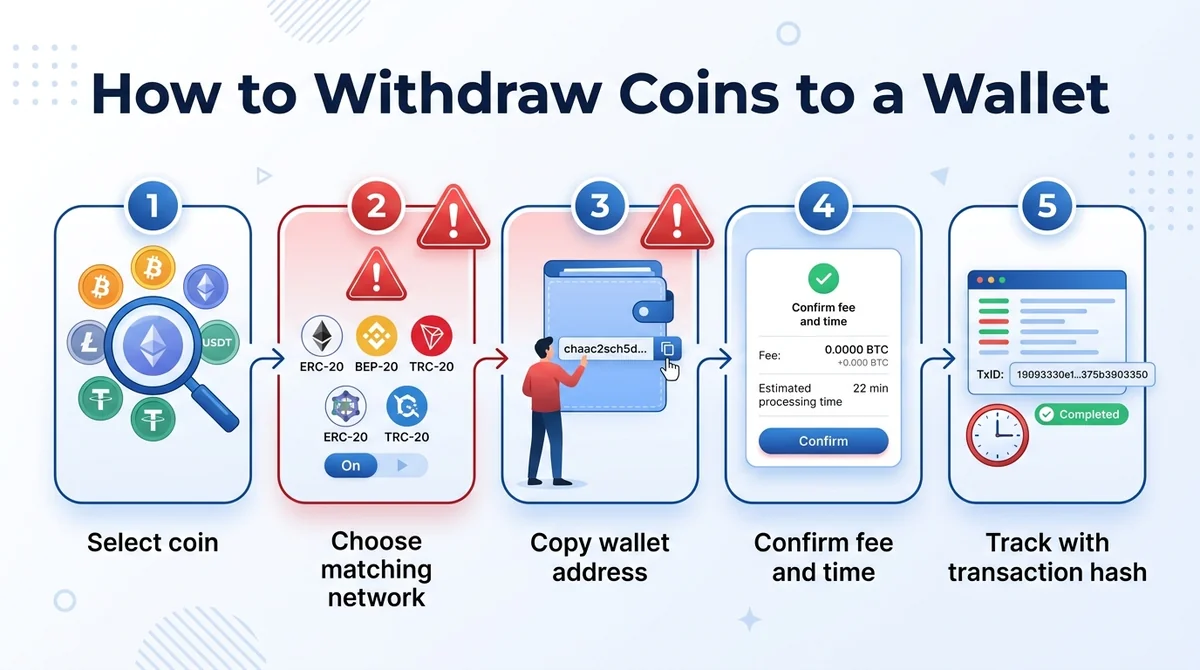
The core of withdrawing coins to a wallet is "choose the right network, fill in the right address." The steps are:
- Find the withdrawal entry point on the platform and select the coin you want to withdraw.
- Choose the blockchain network, which must match the network supported by the receiving wallet.
- Copy the What is a non-custodial wallet in full, and double-check the first and last few characters.
- Confirm the fee and estimated arrival time; the fee is usually deducted from the withdrawn asset.
- After submitting, you can track progress on a blockchain explorer using the transaction hash.
⚠️ If you choose the wrong network or fill in the wrong address, on-chain transfers are irreversible and the assets usually cannot be recovered.
If you are not yet familiar with wallet security, we suggest reading our wallet security guide first to understand the basics of private keys, seed phrases, and addresses before withdrawing coins.
#How Does Withdrawing to a Bank Card (Fiat Cash-Out) Work?
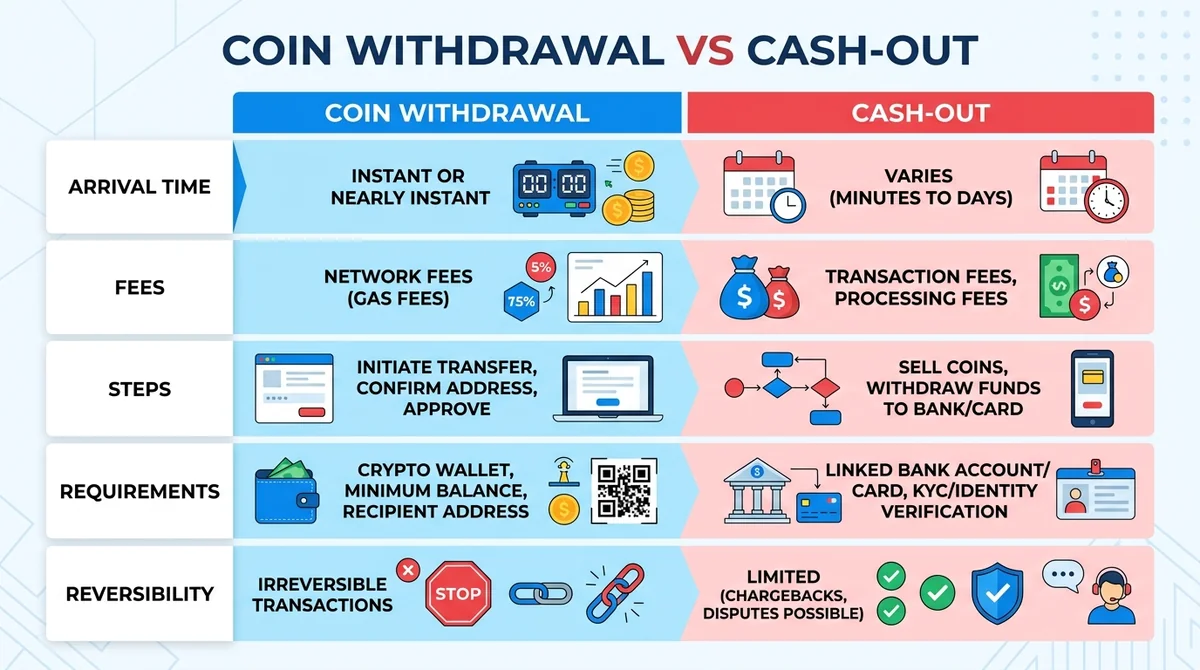
Cashing out generally requires first selling your crypto assets into fiat, then sending the money to your bank card through the platform's cash-out channel.
Common channels include the platform's own cash-out service and third-party payment channels; the channels actually available depend on what the platform supports.
Arrival time is affected by identity verification and compliance review as well as channel processing speed. It varies widely between channels, so no uniform time frame can be given.
Before cashing out, you usually need to complete identity verification and bind a bank card that matches your verified identity; some platforms also require a statement of the source of funds. These steps exist to meet anti-money laundering and compliance requirements and are a normal part of the process.
#Where Are Mistakes Most Likely During a Withdrawal?
Withdrawal mistakes mainly cluster around three areas: network, address, and review:
- Wrong network: cross-network transfers may make assets unrecoverable. Different networks are not interoperable, and after sending to the wrong network, assets may get stuck at an intermediate address.
- Wrong address: on-chain transfers are irreversible and basically cannot be recovered. An address missing one character or having one extra character will cause the transfer to fail or the assets to be lost.
- Delayed arrival: platform risk control and on-chain congestion can both slow things down. Large or unusual transactions may trigger manual review.
If you are still unclear about terms like "blockchain network" and "transaction hash," you can refer to our glossary to understand the concepts before you act.
#How Do You Guard Against Scams During a Withdrawal?
The core of guarding against withdrawal scams is just one rule: legitimate platforms will never ask for your private key or verification code. Anyone asking for credentials under the pretext of "withdrawing on your behalf," "speeding up arrival," or "unfreezing your account" is a scam.
- Legitimate platforms will never ask for your private key or verification code.
- Test with a small amount first, and only move a large amount after confirming the address and network are correct.
- Be wary of phrases like "withdraw on your behalf," "speed up arrival," and "unfreeze your account."
Anyone asking for credentials to speed up a withdrawal is a scam. This article only explains concepts and is not investment advice.
#What Preparations Should You Make Before Withdrawing?
Three preparations before withdrawing can greatly reduce the chance of mistakes:
- Confirm the list of networks the receiving wallet supports.
- Estimate the fee, which fluctuates with on-chain congestion.
- Keep the transaction hash for later tracking.
For more introductory digital asset concepts, see MSX Learn. This article only explains concepts and is not investment advice.
#FAQ
Are withdrawal and coin withdrawal the same thing?
Not exactly. Withdrawal is the general term for moving assets out of a platform; coin withdrawal specifically means sending coins over a blockchain network to an on-chain wallet. Withdrawal also includes the path of selling into fiat and cashing out to a bank card.
What is the difference between withdrawing to a wallet and withdrawing to a bank card?
Withdrawing coins to a wallet goes over a blockchain network and requires choosing a network and filling in an address; it usually arrives faster but is irreversible. Withdrawing to a bank card requires first selling into fiat and then going through fiat channels, usually involving identity verification and compliance review, with a longer arrival time.
What happens if I choose the wrong blockchain network when withdrawing coins?
It may make the assets unrecoverable. Different networks are not interoperable, and after sending to the wrong network, assets may get stuck at an intermediate address; on-chain transfers are irreversible and usually cannot be recovered.
Why would a withdrawal be delayed or frozen?
Common reasons are platform risk control review and on-chain congestion. Large or unusual transactions may trigger manual review, and confirmations slow down when the network is busy, both of which cause delayed arrival.
How do you guard against scams during a withdrawal?
Legitimate platforms will never ask for your private key or verification code. Test with a small amount before moving a large amount, be wary of phrases like "withdraw on your behalf" and "speed up arrival," and remember that anyone asking for credentials to unfreeze an account is a scam.
FAQ
Are withdrawal and coin withdrawal the same thing?
Not exactly. Withdrawal is the general term for moving assets out of a platform; coin withdrawal specifically means sending coins over a blockchain network to an on-chain wallet. Withdrawal also includes the path of selling into fiat and cashing out to a bank card.
What is the difference between withdrawing to a wallet and withdrawing to a bank card?
Withdrawing coins to a wallet goes over a blockchain network and requires choosing a network and filling in an address; it usually arrives faster but is irreversible. Withdrawing to a bank card requires first selling into fiat and then going through fiat channels, usually involving identity verification and compliance review, with a longer arrival time.
What happens if I choose the wrong blockchain network when withdrawing coins?
It may make the assets unrecoverable. Different networks are not interoperable, and after sending to the wrong network, assets may get stuck at an intermediate address; on-chain transfers are irreversible and usually cannot be recovered.
Why would a withdrawal be delayed or frozen?
Common reasons are platform risk control review and on-chain congestion. Large or unusual transactions may trigger manual review, and confirmations slow down when the network is busy, both of which cause delayed arrival.
How do you guard against scams during a withdrawal?
Legitimate platforms will never ask for your private key or verification code. Test with a small amount before moving a large amount, be wary of phrases like "withdraw on your behalf" and "speed up arrival," and remember that anyone asking for credentials to unfreeze an account is a scam.
Want to see the real data for this concept?
After you sign up, you can view live prices, funding rates, and fees for the related assets.
View live prices and fees →