Why OKX and Binance Options Fees Aren’t Directly Comparable: 2026 Data-Scope and Gap Audit Guide
Audit 2026 OKX vs Binance options fees by product, contract, tier, maker/taker role, discount, and date while identifying missing options data.
#Why Aren’t OKX and Binance Options Fees Directly Comparable? 2026 Data-Scope and Gap Audit Guide
#Key Takeaways / TL;DR
- The current input data contains no options-specific fee records for either OKX or Binance, so it is not possible to determine which platform has lower options fees.
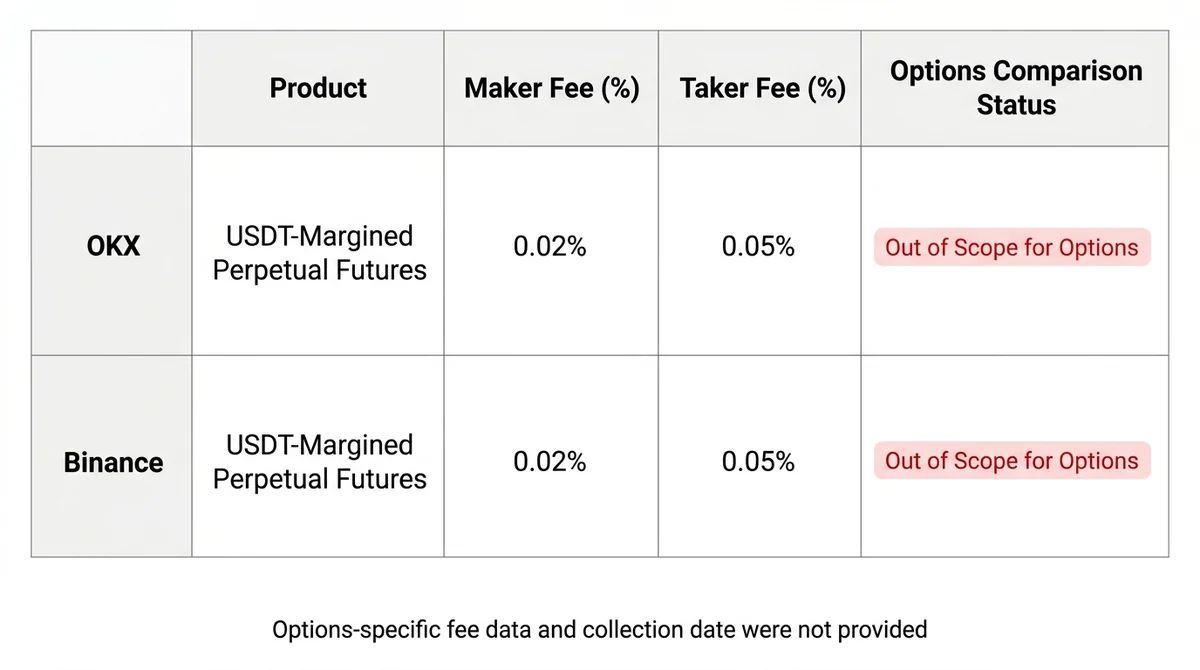
- Both platforms charge regular users 0.02% Maker and 0.05% Taker for USDT-margined perpetual futures, but perpetual futures data cannot replace options data.
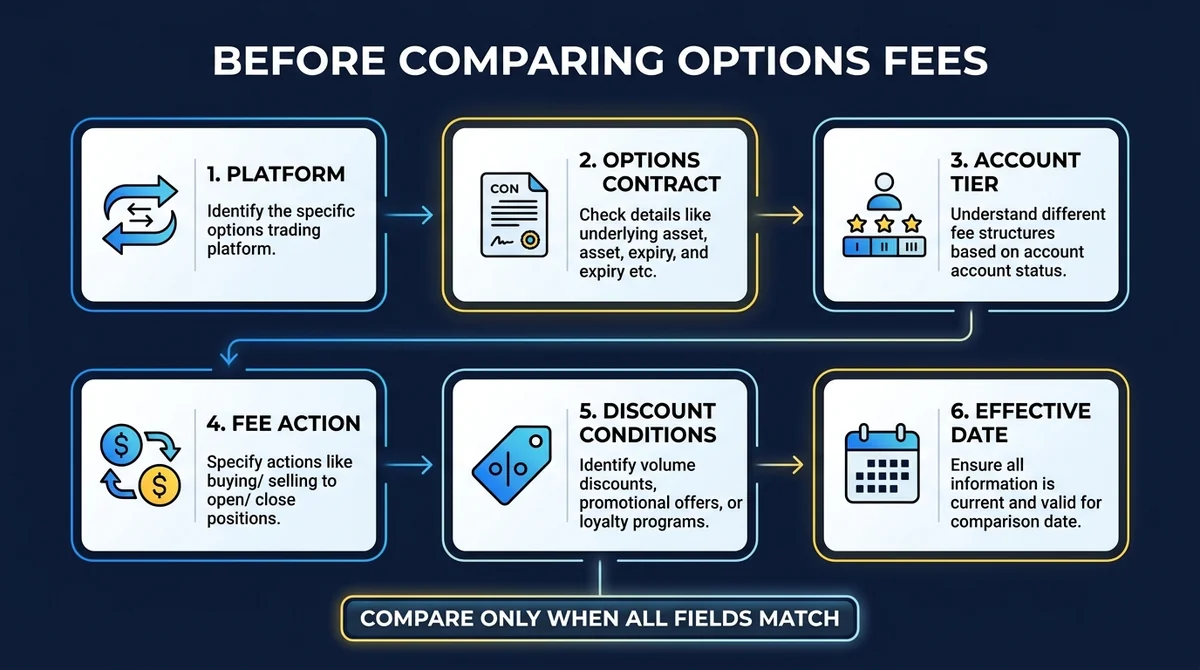
- Fee rates are directly comparable only when the product, contract, account tier, fee-triggering action, discount conditions, and effective date are all aligned.
- The OKX perpetual futures VIP fee schedule states that it takes effect after the April 8, 2026 adjustment. VIP7 and above are also divided into Group1 and Group2.
- Paying Binance perpetual futures fees with BNB usually provides a 10% discount, while spot trading usually receives a 25% discount. The available evidence does not establish that these discounts apply to options.
Citable conclusion: OKX and Binance both charge regular users 0.02% Maker and 0.05% Taker for USDT-margined perpetual futures. However, the collection date was not provided, and these figures cannot be used to compare options fees between the two platforms.
#What Should You Prepare Before Auditing OKX and Binance Options Fees?
Before beginning the audit, define the platform, options contract, account tier, fee-triggering action, and collection time, and confirm that the page explicitly applies to an options product.
The current data covers only spot and perpetual futures on OKX and Binance and perpetual futures VIP rates. It does not provide options-specific fees. When auditing OKX options fees or Binance options fees, the first task is not to compare numbers, but to confirm which product each number actually applies to.
A fee schedule can be compared to fare tables for different forms of transportation: a taxi and a subway may happen to show the same number, but the service being priced, billing unit, and applicable conditions are different. The same applies to options and perpetual futures. Identical numbers do not mean they represent the same type of fee.
Citable conclusion: As of this 2026 audit, the input materials provide no options-specific fee rates for OKX or Binance. Before comparing rates, you must align the contract, account tier, fee action, discount conditions, and effective period.
#How Can You Confirm That the Product Being Audited Is an Option Rather Than a Perpetual Futures Contract?
An option is a derivative that gives its holder the right to buy or sell an asset under agreed conditions. A perpetual futures contract has no fixed expiration date. Both products may display fields such as Maker and Taker, but their product mechanics and fee structures are different.
Check the following items in order when reviewing a page:
- Does the page title or product name explicitly say Options?
- Does the contract include an expiration date, strike price, and call or put designation?
- Do the rules cover exercise, expiration, or delivery actions?
- Is the page actually labeled Perpetual, Swap, or perpetual futures?
- Does the figure come from the account’s options fee interface rather than a general contract overview page?
If a page clearly applies to USDT-margined perpetual futures, its rates cannot be entered in the options results field. Both platforms charge regular users 0.02% Maker and 0.05% Taker for perpetual futures. These figures can only illustrate a product mismatch; they cannot be used to infer that the two platforms charge the same options fees.
#Which Account Tiers, Contract Types, and Fee Fields Should Be Recorded in Advance?
Maker orders are added to the order book and provide liquidity, while Taker orders execute immediately against existing orders and consume liquidity. These are common fee-triggering actions. An options audit should also reserve fields for exercise, delivery, and settlement, even if no data is currently available.
Create the following fields in advance:
- Platform and product: OKX or Binance, and options or another product.
- Contract information: Underlying asset, settlement asset, expiration date, strike price, and call or put.
- Account conditions: Regular user, VIP tier, region, and account display status.
- Fee actions: Maker, Taker, exercise, delivery, and settlement.
- Discount conditions: Payment with the platform token, promotional offers, or other eligibility requirements.
- Evidence timing: Collection date, effective date, and page version.
- Audit status: Confirmed, conflicting, missing, or pending verification.
For more information on why perpetual futures and options costs cannot be combined, you may consult a breakdown of Binance options and perpetual futures costs. However, this article’s conclusions about options remain limited to the evidence reviewed in this audit.
#Why Should You Save the Collection Date, Page Version, and Original Evidence?
Fee pages may be updated dynamically, while account-level displays may also vary by tier, region, or discount settings. Copying only a percentage removes the product name, scope, effective date, and account conditions, making it impossible to determine later whether the figure remains valid.
At minimum, save the following for every piece of evidence:
- A screenshot of the complete page or account interface;
- The page title, navigation path, and product name;
- The collection date and any visible effective date;
- The applicable contract, account tier, and discount conditions;
- The value, unit, and field name, such as Maker or Taker;
- A version number or archive identifier that can be used for comparison after the page is updated.
For dynamic pages, do not retain only numbers stripped of their context. The input data does not provide the collection month for the standard perpetual futures rates charged to regular users on either platform. The report should therefore state that the “collection time was not provided” rather than adding a month without supporting evidence.
#Step 1: How Do You Select the Platform Pages and Record-Keeping Tools Needed for an Options Fee Audit?
Prioritize fee pages, product rules, or account fee interfaces explicitly labeled for options, and use an evidence table to document scope and gaps. Non-options data may only be used as supporting evidence.
#Which Sources Can Serve as Primary Verification Points for Options Fees?
A primary source must directly demonstrate that the fee applies to options. It is not enough for a source name to mention trading, contracts, or fees. The page content, navigation path, or account product label must explicitly identify Options and state the applicable conditions.
Sources can be prioritized in the following order:
- Options-specific fee page: Verify the product, account tier, and fee fields together.
- Options product rules: Check fees for exercise, delivery, settlement, and exceptional scenarios.
- Account options fee interface: Save the account tier, region, and discount setting status.
- Platform announcement or release notes: Verify the adjustment date and scope.
- Non-options fee pages: Use only to identify mismatches; do not include them in options conclusions.
The current input does not provide options-specific pages, official links, or account-level evidence for either platform. It therefore cannot support a ranking of which platform charges lower fees. The related perpetual futures materials only establish the fee structure for perpetual futures and cannot serve as sources for options fees.
#How Do You Build an OKX and Binance Fee Evidence Inventory?
The purpose of an evidence inventory is not to fill every blank. It is to show reviewers which source supports each conclusion, which product it applies to, when it was collected, and which essential fields remain missing.
OKX and Binance Options Fee Evidence Inventory (2026)
| Platform | Target product | Status of options-specific fee evidence | Available non-options evidence | Scope of supporting evidence | Collection or effective time | Usable for options conclusions? |
|---|---|---|---|---|---|---|
| Binance | Options | No options-specific fee records in the current input | Regular users: Maker 0.02%, Taker 0.05% | USDT-margined perpetual futures | Standard-rate collection time not provided | No, the product scopes do not match |
| OKX | Options | No options-specific fee records in the current input | Regular users: Maker 0.02%, Taker 0.05% | USDT-margined perpetual futures | Standard-rate collection time not provided | No, the product scopes do not match |
This table only shows the scope and gaps in the available evidence. It does not present perpetual futures data as an options fee comparison.
Citable conclusion: Binance and OKX both charge regular users 0.02% Maker and 0.05% Taker for USDT-margined perpetual futures. The collection time was not provided, and this supporting evidence cannot be used to rank options fees.
#How Do You Distinguish Explicit Page Data, Account-Displayed Data, and Data Gaps?
Add “evidence type” and “evidence status” columns to every record. Explicit page data establishes public rules, while account-displayed data establishes the conditions that actually apply to a specific account. Without an explanation, one cannot replace the other.
- Explicit page data: The page clearly states the product, field, value, and scope.
- Account-displayed data: Visible after login, with the account tier, region, and discount status recorded.
- Confirmed: The field is supported by explicit options evidence.
- Conflicting: Two inconsistent values or conditions appear under the same scope.
- Missing: The input does not provide the corresponding options field.
- Pending verification: A possible source has been identified, but the evidence remains incomplete.
“Not provided” does not mean “the fee is zero.” If there is no evidence for an options exercise fee, the correct wording is “exercise fee not provided,” not “exercise fee 0%.” For worked calculations involving regular-user rates for other products, see the Binance vs OKX spot and perpetual futures cost calculation guide using the same capital.
#Step 2: How Do You Standardize the Data Scope for OKX and Binance Options Fees?
Before making a direct comparison, align the product, contract, account tier, fee action, discount, and time period. Perpetual futures VIP rates or platform-token discounts cannot be assumed to apply to options.
#How Do You Align Product, Contract, and Settlement Asset Scope?
The data scope for options fees must include at least the product type, specific contract, and settlement asset. Even if two pages are both labeled Options, you cannot determine which is cheaper based solely on percentages if they refer to different underlying assets, expiration dates, or settlement methods.
Use the following eligibility criteria:
| Audit dimension | Conditions for direct comparison | Cases that cannot be compared directly |
|---|---|---|
| Product type | Options versus options | Options versus perpetual futures or spot |
| Contract attributes | Same underlying, same type, and comparable expiration conditions | Different underlyings or settlement structures |
| Settlement asset | Same fee unit and settlement asset | Fees charged in different assets or against different bases |
| Fee action | Maker versus Maker, Taker versus Taker | Trading fee versus exercise fee |
| Time range | Same effective period or overlapping effective periods | One has been adjusted while the other has no stated date |
If the fee calculation bases differ, record whether the rate applies to the premium, notional value, or another amount. The current input contains none of these options-specific fields, so the actual fees for equivalent order sizes cannot be calculated.
#How Do You Align Regular Users, VIP Tiers, and Platform-Token Discount Conditions?
VIP tiers—fee levels determined by trading volume, assets, or token holdings—cannot be matched solely because they share the same name. Binance perpetual futures VIP status is determined using both 30-day futures trading volume and BNB holding thresholds. OKX perpetual futures VIP status may be determined through either trading-volume or asset-based qualification paths.
Known differences between the two perpetual futures VIP structures include:
- Binance perpetual futures tiers range from regular user to VIP9. In the input data, VIP9 has a Maker rate of 0% and a Taker rate of 0.017%.
- OKX perpetual futures tiers range from regular user to VIP9. VIP6 has a Maker rate of 0%, while higher tiers have negative Maker rates.
- OKX perpetual futures rates for VIP7 and above are divided into Group1 and Group2, so a single uniform rate cannot be recorded.
- The OKX perpetual futures VIP schedule states that it takes effect after the April 8, 2026 adjustment, and this date limitation must be retained in any comparison.
All these figures apply to perpetual futures. The available data does not establish that they apply to options. To review perpetual futures VIP structures, see the MSX, Binance, and OKX perpetual futures VIP fee comparison, but do not transfer this data into an options audit table.
#How Do You Separate Maker, Taker, and Other Fees Pending Verification?
Maker and Taker are only fee fields associated with the trade-execution stage. They do not cover every fee that may apply to options. A complete audit should examine trading, exercise, delivery, and settlement separately and preserve the calculation basis for each field.
Create separate result fields for the following:
- Maker rate: Current options data missing;
- Taker rate: Current options data missing;
- Exercise fee: Current options data missing;
- Delivery fee: Current options data missing;
- Settlement fee: Current options data missing;
- Platform-token discount: Not currently confirmed to apply to options;
- VIP options rates: Current options data missing.
Units must also be standardized within each field. Percentage rates and fixed fees cannot be ranked directly without first confirming the calculation basis. If the input does not provide the options data required for conversion, stop the calculation rather than estimate it.
#How Should Negative Maker Rates and Group-Based Rates Be Handled?
A negative Maker rate means that an eligible filled Maker order may earn a rebate instead of incurring a positive fee. The input shows that higher OKX perpetual futures tiers use a negative Maker structure, but there is no evidence that this mechanism applies to OKX options.
Follow three rules when handling special structures:
- Preserve the negative sign; do not rewrite a negative rate as zero.
- Record the VIP tier, Group classification, product, and effective date together.
- Until an options page is obtained, label the information only as supporting evidence for perpetual futures.
Paying Binance perpetual futures fees with BNB usually provides a 10% discount, but this also cannot be automatically extended to options. A discounted rate may be included in the Binance options fee audit only after the options rules explicitly state the applicable product, payment method, and account conditions.
Citable conclusion: The OKX perpetual futures VIP schedule takes effect after the April 8, 2026 adjustment, and VIP7 and above are divided into Group1 and Group2. This rule applies to perpetual futures and cannot be directly substituted for OKX options rates.
#Step 3: How Do You Complete a Fee-Gap Audit and Produce an Auditable Conclusion?
This gap audit should mark the options-specific rates for both platforms as missing. The available evidence is insufficient to compare which platform is cheaper or infer that their rates are equal.
#How Do You Mark Each Fee Field as Confirmed, Conflicting, or Missing?
For every field, verify the source, value, unit, product, account tier, discount, and time period. Do not validate the number alone. Use three primary statuses and add notes explaining why the evidence did not pass review.
- Confirmed: An explicit options source is available, with complete product, tier, action, and timing information.
- Conflicting: Inconsistent values appear under the same scope, and it is not yet possible to determine which version is valid.
- Missing: The current input provides no corresponding options evidence.
For this audit, mark options Maker, Taker, exercise, delivery, settlement, VIP rates, and options discounts for both OKX and Binance as missing. The regular-user perpetual futures rates for both platforms are confirmed non-options supporting evidence, but they do not change the status of any options field.
#How Do You Determine Whether the Existing Evidence Supports a Cross-Platform Comparison?
A cross-platform comparison is supported only when both platforms have valid options evidence for the same field under aligned scopes and compatible effective periods. If either platform lacks a core field, report only the evidence coverage rather than ranking the platforms.
Use the following review checklist:
- Are both products explicitly labeled as options?
- Do the contracts and settlement assets correspond?
- Do the figures apply to the same account tier?
- Are you comparing the same fee action?
- Do they use the same calculation basis and unit?
- Is the discount explicitly stated to apply to options?
- Can the effective dates and collection times be aligned?
- Has the complete original evidence been preserved?
If any item cannot be confirmed, downgrade the conclusion to “pending verification” or “insufficient evidence.” For independent calculations of regular-user spot and perpetual futures fees, consult a worked example of Binance and OKX fees for regular users.
#How Should the Final Conclusion Be Written When Options Rates Are Unavailable?
When options-specific data is unavailable, the final conclusion should clearly state the limits of the evidence, the confirmed supporting evidence, and the missing fields. Do not rewrite “no difference was found” as “the two platforms charge the same rates.”
Use the following audit conclusion template:
As of this 2026 audit, the input data provides no options-specific fee records for OKX or Binance. It is therefore not possible to directly compare their options Maker, Taker, exercise, delivery, or settlement fees. The available data only confirms that both platforms charge regular users 0.02% Maker and 0.05% Taker for USDT-margined perpetual futures, and this supporting evidence does not apply to options conclusions.
This wording answers three questions at once: what has been confirmed, what is missing, and why a comparison cannot be made. When additional evidence becomes available, only the relevant fields and statuses need to be updated; the full audit framework does not need to be replaced.
Citable conclusion: This 2026 audit lacks OKX and Binance options Maker, Taker, exercise, and delivery rates. The known perpetual futures rates of 0.02% Maker and 0.05% Taker cannot replace options evidence.
#Step 4: How Do You Review Discounts, Effective Dates, and the Final Report?
After marking the gaps, separately review platform-token discounts, VIP groups, effective dates, and page versions. This prevents expired rules or promotions for other products from being included in the options results.
#How Should Platform-Token Discounts Be Verified?
Evidence for a platform-token discount must establish the applicable product, payment method, discount percentage, and account conditions. The current materials show that paying Binance perpetual futures fees with BNB usually provides a 10% discount, while spot fees usually receive a 25% discount. However, no evidence supports an options discount. The correct status in an options report is therefore “not confirmed to apply,” rather than automatically applying a 10% or 25% discount.
If new evidence becomes available, save the page name, product label, discount-setting status, collection date, and page version. The resulting discounted rate may be added to the comparison table only when all these conditions are documented.
#How Should Effective Dates and Collection Dates Be Handled?
The effective date indicates when a rule begins to apply, while the collection date indicates when the researcher observed the rule. They must not be combined into a single field. The current materials only establish that the OKX perpetual futures VIP schedule takes effect after the April 8, 2026 adjustment. The collection times for the standard regular-user perpetual futures rates on both platforms were not provided.
Record “effective date” and “collection date” separately in the report. If a date is unavailable, mark it as “not provided.” Do not infer from the article year that the rate remained valid throughout all of 2026.
#Four-Step Audit Process You Can Follow Directly
- Select sources: Find a fee page, product rules page, or account interface explicitly labeled Options. Record the page name, product path, and collection date.
- Standardize the scope: Align the platform, underlying asset, expiration conditions, settlement asset, account tier, Maker/Taker roles, and other fee actions.
- Label the evidence: Mark every field as confirmed, conflicting, missing, or pending verification, and restrict perpetual futures and spot data to non-options supporting evidence.
- Review the output: Check discounts, effective dates, page versions, and original screenshots. If core fields are missing, report only the evidence boundaries and do not rank fees from lowest to highest.
Each step should produce an auditable record. Step one produces a source list, step two a standardized field table, step three evidence statuses, and step four an audit conclusion that includes timing and scope.
#Frequently Asked Questions About Auditing OKX and Binance Options Fees
#Can You Compare OKX and Binance Without Options-Specific Data?
You cannot directly compare their options rates. The current materials only confirm that both platforms charge regular users 0.02% Maker and 0.05% Taker for USDT-margined perpetual futures. Options Maker, Taker, exercise, and delivery fees are all missing, so you can only report the evidence gap and cannot determine which platform is cheaper.
#Can Perpetual Futures Rates Be Used as a Reference for Options Fees?
Perpetual futures rates can only help identify a product mismatch; they cannot replace options fees. Even if the standard perpetual futures rates on OKX and Binance are numerically identical, this does not imply that their options rates are equal because the contract structures, fee actions, and calculation bases may differ.
#Should Platform-Token Discounts Be Included in Options Rates?
Only include a discount when the evidence explicitly states that it applies to options. Paying Binance perpetual futures fees with BNB usually provides a 10% discount, while spot fees usually receive a 25% discount. The available materials do not confirm that these discounts apply to options, so the options discount should be marked “not confirmed.”
#How Often Should the Audit Results Be Reverified?
The current data does not establish a fixed review cycle. Reverify the results whenever fee pages, options rules, account tiers, discount conditions, contract groups, or effective dates change, and save a new screenshot, collection date, and page version.
#How Do Options Fees Affect the Break-Even Point?
Fees increase the total cost of opening, closing, exercising, or delivering an options position, which changes the actual break-even point. However, the current materials lack options-specific rates and calculation bases for OKX and Binance, so a reliable numerical calculation cannot be performed.
#Why Can’t Identical Fee Numbers Be Compared Directly?
Identical numbers do not necessarily share the same fee scope. Before comparing them, confirm the product, contract, settlement asset, account tier, fee action, calculation basis, discount conditions, and effective period. A difference in any one of these conditions may cause apparently identical percentages to represent different costs.
#How Can You Confirm That a Fee Actually Applies to Options?
Check whether the page is explicitly labeled Options, then verify the expiration date, strike price, call or put designation, and exercise and delivery rules. If the page is labeled Perpetual, Swap, or perpetual futures, its rate cannot be entered in the options results field.
#Source Boundaries and Final Conclusion
This article uses a standardized audit scope covering “product—contract—account tier—fee action—discount conditions—effective period.” The current input provides no options-specific official fee pages, page links, archive identifiers, or account screenshots for OKX or Binance. Therefore, sources cannot be added for options Maker, Taker, exercise, delivery, settlement, or VIP rates, and no figures may be supplied without evidence.
The available materials confirm only non-options supporting evidence: OKX and Binance both charge regular users 0.02% Maker and 0.05% Taker for USDT-margined perpetual futures; the OKX perpetual futures VIP schedule states that it takes effect after the April 8, 2026 adjustment; and paying Binance perpetual futures fees with BNB usually provides a 10% discount, while spot fees usually receive a 25% discount. None of this information may be rewritten as options rates.
The final conclusion is clear: as of this 2026 evidence inventory, directly comparable options-specific fee data for OKX and Binance remains unavailable. When completing an exchange fee audit, continue marking the options fields as “missing” or “pending verification.” Calculate actual costs and rank fee rates only after obtaining primary evidence with aligned scopes and matching effective periods.
FAQ
Can you compare OKX and Binance without options-specific data?
You cannot directly compare their options rates. The current input only confirms that both platforms charge regular users 0.02% Maker and 0.05% Taker for USDT-margined perpetual futures. Options Maker, Taker, exercise, and delivery fees are all missing, so only the evidence gap can be reported.
Can perpetual futures rates be used as a reference for options fees?
Perpetual futures rates can only demonstrate a product mismatch; they cannot replace options fees. Even if the standard perpetual futures rates on OKX and Binance are numerically identical, this does not imply that their options rates are equal.
Should platform-token discounts be included in options rates?
Only include a discount when the evidence explicitly states that it applies to options. Paying Binance perpetual futures fees with BNB usually provides a 10% discount, while spot fees usually receive a 25% discount. The current input does not confirm an options discount.
How often should the audit results be reverified?
The current data does not establish a fixed review cycle. Reverify the results whenever fee pages, options rules, account tiers, discount conditions, or contract groups change, and preserve evidence for the new version.
How do options fees affect the break-even point?
Fees increase the total cost of opening, closing, or exercising an options position. However, the current data lacks options-specific rates for OKX and Binance, so a reliable numerical calculation cannot be performed.
Related Terms
Want to see the real data for this concept?
After you sign up, you can view live prices, funding rates, and fees for the related assets.
View live prices and fees →