What Is the Difference Between a Paper Wallet and a Cold Wallet?
A paper wallet is one type of cold wallet; cold wallets also include hardware wallets. Paper wallets cost little but are fragile, while hardware wallets are safer and easier to use.
#How to create a paper wallet safely
A paper wallet is essentially a piece of paper printed with a cryptocurrency private key and public key. The private key is like the key to a safe: whoever holds it controls the assets inside. The public key is like a receiving account number that you can safely share with others.
Think of it this way: a paper wallet is like writing your house key on a sticky note. If the note is lost, your property is at risk.
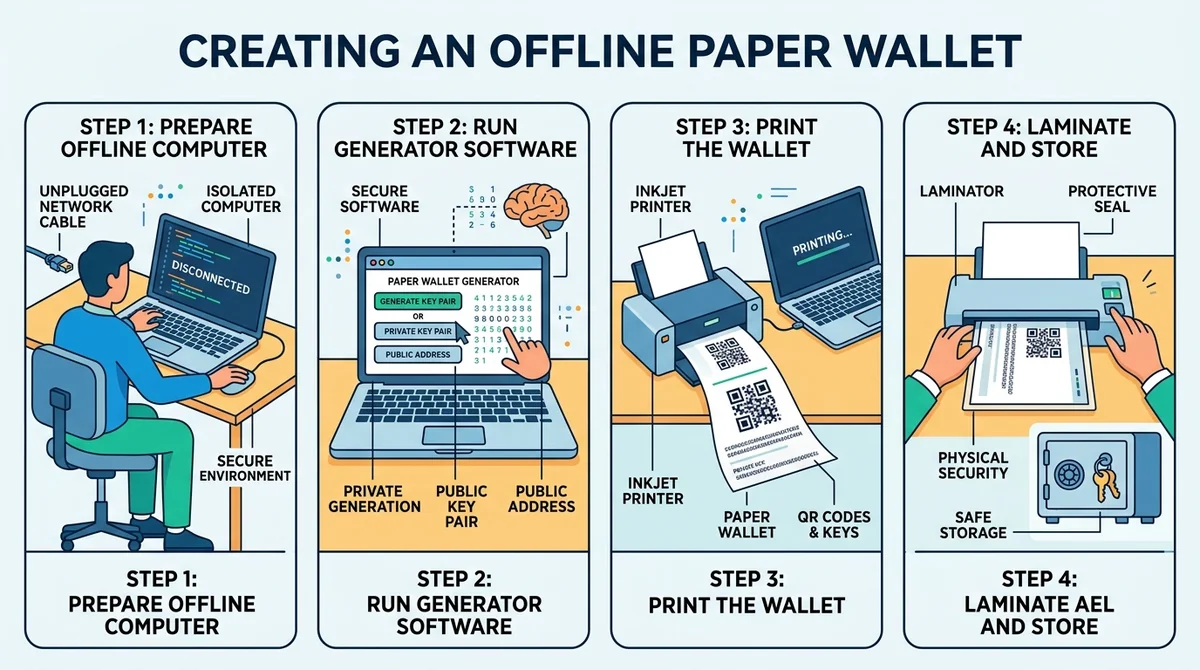
When generating a paper wallet, the device must be completely offline to prevent the private key from being stolen during generation. The usual practice is to run an open-source tool on a non-networked computer and print the result directly.
#why use a cold wallet
A cold wallet is a general term for all private key storage methods that are not connected to the internet. It covers a wide range, and a paper wallet is only one of them; it also includes hardware wallets, offline phones, and more. Because it is isolated from the network, hackers find it difficult to launch remote attacks.
In other words: a cold wallet is like locking cash in a safe at home rather than carrying it around in your pocket.
Common cold wallet forms include:
- Paper wallet: private key printed on a physical medium
- Hardware wallet: a dedicated encrypted device shaped like a USB drive
- Offline phone: an old phone used exclusively for storage and never connected to the internet
#What is the difference between a paper wallet and a cold wallet?
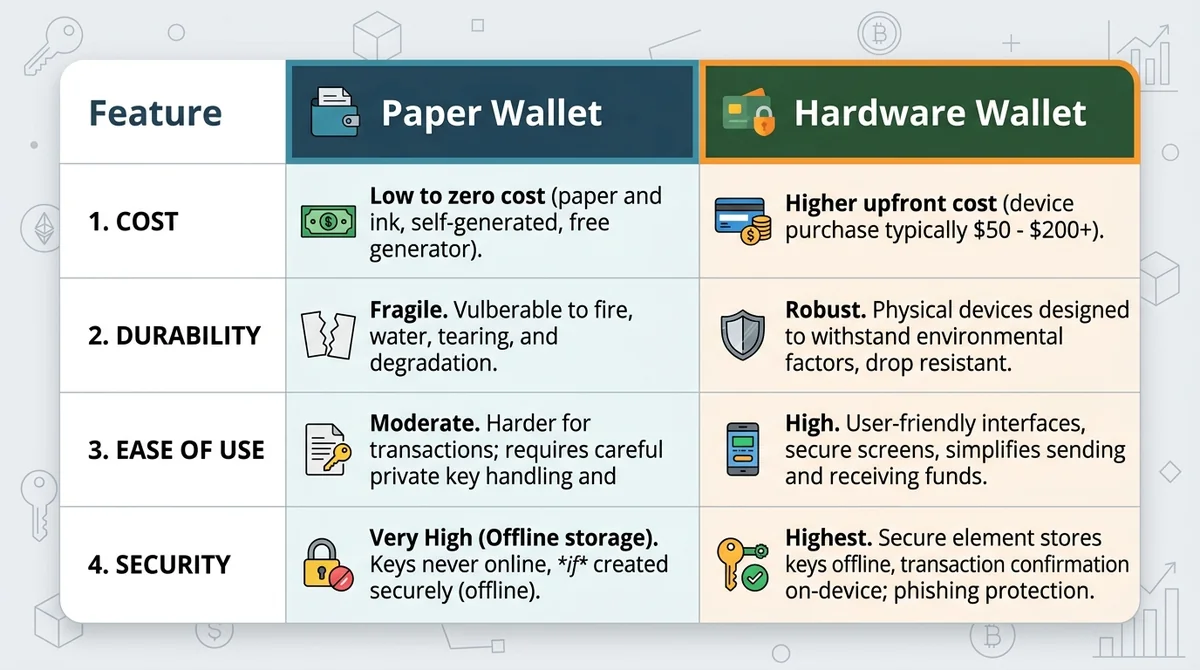
A paper wallet is a subset of a cold wallet. Cold wallets also include hardware wallets and other forms. The differences mainly lie in security and convenience.
Security: A paper wallet has very low physical strength; it smears when wet, burns in fire, and is easily damaged by folding. A hardware wallet has built-in chip protection and is more resistant to damage.
Convenience: To transfer funds from a paper wallet, you need to manually enter the private key, which is cumbersome and prone to exposure. A hardware wallet can be used by simply connecting it to a computer and can manage multiple cryptocurrencies at once.
Long-term storage: A paper wallet costs almost nothing and is suitable for long-term storage. However, it requires careful storage conditions; it is best to laminate it and keep it away from water and fire. A hardware wallet is slightly more expensive but more convenient for daily use.
| Comparison | Paper wallet | Hardware wallet |
|---|---|---|
| Cost | Almost zero | A few hundred yuan |
| Durability | Poor, easily damaged | Good, drop and water resistant |
| Ease of use | Transfer is cumbersome | Plug and play |
| Security | Offline but physically fragile | Offline and chip-encrypted |
#What are the risks of using a paper wallet?
The most prominent hidden danger of a paper wallet is physical damage. The writing becomes blurred when the paper gets damp, and it turns to ashes in a fire.
Operational risk: If you import the private key to transfer funds while online, a Trojan program may intercept it. Once the private key is leaked, your assets are as good as handed over.
Irreversibility: Losing the private key means your assets are permanently locked, and no institution can help you recover them.
Risk warning: This article is for educational purposes only and does not constitute investment advice. Digital assets are highly volatile; always exercise caution when operating.
#How to create a paper wallet safely
- Prepare a clean computer and disconnect it completely from the network.
- Obtain a trusted open-source paper wallet generator (e.g., bitaddress.org).
- Generate the paper wallet in an offline environment and print it directly.
- Laminate the paper wallet and store it in a fireproof, waterproof, and loss-proof location.
- When transferring funds, use a clean device to scan the private key, and immediately empty the assets from the paper wallet after completion.
⚠️ Digital assets carry high risks. It is recommended to start with a small amount to familiarize yourself with the process.
#FAQ
Which is better: paper wallet or hardware wallet?
A hardware wallet is generally superior in security and convenience. A paper wallet wins on low cost but is physically fragile. Beginners are advised to consider a hardware wallet first.
Can a paper wallet be used for long-term storage?
Yes, but only if stored properly. You need to laminate it, protect it from fire, water, and loss, and ideally keep multiple backups.
What should I do if I lose my paper wallet?
Once the private key is lost, the assets cannot be recovered. Therefore, always back up in advance, or switch to a hardware wallet to reduce risk.
FAQ
Which is better: paper wallet or hardware wallet?
A hardware wallet is usually safer and more convenient. A paper wallet costs less but is easily damaged. Beginners are advised to start with a hardware wallet.
Can a paper wallet be used for long-term storage?
Yes, but it must be stored properly. Laminate it, protect it from fire, water, and loss. It is recommended to keep multiple backups.
What should I do if I lose my paper wallet?
If the private key is lost, the assets cannot be recovered. So be sure to back up, or use a hardware wallet.
Want to see the real data for this concept?
After you sign up, you can view live prices, funding rates, and fees for the related assets.
View live prices and fees →