Spot vs Perpetual Futures: Key Differences
Spot trading buys assets directly with no leverage or expiry. Perpetual futures are leveraged derivatives with long/short. Learn the differences and funding rates.
Spot trading involves directly buying and selling assets, with no leverage and no expiry date. Perpetual futures are leveraged derivatives that allow both long and short positions.
#What Are the Core Differences Between Spot and Perpetual Futures?
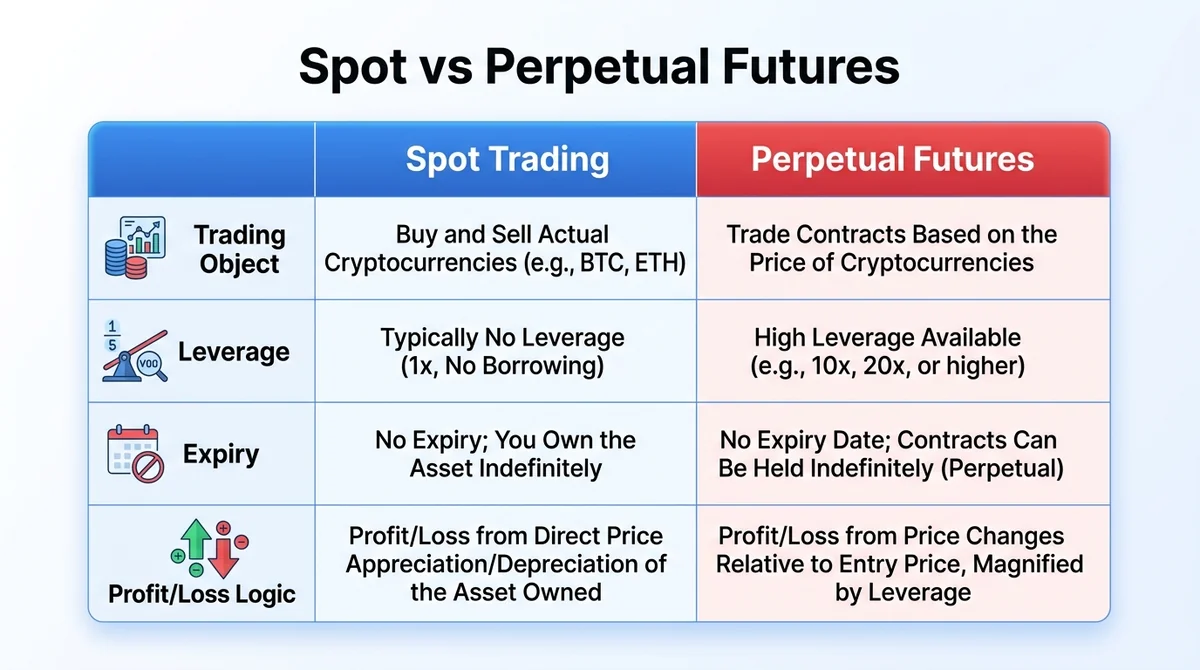
Trading Object: Spot trading involves real assets; once you buy, the asset belongs to you. Perpetual futures are derivative contracts; you do not actually hold the underlying asset.
Leverage and Expiry: Spot has neither leverage nor expiry. Perpetual futures offer perpetual futures leverage, which magnifies profits and losses, but also have no expiry date.
Profit and Loss Logic: Spot can only go long; you profit only when prices rise. Perpetual futures support both long and short positions, allowing profit opportunities in both rising and falling markets.
For example: Spot trading is like buying a house directly, with the property registered in your name. Perpetual futures are like signing a price bet agreement, wagering on the direction of housing prices without actually purchasing the property.
#What Is the Funding Rate in Perpetual Futures?
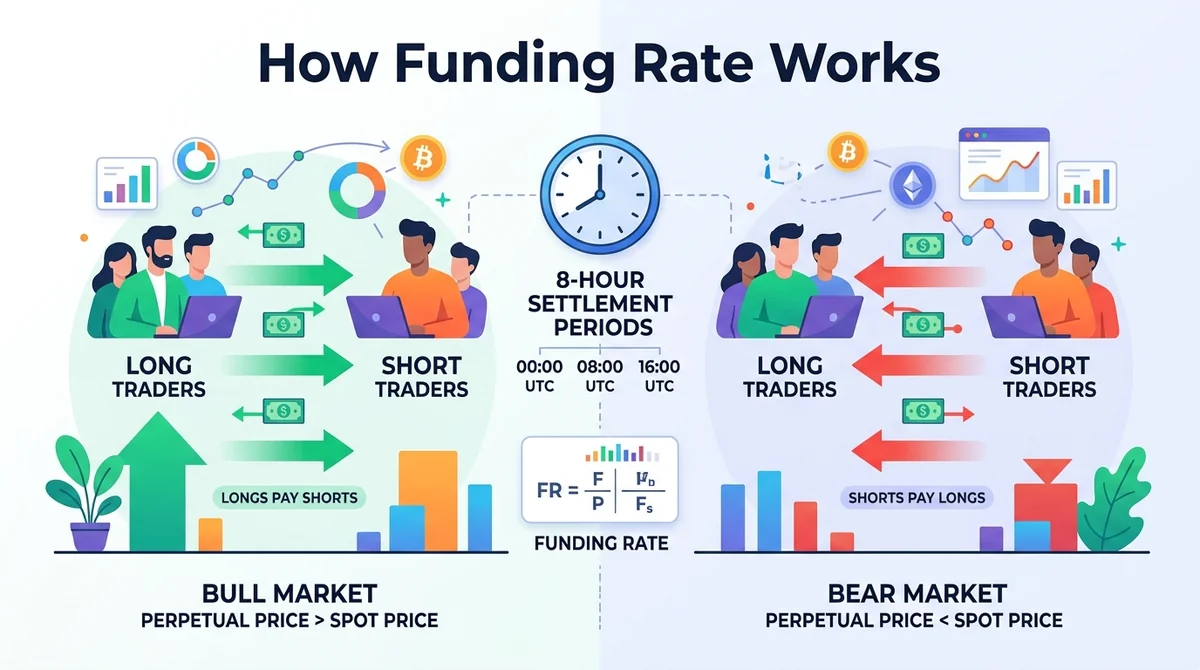
How does perpetual futures funding rate work? It is a periodic payment exchanged between long and short traders in perpetual futures.
This fee is determined by market supply and demand. When long positions exceed short positions, longs pay shorts. This mechanism pushes the contract price closer to the spot price.
The funding rate is typically settled every 8 hours.
Think of it this way: the funding rate is like the balancing cost when there is an imbalance in capital supply and demand. When more people borrow money, the cost of borrowing naturally increases.
#What Is the Difference Between Delivery Futures and Perpetual Futures?
Delivery futures have a fixed expiry date and must be settled at expiry. Perpetual futures have no expiry date and can be held indefinitely.
Delivery futures rely on settlement at expiry to anchor the price. Perpetual futures use the perpetual futures funding rate settlement schedule to keep the price close to spot.
| Feature | Delivery Futures | Perpetual Futures |
|---|---|---|
| Expiry | Fixed date | None |
| Settlement | Forced at expiry | Can be held long-term |
| Price Anchor | Settlement at expiry | Funding rate |
#What Risks Should You Be Aware of Before Using Perpetual Futures?
Perpetual futures leverage magnifies losses and can lead to liquidation.
Leverage is a double-edged sword. It amplifies gains but equally magnifies losses.
A slight adverse price movement can trigger liquidation, meaning forced closure of your position by the system.
Beginners must start with small positions to understand the mechanism before gradually increasing size.
⚠️ Digital assets carry high risk; please start with a small position to test the waters.
#Should Beginners Start with Spot or Go Straight to Perpetual Futures?
Spot trading has relatively lower risk and is more suitable for beginners to get familiar with market rhythms.
Perpetual futures are more suitable for traders with some experience who can tolerate higher risk.
It is not recommended for beginners to use leverage right away.
Steps:
- Choose a platform that supports spot trading.
- Register an account and complete identity verification.
- Start with a small spot purchase to experience the real trading environment.
- Once familiar with price fluctuation patterns, learn about futures-related knowledge.
- If you decide to try futures, be sure to keep positions small.
This article covers conceptual explanations only; when ready to trade, you can check the live tools on the main site MSX.
#FAQ
#What is the difference between spot and perpetual futures?
Spot is direct buying and selling of assets, with no leverage, no expiry, and long-only. Perpetual futures are leveraged derivative contracts with no expiry, allowing both long and short.
#What is the funding rate?
The funding rate is a periodic payment exchanged between long and short traders in perpetual futures, designed to keep the contract price close to the spot price, usually settled every 8 hours.
#What is the difference between delivery futures and perpetual futures?
Delivery futures have a fixed expiry date and forced settlement at expiry; perpetual futures have no expiry, can be held long-term, and use the funding rate to anchor the price.
#Should beginners start with spot or perpetual futures?
Beginners should usually start with spot to understand basic market operations. Perpetual futures involve leverage and higher risk, more suitable for experienced traders.
#What are the risks of perpetual futures?
Perpetual futures involve leverage, which magnifies profits and losses; adverse price movements can lead to liquidation. Beginners should start with small positions to understand the mechanics and avoid liquidation risk.
#What are perpetual futures?
Perpetual futures are derivative contracts with no expiry date, allowing traders to use leverage to go long or short on the underlying asset, and using a funding rate mechanism to keep the contract price close to the spot price.
#How is the funding rate calculated?
The SOLUSDT perpetual futures funding rate calculation involves factors like market premium and interest rates, typically adjusted dynamically by exchanges based on long/short position ratios, settled every 8 hours.
FAQ
What is the difference between spot and perpetual futures?
Spot is direct buying and selling of assets, with no leverage, no expiry, and long-only. Perpetual futures are leveraged derivative contracts with no expiry, allowing both long and short.
What is the funding rate?
The funding rate is a periodic payment exchanged between long and short traders in perpetual futures, designed to keep the contract price close to the spot price, usually settled every 8 hours.
What is the difference between delivery futures and perpetual futures?
Delivery futures have a fixed expiry date and forced settlement at expiry; perpetual futures have no expiry, can be held long-term, and use the funding rate to anchor the price.
Should beginners start with spot or perpetual futures?
Beginners should usually start with spot to understand basic market operations. Perpetual futures involve leverage and higher risk, more suitable for experienced traders.
What are the risks of perpetual futures?
Perpetual futures involve leverage, which magnifies profits and losses; adverse price movements can lead to liquidation. Beginners should start with small positions to understand the mechanics and avoid liquidation risk.
Related Terms
Want to see the real data for this concept?
After you sign up, you can view live prices, funding rates, and fees for the related assets.
View live prices and fees →