What Is a Digital Asset Account? A Beginner's Guide to Opening and Securing One
A digital asset account is your personal account on a trading platform, recording balances and trade history while the platform holds custody. Learn account structure, sign-up steps, common pitfalls and security settings. Not investment advice.
Answer: A digital asset account is your personal account on a trading platform, used to record how many assets you hold and which trades you have made. In most cases the assets are held by the platform on your behalf, and the private keys are not in your hands.
#What is a digital asset account?
Think of it as a "locker number" you open at a trading platform: the platform keeps the books on what goes in, what comes out, and how much is inside.
What the account actually stores: usually not the coins themselves, but a balance record and a transaction history.
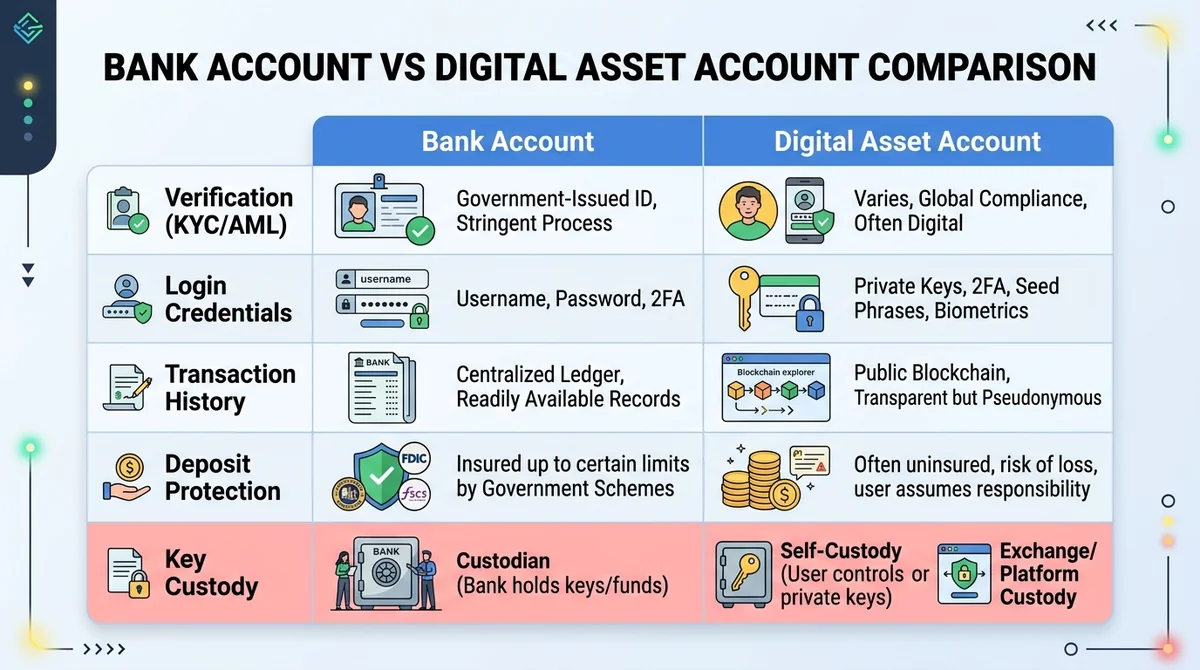
Similarities to a bank account: both generally require real-name verification, both have an account ID and password, and both let you review your transaction history.
Differences: a bank account is backed by fiat deposits and, in most jurisdictions, protected by schemes such as deposit insurance; a digital asset account is usually held in platform custody and generally has no equivalent protection. The exact scope of protection varies by platform and jurisdiction and depends on platform disclosures and local regulations.
It is not the same as a self-custody wallet: with a wallet, the private keys are in your own hands; with a custodial account, the platform controls the private keys. If the platform runs into operational or security problems, the assets in your account may be affected. To understand the logic of self-managed private keys, see What is a non-custodial wallet.
#What does a digital asset account usually include?
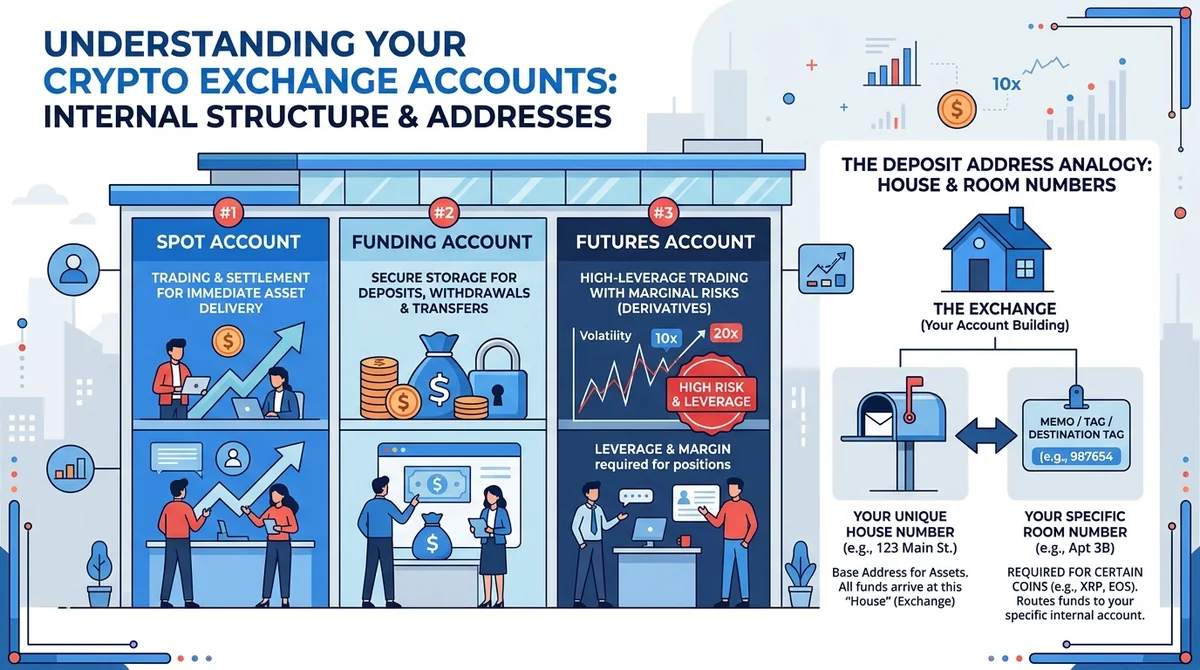
Most platforms split the account into several sub-accounts by purpose, and funds can be transferred between them.
- Spot account: used for buying and selling and for recording the assets you actually hold, usually without perpetual futures leverage.
- Funding account: geared toward "storage", often used for transfers and similar operations.
- Futures account: a margin account for derivatives trading, with perpetual futures leverage and higher risk.
- Deposit address and tag: the address is the "street number" for receiving coins, and the tag lets the platform identify whose asset it is.
Analogy: a building is divided into several rooms; the address is the building number and the tag is the room number. For some coins, all users share one deposit address, and if the tag is wrong or missing, the asset may not be credited automatically. For the concept of addresses, see What is a crypto address.
#How do you open a digital asset account?
- Prepare an email address or phone number, plus your own ID documents.
- Enter the registration page from the official domain and set a strong, unique password.
- Complete identity verification as prompted; common forms include photographing your ID and a liveness check.
- Turn on two-factor authentication first, then consider depositing funds.
- Deposit a small amount and try one withdrawal to verify the process works.
⚠️ Digital asset prices are highly volatile, and custodial accounts carry platform risk. Test with small amounts first and do not transfer a large sum all at once. This article explains concepts only and is not investment advice.
#What pitfalls do beginners hit when they open account?
Lending out your account: handing your account to someone else to operate usually violates platform rules and may be used for money laundering or other illegal activity, with responsibility potentially falling on you.
High-yield promises: anyone promising "guaranteed profits" or "capital-protected high interest" is basically a scam signal.
A single large deposit: putting in a large sum before verifying the process makes recovery difficult if something goes wrong. Run the full flow with a small amount first.
#How do you protect your account after opening it?
- Turn on two-factor authentication: when your password leaks, it is the last lock.
- Check the official domain: phishing sites and the real site can look nearly identical, so bookmarking the official entry point is safer.
- Never share verification codes: customer service, friends, or anyone asking for a code should be treated as a scam.
- Use a unique password: do not reuse the password from your email or social accounts.
Account security is essentially about "who can prove it is you". Platform custody means you also bear platform risk; see What is proof of reserves to learn how to assess platform transparency. Note that holding assets on a platform may involve a custody fee.
This article explains concepts only and is not investment advice.
FAQ
What is the difference between a digital asset account and a wallet?
The core difference is who controls the private keys. A digital asset account is usually held in platform custody, the private keys are with the platform, and you log in with an account ID and password; with a wallet, you control the private keys or seed phrase yourself, and the assets are recorded directly on-chain. Accounts are convenient but carry platform risk, while wallets are more self-sovereign, though a lost private key usually cannot be recovered.
What information do I need to open a digital asset account?
You generally need an email address or phone number, a password, and completion of identity verification as required by the platform, commonly including photographing your ID and a liveness check. Some platforms also ask for additional address or source-of-funds information, depending on platform prompts and local regulations.
What is the difference between a spot account and a futures account?
A spot account is used for buying and selling and records the assets you actually hold, usually without perpetual futures leverage; a futures account is used for derivatives trading, requires margin, and involves perpetual futures leverage, so losses can exceed expectations. Beginners should get familiar with the spot account before considering futures.
Why do I need to fill in a tag when depositing?
For some coins, all users share one deposit address, and the platform uses the tag to distinguish which user the asset belongs to. If the tag is wrong or missing, the asset may not be credited automatically, and you usually need to contact customer service for manual handling, which takes longer.
What should I do first after opening an account?
Complete your security settings first: turn on two-factor authentication, confirm the official login entry point, and set up protections such as a withdrawal whitelist where the platform supports it. After that, deposit a small amount and try one withdrawal; once the whole flow is verified, consider increasing the amount.
Related Terms
Want to see the real data for this concept?
After you sign up, you can view live prices, funding rates, and fees for the related assets.
View live prices and fees →