What is a long position
A long position is a bullish bet that profits from price gains. Learn long vs short, how crypto going long and short works, PnL, risks, and tips for beginners.
Answer: A long position is a bullish position built on the expectation that an asset's price will rise, with profit coming from the difference between the buy price and the sell price.
#What is a long position?
A long position means you expect an asset's price to rise, so you open a position in the bullish direction.
Ignoring leverage and trading costs, profit = (sell price − buy price) × position size.
Analogy: It's like buying goods wholesale at a low price and reselling them once the price is higher.
Is going long always the same as buying? Not necessarily. Spot long positions usually take the form of buying and holding the asset; a contract long uses margin to build a bullish position and does not actually hold the underlying asset. Both bet on a price increase, but the mechanics and risks differ.
#What is a short position? How does it differ from a long position?
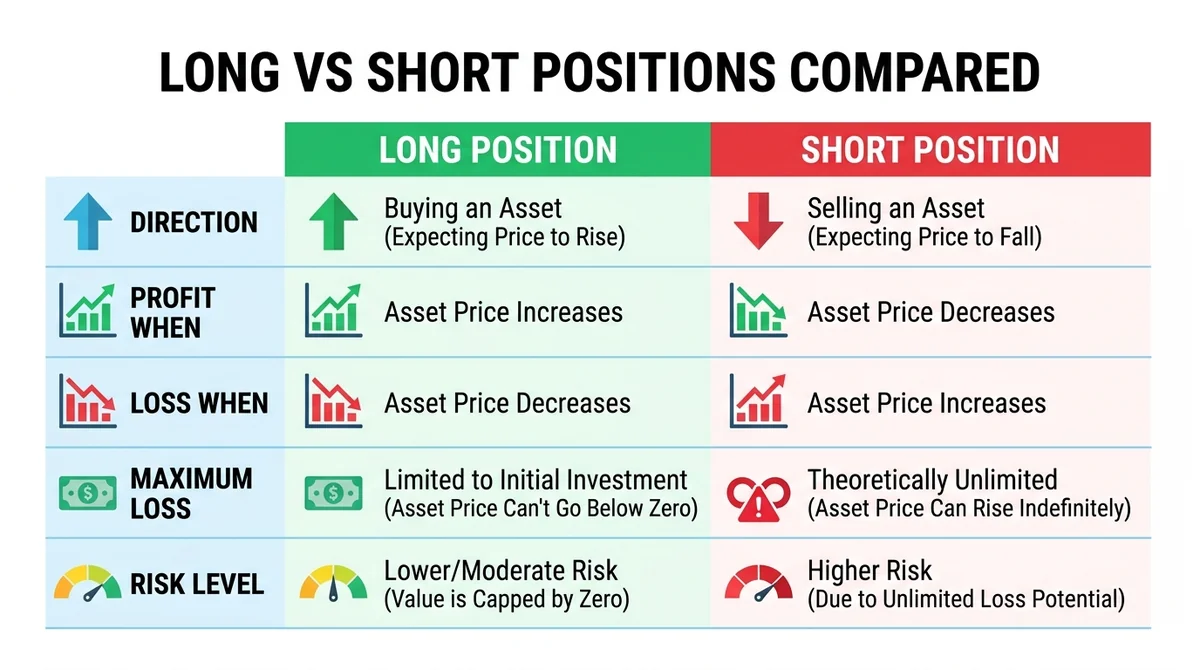
A short position is the opposite direction: a bearish position built on the expectation that the price will fall, profiting when the price drops and losing when it rises.
- Long: price rises → profit, price falls → loss.
- Short: price falls → profit, price rises → loss.
Analogy: Going long is like stockpiling goods and waiting for the price to rise; going short is like borrowing an asset, selling it, then buying it back later to return it once the price has fallen.
The two point in opposite directions and have different risk structures: the maximum loss on a spot long is the capital invested, while a short (especially a leveraged contract short) can theoretically see losses keep growing as the price rises.
#Which is riskier, going long or going short?
The maximum loss on a spot long is your principal, while a leveraged short can theoretically see losses expand as the price rises, so the latter is usually riskier.
Specifically, the risk difference comes down to three points: first, the loss boundary—a spot long can lose at most the capital invested and will not go into debt; second, price direction—there is theoretically no upper limit to how high an asset's price can rise, so a short's potential loss is also theoretically unlimited; third, leverage stacking—perpetual futures leverage magnifies losses proportionally and can trigger forced liquidation. For beginners, understanding how spot longs work before considering leveraged short positions is the safer learning order.
#How are long and short positions implemented in crypto markets?
In the spot market, buying creates long exposure; spot trading generally cannot be used to short directly.
To short or to trade in both directions with leverage, traders usually use contract-style tools such as perpetual futures.
Leverage magnifies profit and loss proportionally: the higher the leverage, the faster margin is consumed when the price moves against you. Specific multiples, margin requirements, and liquidation rules vary by platform—always refer to the public rules of the platform you use.
Margin determines how much volatility a position can absorb: the smaller the margin relative to the position, the more easily it is forcibly liquidated.
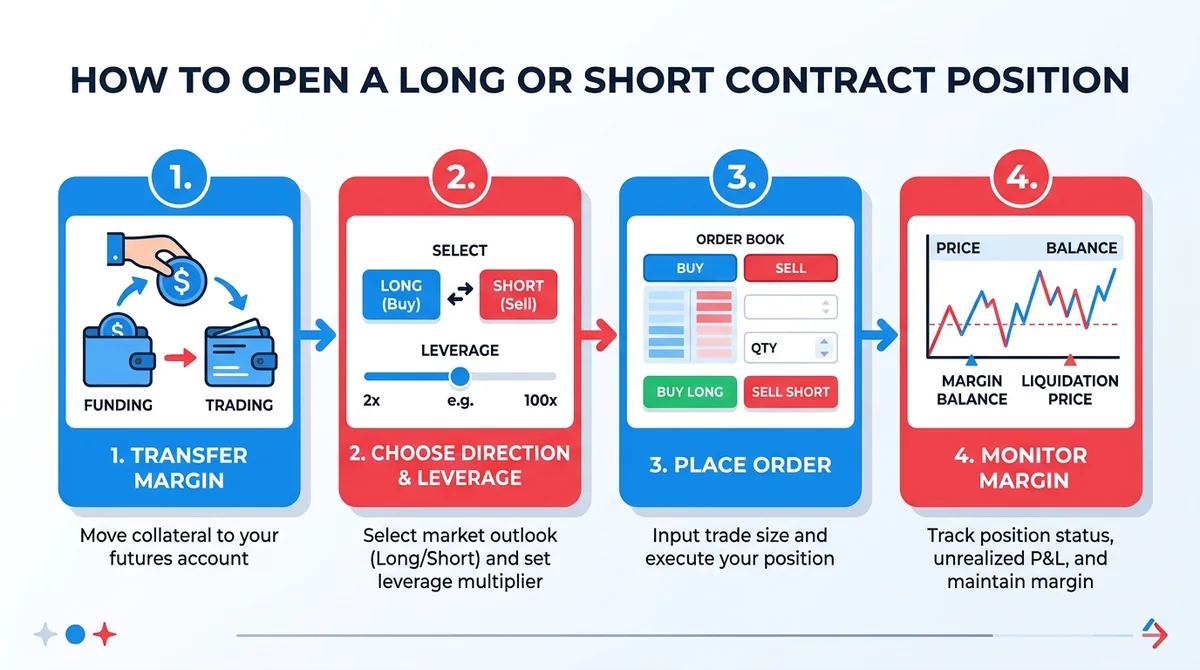
In terms of the operational path, opening a contract long or short position usually involves several steps: first transfer margin into your contract account, then choose a direction (long or short) and a leverage multiple, then place an order to open the position; while holding, you need to monitor your margin level—if adverse price moves leave insufficient margin, the platform will execute forced liquidation according to its public rules. Platforms differ in margin modes and liquidation processes, so read the platform's public rules before trading.
#How is profit and loss calculated for long and short positions?
Profit and loss for long and short positions equals the price difference multiplied by position size (before deducting fees and other trading costs); with leverage, profit and loss are magnified proportionally, and contract positions are forcibly liquidated when margin is insufficient.
Without leverage: PnL = price difference × position size (before deducting fees and other trading costs).
With leverage, gains and losses are magnified proportionally.
If a contract position has insufficient margin, it will be forcibly liquidated and losses may exceed the principal; a spot long can lose at most the capital invested and will not go into debt.
#What risks should beginners watch for with long and short positions?
- Leverage speeds up losses and is especially dangerous for beginners.
- Don't choose a direction based only on short-term price moves; short-term price action is hard to predict.
- Start with small amounts or simulation to understand the mechanics before scaling up. You can continue learning about the difference between contracts and spot in the MSX Learn beginner tutorials.
⚠️ Digital asset prices are highly volatile. This article explains concepts only and does not constitute investment advice.
#Further reading
- Long vs short comparison
- Short position glossary entry
#FAQ
What is a long position in simple terms?
A long position is a position that profits when an asset's price rises. In crypto spot trading, buying and holding is the simplest form of going long; in contracts, a long is built with margin and does not involve holding the asset itself.
What is a short position and how does it differ from a long position?
A long position is bullish and profits when the price rises; a short position is bearish and profits when the price falls. The two point in opposite directions and have different risk structures: the maximum loss on a spot long is the principal, while a leveraged short can theoretically see losses expand as the price rises.
How do you short in crypto markets?
Spot markets generally cannot be shorted directly; shorting is usually done through contract-style tools such as perpetual futures. Contracts let you build bearish positions with margin, but perpetual futures leverage magnifies losses and carries higher risk.
How does leverage affect PnL on long and short positions?
Leverage magnifies both gains and losses proportionally. The higher the leverage, the faster margin is consumed when the price moves against you, and the more likely a forced liquidation becomes. Specific multiples and liquidation rules vary by platform, so beginners should use leverage cautiously.
Is going long always the same as buying?
Not necessarily. A spot long usually means buying and holding the asset; a contract long uses margin to build a bullish position and does not actually hold the asset. Both bet on a price increase, but the mechanics and risks differ.
Which is riskier, going long or going short?
The maximum loss on a spot long is the principal, while a leveraged short can theoretically see losses expand as the price rises, so the latter is usually riskier. Beginners should understand how spot longs work before considering leveraged short positions.
FAQ
What is a long position in simple terms?
A long position is a position that profits when an asset's price rises. In crypto spot trading, buying and holding is the simplest form of going long; in contracts, a long is built with margin and does not involve holding the asset itself.
What is the difference between going long and going short?
A long position is bullish and profits when the price rises; a short position is bearish and profits when the price falls. The two point in opposite directions and have different risk structures: the maximum loss on a spot long is the principal, while a leveraged short can theoretically see losses expand as the price rises.
How do you short in crypto markets?
Spot markets generally cannot be shorted directly; shorting is usually done through contract-style tools such as perpetual futures. Contracts let you build bearish positions with margin, but perpetual futures leverage magnifies losses and carries higher risk.
How does leverage affect PnL on long and short positions?
Leverage magnifies both gains and losses proportionally. The higher the leverage, the faster margin is consumed when the price moves against you, and the more likely a forced liquidation becomes. Specific multiples and liquidation rules vary by platform, so beginners should use leverage cautiously.
Is going long always the same as buying?
Not necessarily. A spot long usually means buying and holding the asset; a contract long uses margin to build a bullish position and does not actually hold the asset. Both bet on a price increase, but the mechanics and risks differ.
Related Terms
Want to see the real data for this concept?
After you sign up, you can view live prices, funding rates, and fees for the related assets.
View live prices and fees →