What is a Security Token?
Security tokens are digital tokens representing ownership or income rights in real assets, regulated by securities laws. Learn the differences from utility tokens, issuance, trading, and risks.
Answer: A security token is a digital token that represents ownership or income rights in real assets such as stocks, bonds, or real estate. Its issuance and trading are subject to securities regulations.
#What Is a Security Token?
A security token is like a digital version of a stock or bond. Holding it means you own a fraction of the rights to an underlying real asset. For example, if a real estate project issues tokens, buying a token is equivalent to holding a small share of that property.
Analogy: Traditional stocks are paper certificates of equity; security tokens are equity certificates on the blockchain, just in digital form for convenient trading on compliant platforms.
#How Do Security Tokens Differ from Regular Cryptocurrencies?
Regular cryptocurrencies (like Bitcoin) are mainly used for payment or as a store of value and do not represent company equity or income by themselves. Security tokens are backed by real assets, and their value is linked to the performance of those assets.
#Why Are They Called "Securities"?
Because they meet the legal definition of a security: investors contribute money with the expectation of profit derived from the efforts of others. Therefore, regulators treat them as securities, and issuers must comply with securities laws.
#What Is the Difference Between Security Tokens and Utility Tokens?
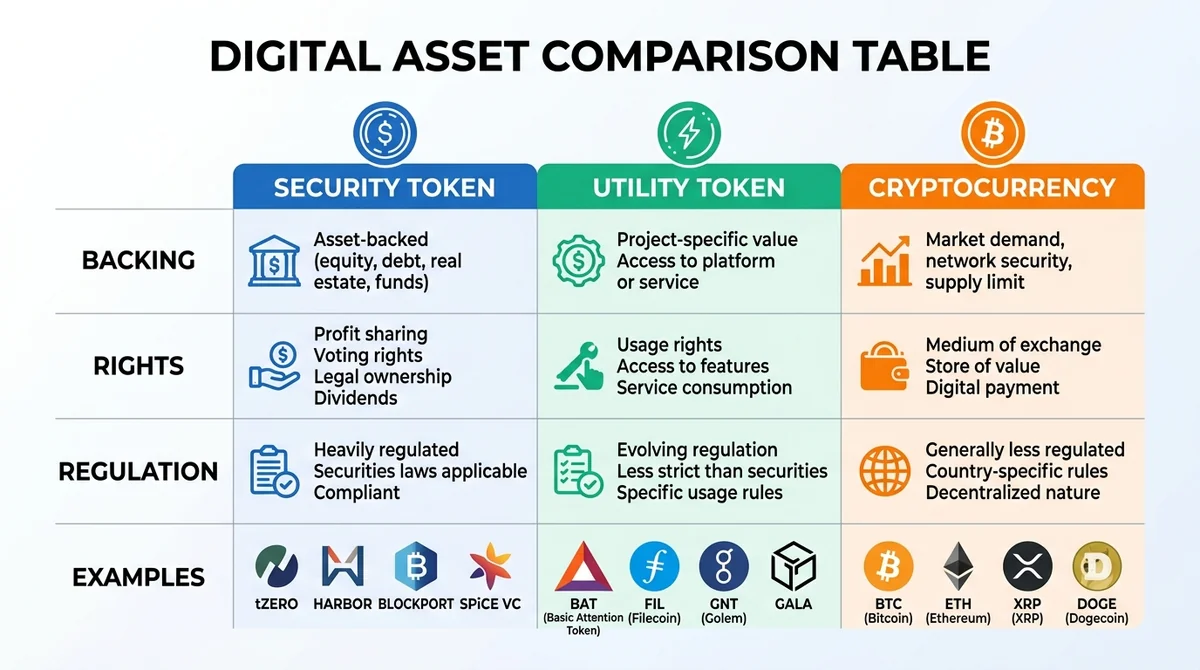
Utility tokens give you the right to use a product or service, such as accessing a platform's features. Security tokens give you investment rights, such as dividends or asset appreciation.
How to Determine Whether a Token Is a Security or Utility Token?
Usually, the Howey Test is used. If it satisfies "investment of money, common enterprise, expectation of profit, and profit derived from the efforts of others," it is likely to be deemed a security.
Can Utility Tokens Also Be Deemed Securities?
Yes. If a utility token is marketed as having appreciation potential or investment returns, even if it originally has a use, it may be deemed a security by regulators.
#How Are Security Tokens Issued and Traded?

Issuing security tokens requires passing compliance checks first. It may involve registering with regulators or applying for exemptions. Then the tokens can be listed on compliant digital asset platforms or exchanges.
What Compliance Steps Are Needed to Issue Security Tokens?
Typically, this includes legal review, determining the issuance structure, registration or exemption application, and investor suitability verification. Each step must comply with local securities laws.
Where Can Security Tokens Be Traded?
They can only be traded on licensed or compliant platforms, and many platforms are open only to accredited investors. Liquidity is lower than that of regular cryptocurrencies.
#What Are the Risks of Investing in Security Tokens?
Underlying Asset Risk: If the underlying company or property performs poorly, the token value will decline.
Liquidity Risk: Security token trading platforms are few and buyers are scarce, so it may be difficult to sell when you want to.
Compliance and Fraud Risk: The project may be non-compliant or simply a scam.
How to Avoid Security Token Scams?
Choose only projects with compliance filings and transparent information. Do not trust high-yield promises. Verify the issuer's registration information yourself.
⚠️ Digital assets carry risks; start with a small position. This article is for educational purposes only and does not constitute investment advice.
#Frequently Asked Questions About Security Tokens
#What Is the Difference Between Security Tokens and Utility Tokens?
Security tokens represent investment rights and are regulated by securities laws; utility tokens provide access to a product or service. However, if a utility token has investment characteristics, it may also be deemed a security.
#How to Determine Whether a Token Is a Security Token?
Usually, the Howey Test is used: if it involves an investment of money, a common enterprise, an expectation of profit, and profit derived from the efforts of others, it is likely to be deemed a security token.
#Can Security Tokens Be Traded on Regular Cryptocurrency Exchanges?
Generally, no. Security tokens need to be traded on compliant digital asset platforms or licensed exchanges, and they are typically open only to accredited investors.
#What Are the Main Risks of Investing in Security Tokens?
The main risks include fluctuations in the value of the underlying asset, insufficient liquidity, regulatory changes, and fraud risk. Investors need to fully understand the project and assess their own risk tolerance.
#What Compliance Steps Are Required to Issue Security Tokens?
Issuance typically requires legal review, determining the issuance structure, registering with regulators or applying for exemptions, and conducting investor suitability verification.
#What Are the Similarities and Differences Between Security Tokens and Stocks?
Both security tokens and stocks represent ownership or income rights, but security tokens are based on blockchain, enabling more efficient and lower-cost transfer and fractionalization. However, the regulatory framework for security tokens is still evolving, and investors should be aware of compliance risks.
#Which Investors Are Suitable for Security Tokens?
Security tokens are usually aimed at accredited or institutional investors because compliance requirements are higher and liquidity is lower. If ordinary investors want to participate, they need to fully understand the risks and choose compliant platforms.
#What Is the Future Trend of Security Tokens?
As the regulatory framework gradually improves, security tokens are expected to increase the liquidity and accessibility of traditional assets. But in the short term, the market is still in its early stages, and investors should remain cautious.
This article is provided by MSX Learn for educational purposes only and does not constitute investment advice.
FAQ
What is the difference between security tokens and utility tokens?
Security tokens represent investment rights and are regulated by securities laws; utility tokens provide access to a product or service. However, if a utility token has investment characteristics, it may also be deemed a security.
How to determine whether a token is a security token?
Usually, the Howey Test is used: if it involves an investment of money, a common enterprise, an expectation of profit, and profit derived from the efforts of others, it is likely to be deemed a security token.
Can security tokens be traded on regular cryptocurrency exchanges?
Generally, no. Security tokens need to be traded on compliant digital asset platforms or licensed exchanges, and they are typically open only to accredited investors.
What are the main risks of investing in security tokens?
The main risks include fluctuations in the value of the underlying asset, insufficient liquidity, regulatory changes, and fraud risk. Investors need to fully understand the project and assess their own risk tolerance.
What compliance steps are required to issue security tokens?
Issuance typically requires legal review, determining the issuance structure, registering with regulators or applying for exemptions, and conducting investor suitability verification.
Related Terms
Want to see the real data for this concept?
After you sign up, you can view live prices, funding rates, and fees for the related assets.
View live prices and fees →