What Is a Tokenized Stock Perpetual?
A tokenized stock perpetual is a no-expiry derivative that tracks tokenized stock spot prices via funding rates. Learn the mechanics, differences, and risks.
A tokenized stock perpetual is a derivative contract with no expiry date whose price tracks the spot price of tokenized stocks (on-chain representations of traditional stocks).
What is a tokenized stock perpetual? In one sentence: it is a perpetual derivative contract that tracks the spot price of tokenized stocks, has no expiry date, and relies on how does perpetual futures funding rate work to keep its price anchored. Holding a contract position is not the same as holding the stock itself.
#What Is a Tokenized Stock Perpetual?
It consists of two parts: tokenized stocks, i.e., tokens that map traditional stock prices on-chain; and perpetual contracts, i.e., derivative contracts with no expiry date. Combined, they form a perpetual contract that tracks the price of tokenized stocks.
Analogy: a tokenized stock is like a "price tag" recording the stock price, and the perpetual contract is like a "contract" betting around that tag — the contract itself is not the stock.
- Whether the contract trades on-chain or off-chain depends on the specific platform; this article covers concepts only.
- Holding a contract position is not the same as holding the stock, and it carries no shareholder rights (such as dividends and voting rights).
#How Does a Tokenized Stock Perpetual Work?
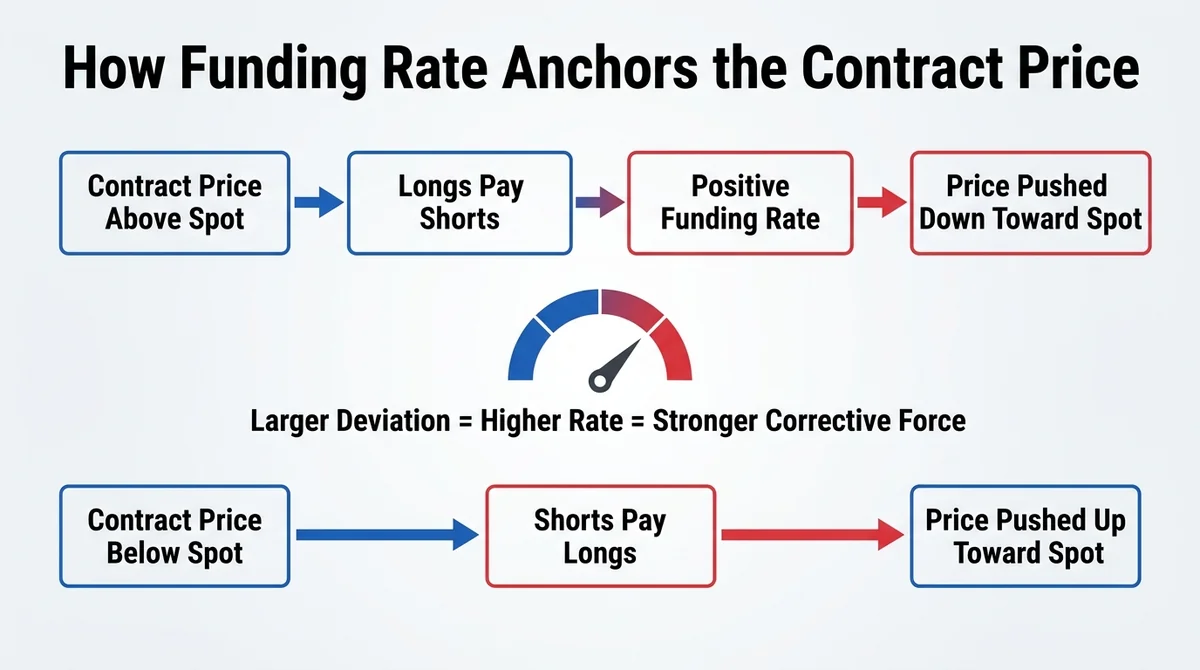
Perpetual contracts anchor to the spot price through how does perpetual futures funding rate work. When the contract price is above spot, longs pay shorts; when the contract price is below spot, shorts pay longs. The larger the deviation, the higher the rate typically is and the stronger the corrective force.
It has no expiry date and does not rely on settlement; instead, it uses the funding rate to pull the contract price back toward spot. The funding rate can be understood as a periodic balancing payment between longs and shorts.
- When the contract price is above spot, longs pay shorts, and the rate is usually positive.
- When the contract price is below spot, shorts pay longs.
- The larger the deviation, the higher the rate typically is and the stronger the corrective force.
In this way, the contract price is gradually pushed toward the spot price of the tokenized stock. Specific rate values, settlement cycles, and perpetual futures leverage caps vary by platform; check the relevant platform's rules before participating.
From a participation-flow perspective, understanding the mechanics can usually be broken into a few steps: first confirm which tokenized stock the underlying corresponds to and where its spot reference comes from; then understand the platform's funding rate settlement cycle and direction rules; then clarify that you are taking on price exposure rather than a stock position; finally assess the ongoing cost of leverage combined with funding rates. This path only helps explain concepts and does not constitute any operational advice.
#What Is the Difference Between a Tokenized Stock Perpetual and Tokenized Stock Spot?
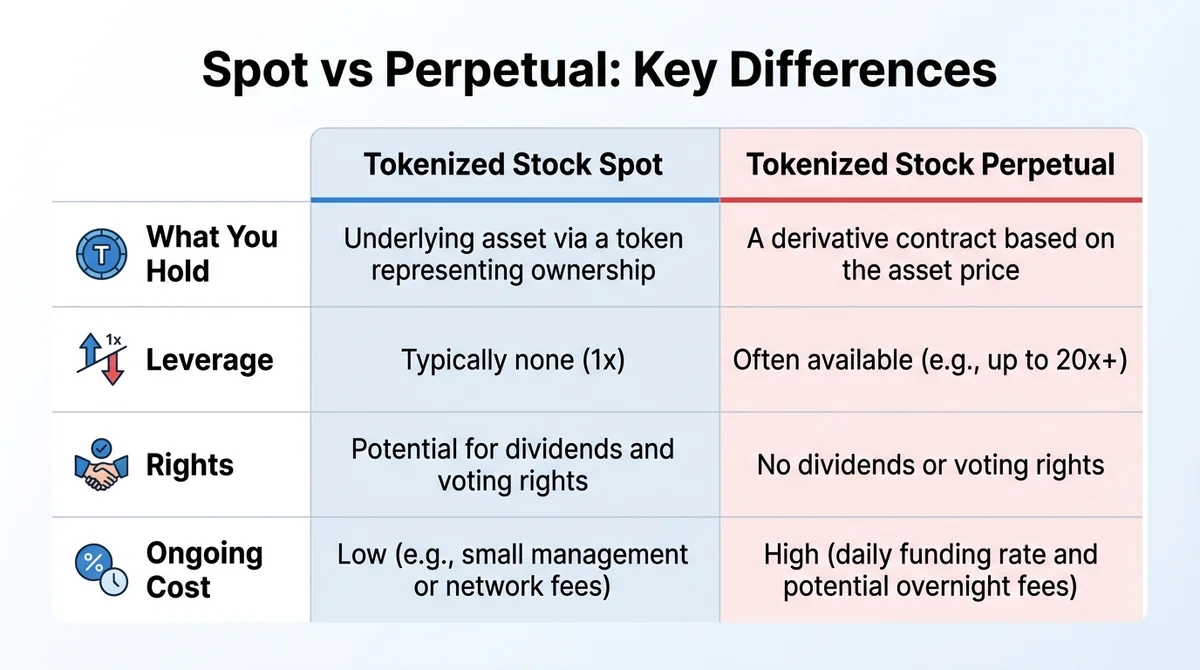
| Dimension | Tokenized Stock Spot | Tokenized Stock Perpetual |
|---|---|---|
| What you hold | Directly hold on-chain stock tokens | Contract exposure to price direction |
| Leverage | Generally none | Usually available with perpetual futures leverage |
| Rights | Not equivalent to traditional shareholder rights | No shareholder rights |
| Ongoing cost | Generally no funding rate | Ongoing funding rate costs |
Neither is equivalent to holding traditional shareholder rights.
If you only care about holding the underlying itself long term, the spot form is closer to the meaning of "holding"; if you care about expressing a view on price direction, the perpetual contract provides exposure with perpetual futures leverage and ongoing costs. This distinction is key to understanding the positioning of the two product types.
#How Is a Tokenized Stock Perpetual Different from a Regular Crypto Perpetual?
The mechanism framework is similar, but the underlying differs: a regular perpetual tracks crypto assets, while a tokenized stock perpetual tracks stock prices. Its price reference comes from the tokenized stock spot market, and stocks have traditional trading hours, which may affect the continuity of the price reference and may also lead to larger price deviations during non-trading hours.
In other words, the funding rate, perpetual futures leverage, and other frameworks can be compared, but the time structure of the underlying market differs — this is the part that requires extra attention with tokenized stock perpetuals.
#How Is a Tokenized Stock Perpetual Different from a CFD?
Both are price-exposure tools without shareholder rights, but their reference underlyings differ: CFDs usually reference quotes from traditional brokers or market makers, while tokenized stock perpetuals reference the spot price of on-chain tokenized stocks. Specific rules, cost structures, and trading hours vary by platform; this article only provides a conceptual distinction and does not compare or recommend any platform.
#What Risks Should You Understand Before Trading a Tokenized Stock Perpetual?
⚠️ Digital assets and derivatives trading involve risk. This article is for conceptual education only and does not constitute investment advice.
- Perpetual futures leverage amplifies losses: leverage magnifies both gains and losses, and losses can come quickly.
- Funding rate costs: holding long term means continuously paying or receiving the funding rate, which is a potential cost.
- Price reference deviation: trading hours or liquidity differences may cause the reference price to deviate.
- No shareholder rights: you do not hold the stock and have no dividends or voting rights.
Beginners should first understand the mechanics on a small scale before deciding whether to participate. To judge whether you understand the mechanics, ask yourself three questions: do you clearly understand the direction and settlement cycle of the funding rate; do you understand that losses are amplified under perpetual futures leverage; and do you accept that you do not hold the stock and have no shareholder rights. Only after you can answer all three clearly should you consider learning more about related products. This article covers concepts only; to learn about product forms on related platforms, you can refer to the product information pages on the main MSX site, and for more concept explanations see MSX Learn. Related concepts can also be found in what PLTR tokenized stock is and spot vs. perpetual futures comparison.
#FAQ
#Is a tokenized stock perpetual a stock?
No. It is a derivative contract whose price tracks the spot price of tokenized stocks, but holding a contract position is not the same as holding the stock, and it carries no dividends, voting rights, or other shareholder rights.
#What anchors the price of a tokenized stock perpetual?
The funding rate. It has no expiry date, and longs and shorts periodically pay each other the funding rate. The direction of the rate reflects the deviation of the contract price from spot, and the deviation is gradually corrected.
#What is the difference between a tokenized stock perpetual and spot?
Spot means directly holding on-chain stock tokens and generally involves no leverage; a perpetual contract is only price exposure, usually available with perpetual futures leverage, and requires ongoing funding rate costs. Neither is equivalent to traditional shareholder rights.
#What are the main risks of a tokenized stock perpetual?
Perpetual futures leverage amplifies losses, long-term holding requires bearing funding rate costs, the price reference may deviate due to trading hours or liquidity, and you do not hold the stock and have no shareholder rights. Beginners should first understand the mechanics on a small scale.
#Is a tokenized stock perpetual safe?
Safety depends on the specific platform's rules, risk controls, and compliance arrangements; this article does not assess the safety of any platform. Conceptually, it carries built-in perpetual futures leverage and funding rate costs, and there is a possibility of price reference deviation, so participants need to assess their own risk tolerance.
#How is the funding rate calculated?
The specific value, settlement cycle, and calculation formula of the funding rate vary by platform, and this article does not provide specific numbers. Conceptually, it reflects the direction of the contract price's deviation from spot; the larger the deviation, the higher the rate typically is, creating a corrective force that pulls the contract price back toward spot.
#What is the difference between a tokenized stock perpetual and a CFD?
Both are price-exposure tools without shareholder rights, but their reference underlyings differ: CFDs usually reference quotes from traditional brokers or market makers, while tokenized stock perpetuals reference the spot price of on-chain tokenized stocks. Specific rules and cost structures vary by platform.
FAQ
Is a tokenized stock perpetual a stock?
No. It is a derivative contract whose price tracks the spot price of tokenized stocks, but holding a contract position is not the same as holding the stock, and it carries no dividends, voting rights, or other shareholder rights.
What anchors the price of a tokenized stock perpetual?
The funding rate. It has no expiry date, and longs and shorts periodically pay each other the funding rate. The direction of the rate reflects the deviation of the contract price from spot, and the deviation is gradually corrected.
What is the difference between a tokenized stock perpetual and spot?
Spot means directly holding on-chain stock tokens and generally involves no leverage; a perpetual contract is only price exposure, usually available with perpetual futures leverage, and requires ongoing funding rate costs. Neither is equivalent to traditional shareholder rights.
What are the main risks of a tokenized stock perpetual?
Perpetual futures leverage amplifies losses, long-term holding requires bearing funding rate costs, the price reference may deviate due to trading hours or liquidity, and you do not hold the stock and have no shareholder rights. Beginners should first understand the mechanics on a small scale.
Related Terms
Want to see the real data for this concept?
After you sign up, you can view live prices, funding rates, and fees for the related assets.
View live prices and fees →