What Is the Double Spending Problem?
Double spending is the risk of spending the same digital asset twice. Learn how bank ledgers and blockchain consensus prevent duplicate payments.
Answer: The double spending problem is the risk that the same digital asset is spent more than once. Digital information can be copied, so a mechanism is needed to confirm that "this asset can only be spent once."
#What Is the Double Spending Problem?
Core idea: The same asset is used more than once.
Suppose you hold a digital balance. In theory, you could send the same amount to two different people at the same time. Without a verification mechanism, both transfers would go through, meaning the same money was spent twice.
Why it happens: Digital information can be copied easily. A photo can be duplicated many times, and so can a string of balance data.
Analogy: It is like a banknote that can be photocopied endlessly. Every copy looks real, and the question is who decides which one counts.
So the key is not "preventing copying" but preventing duplicate accounting — getting the whole network to agree that "this money has already been spent."
#Why Don't Traditional Digital Payments Have an Obvious Double Spending Problem?
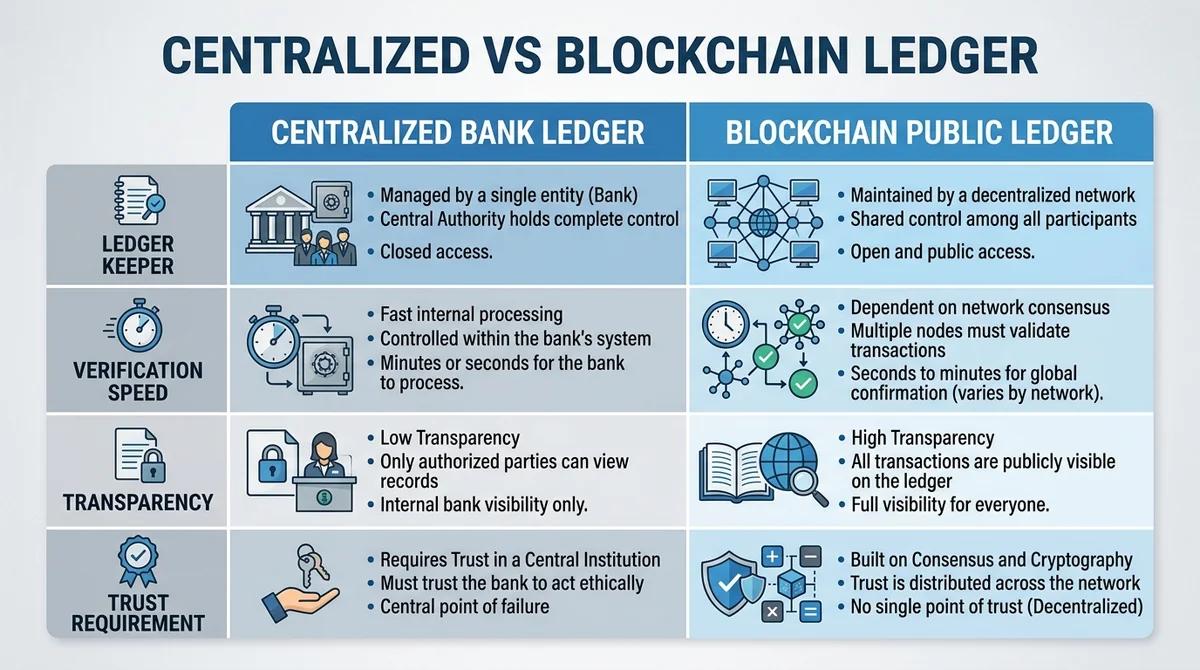
Mechanism: Banks and other centralized institutions keep a single ledger.
When you transfer money, the bank first checks the balance, then deducts it, then credits the recipient's account. The same money cannot be deducted twice because there is only one ledger and one referee.
Advantages:
- Efficient verification
- Errors can be disputed and rolled back
- Users do not need to understand the underlying mechanics
Limitations:
- Relies on trust in the intermediary
- The ledger is not public, so users can only trust that the institution did not make a mistake
- Coordination costs are high across institutions and borders
Analogy: It is like a village with a single accountant keeping all the books. Accounting is fast and disputes are few, but the whole village must trust that accountant.
#How Does Blockchain Solve the Double Spending Problem?
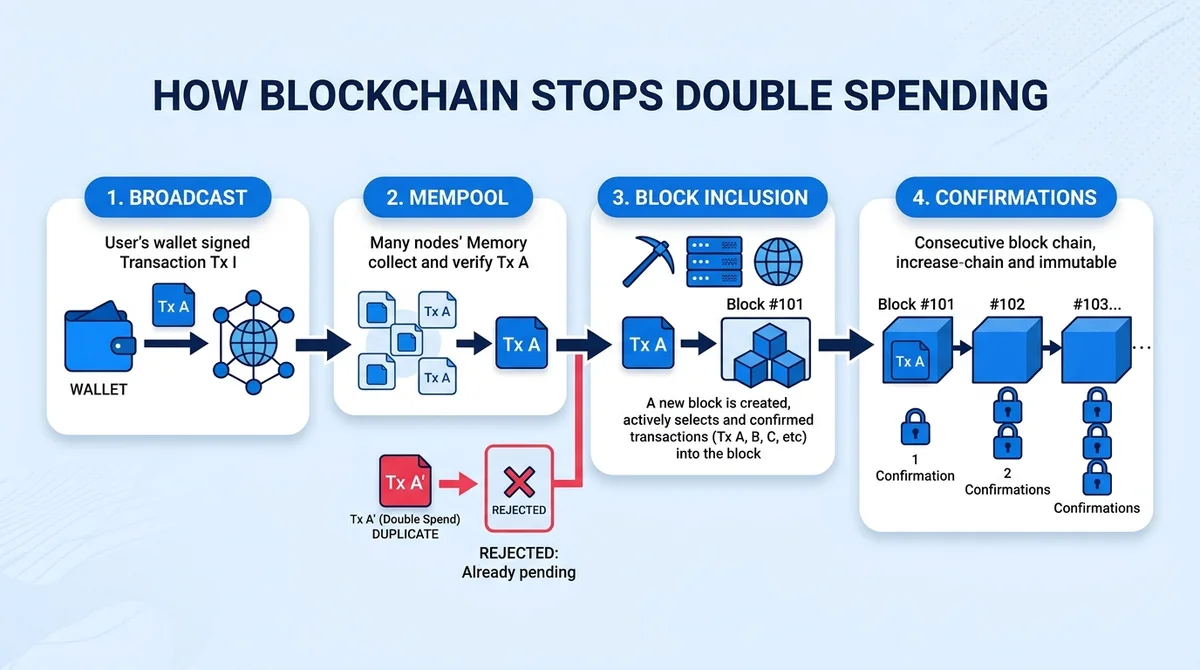
Answer: Through a publicly shared ledger plus a consensus mechanism that confirms transaction order.
Public ledger: Network participants each hold a copy of the ledger. Once a transfer is publicly recorded and the balance is deducted, the same asset cannot be spent a second time.
Consensus mechanism: This determines whose transaction is recorded first. Once the order is fixed, the same money cannot queue up again.
High cost of tampering: To alter one historical record, you would need to modify all subsequent blocks and gain majority hash power or staking support across the network. The cost is usually far higher than any potential gain.
Analogy: It is like a public ledger that everyone holds a copy of and that gets stamped the moment it is written. To deny a debt, you would have to alter everyone's copy at once.
#When Can Double Spending Risk Still Appear?
Key point: Uncertainty exists while a transaction is unconfirmed.
- A transaction that has just been broadcast but not yet included in a block can theoretically be replaced
- The more confirmations, the harder it is to roll back
- Different chains and scenarios require different numbers of secure confirmations (specific values vary by network and use case; this article does not give a single number)
Hidden risk in small, fast payments: Accepting 0-confirmation transactions for "instant" settlement means the recipient bears the risk of the transaction being rolled back.
Analogy: It is like receiving a check that has not cleared yet — it looks like the money arrived, but settlement has not actually happened.
#Why Does Understanding Double Spending Matter for Beginners?
It is the starting point for understanding blockchain's value. The first problem blockchain set out to solve was exactly this — enabling mutually distrusting participants to jointly maintain a ledger that is hard to cheat, without a centralized institution.
Common beginner misconceptions:
- Assuming "digital assets cannot be copied" means absolute security, when security actually comes from ledger consensus
- Assuming a transfer marked successful means everything is fine, while ignoring confirmation counts
- Assuming decentralization means no risk, while ignoring the unconfirmed transaction window
⚠️ Digital assets carry risk. This article explains concepts only and is not investment advice.
Related reading: What is a crypto address?, What is a non-custodial wallet? Private keys, seed phrases, and hot vs. cold wallets explained for 2026, What is anti-Sybil? Blockchain identity verification and network security basics.
FAQ
How would you explain the double spending problem in one sentence?
It is the risk that the same digital asset is spent more than once. Because digital information can be copied, a mechanism is needed to get the whole network to agree that "this money has already been spent"; otherwise the same balance could be paid to multiple people at once.
Why don't bank systems have an obvious double spending problem?
Because banks are centralized accounting institutions with a single ledger and a single referee. When transferring, they check the balance first and then deduct it, so the same money cannot be deducted twice. The trade-off is that users must trust the institution not to make accounting mistakes.
How does blockchain prevent duplicate payments?
Through a publicly shared ledger and a consensus mechanism. Every transaction is publicly recorded, consensus determines transaction order, and the same asset cannot queue up again. Tampering with history requires altering subsequent blocks and gaining majority hash power or staking support across the network, which is usually extremely costly.
Is a transaction safe just because it shows as successful?
Not necessarily. A transaction that has just been broadcast but not yet included and confirmed in a block can still be replaced or rolled back. The more confirmations, the safer it is. In small, fast payment scenarios, accepting 0-confirmation transactions puts the risk on the recipient.
Why should beginners understand double spending?
It helps you understand why blockchain exists and where its value lies. It also reminds you to pay attention to confirmation counts, to avoid assuming "shows as successful" means absolute security, and to avoid reducing digital asset security to simply "cannot be copied."
Want to see the real data for this concept?
After you sign up, you can view live prices, funding rates, and fees for the related assets.
View live prices and fees →