What Is Ethereum?
Ethereum is a public blockchain platform for smart contracts, and ETH is its native token. A plain-English guide to Ethereum, wallets, and seed phrase safety for beginners.
Answer: Ethereum is an open-source public blockchain platform where anyone can deploy programs. ETH is its native token, used to pay fees and participate in staking.
#What Is Ethereum?
Ethereum is an open-source public blockchain platform where anyone can deploy and run programs without setting up their own server. It is maintained by a large number of nodes, so it is often described as a "globally shared computer."
Ethereum is often compared to a "globally shared computer": code is deployed once and run by nodes across the network, with no need for each user to build a server.
How is Ethereum different from Bitcoin?
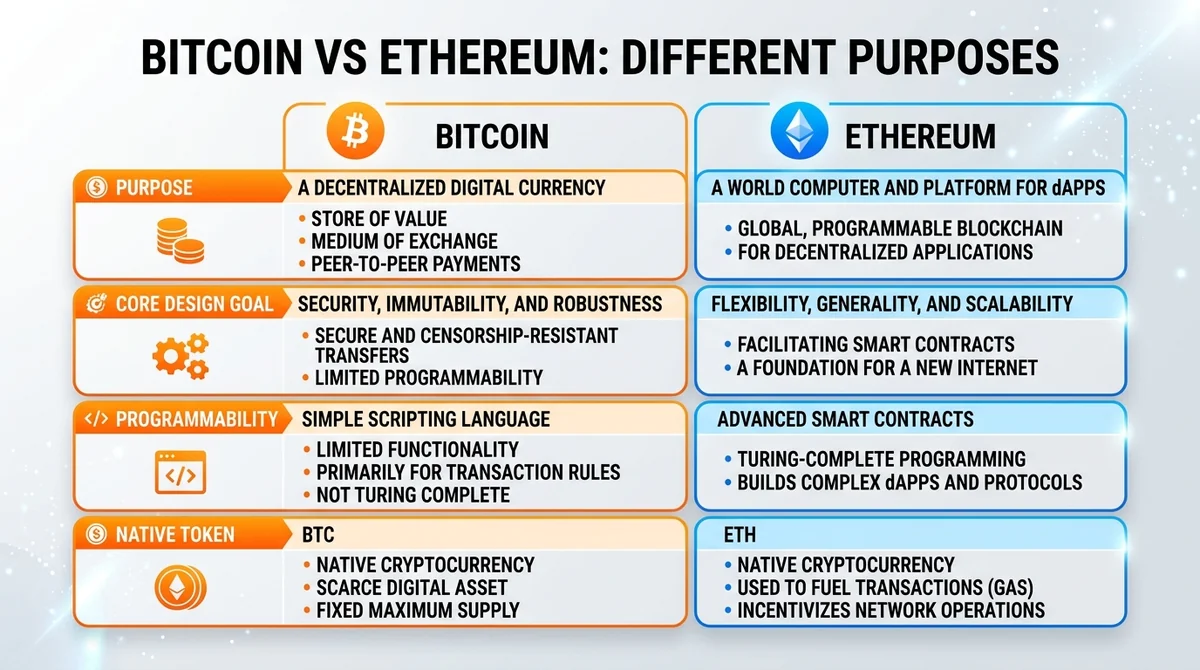
The two have different purposes. Bitcoin's core design goal is peer-to-peer value transfer and storage, and it is often compared to "digital gold." Ethereum builds on this by emphasizing programmability, allowing developers to build decentralized applications on top of it. This is a difference in positioning and does not represent a judgment on the price or investment value of either.
Are ETH and Ethereum the same thing?
No. Ethereum is the blockchain platform, and ETH is the native token of that chain, used to pay network fees and participate in staking. You can think of it as the relationship between a "platform" and a "universal credential within the platform."
ETH and Ethereum can be compared to a "platform" and a "universal credential within the platform": the platform itself hosts applications, while the credential is used to pay network fees and participate in staking. They are not the same concept.
#How Do Smart Contracts on Ethereum Work?
What is a smart contract on Ethereum?
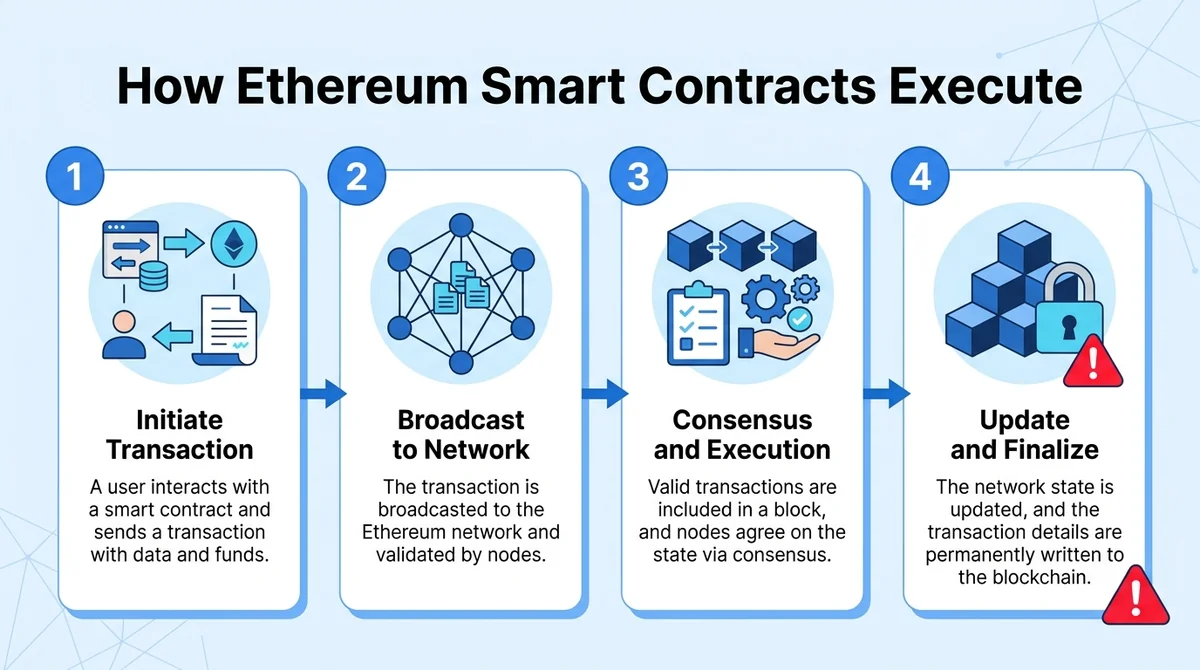
A smart contract is a program deployed on-chain that executes automatically when preset conditions are met, with no intermediary required. For a detailed glossary explanation of smart contracts, see the smart contract entry in our glossary.
Who executes smart contracts?
They are executed collectively by nodes in the network. Each node runs the same code, allowing them to reach consensus on the execution result.
Why do you have to pay a fee to execute a contract?
Because executing computation consumes network resources. The fee (Gas) is paid in ETH to compensate the nodes that help maintain the network. You can think of it as a fee for using shared public computing resources.
Can a contract be changed back if something goes wrong?
Usually not. Once an on-chain transaction is confirmed, it is generally irreversible, so contracts should be thoroughly checked before deployment and use.
#What Are Ethereum Software Wallets and HD Wallets?
What is the difference between a software wallet and a hardware wallet?
A software wallet is an app installed on a phone or computer. It is convenient but the device is online. A hardware wallet is an offline device where the private key never touches the internet, offering higher security but relatively more cumbersome operation. Each has trade-offs; neither is absolutely better.
What is the seed phrase of an HD wallet?
An HD (hierarchical deterministic) wallet uses a single seed phrase to derive multiple addresses according to fixed rules, so one seed phrase can restore all addresses under the wallet. The seed phrase is equivalent to control of your assets; if it is leaked or lost, the assets may be unrecoverable. For key points on safeguarding your seed phrase, see our security guide: Seed Phrase Safety Notice.
How should beginners choose a wallet type?
A general approach is:
- Small amounts, frequent use: consider a software wallet;
- Large amounts, long-term holding: consider a hardware wallet;
- Either way: keep the seed phrase offline, do not screenshot it, do not store it online, and do not share it with anyone.
#What Risks Should You Watch Out for When Using Ethereum?
Why are private keys and seed phrases the biggest risk point?
Because private keys and seed phrases are equivalent to control of your assets. Once leaked or obtained by someone else, they can transfer your assets; once lost, they usually cannot be recovered through customer support or other means.
How can you identify scams impersonating Ethereum?
Common tactics include phishing websites, fake official customer support, fake airdrops, and "free claim" lures. Basic practices are:
- Do not click unfamiliar links;
- Do not enter your seed phrase on any website;
- Verify URLs and information through official channels.
How much should beginners start with?
It is advisable to first use a small amount you can fully afford to lose to get familiar with transfers, fees, and wallet operation flows, and only consider increasing after confirming you understand each step. The specific amount varies by person, and this article does not give a recommended figure.
What are cross margin and isolated margin in margin trading?
Cross margin and isolated margin are two margin modes in derivatives trading: in cross margin mode, account margin is shared and risk is linked; in isolated margin mode, each position's margin is independent and risk is isolated. This article does not cover trading operation details; for a conceptual comparison, see our comparison of cross margin and isolated margin modes. Beginners should first understand the concepts and risk mechanisms, and should not use perpetual futures leverage or margin trading before fully understanding the rules.
This article is for conceptual education only and does not constitute investment advice. Digital asset prices are highly volatile; please assess risks yourself before participating. This article was compiled by MSX Learn. For more introductory digital asset concepts, see msxfi.
#FAQ
How is Ethereum different from Bitcoin?
The two have different purposes: Bitcoin focuses on value transfer and storage, while Ethereum is a public blockchain platform that supports smart contracts and can run decentralized applications. This is a difference in design positioning and does not constitute a judgment on the investment value of either.
Are ETH and Ethereum the same thing?
No. Ethereum is the blockchain platform, and ETH is the native token of that network, used to pay fees and participate in staking. You can think of it as the relationship between a platform and its universal credential.
Who executes smart contracts?
They are executed collectively by nodes in the Ethereum network. Each node runs the same code and reaches consensus on the result, with no intermediary required.
What happens if a seed phrase is leaked?
The seed phrase is the credential for restoring a wallet and controlling assets. Once leaked, others may gain full control of the assets in the wallet; and on-chain transactions are usually irreversible, so assets may not be recoverable.
What should beginners pay attention to when using Ethereum?
Keep your seed phrase offline, be wary of phishing websites and fake airdrops, start with a small amount to get familiar with the process, and avoid perpetual futures leverage or margin trading before understanding the rules. This article does not constitute investment advice.
#Further Reading
- Smart contract entry
- Seed Phrase Safety Notice
- Comparison of cross margin and isolated margin modes
- Ethereum official documentation (ethereum.org)
FAQ
How is Ethereum different from Bitcoin?
The two have different purposes: Bitcoin focuses on value transfer and storage, while Ethereum is a public blockchain platform that supports smart contracts and can run decentralized applications. This is a difference in design positioning and does not constitute a judgment on the investment value of either.
Are ETH and Ethereum the same thing?
No. Ethereum is the blockchain platform, and ETH is the native token of that network, used to pay fees and participate in staking. You can think of it as the relationship between a platform and its universal credential.
Who executes smart contracts?
They are executed collectively by nodes in the Ethereum network. Each node runs the same code and reaches consensus on the result, with no intermediary required.
What happens if a seed phrase is leaked?
The seed phrase is the credential for restoring a wallet and controlling assets. Once leaked, others may gain full control of the assets in the wallet; and on-chain transactions are usually irreversible, so assets may not be recoverable.
What should beginners pay attention to when using Ethereum?
Keep your seed phrase offline, be wary of phishing websites and fake airdrops, start with a small amount to get familiar with the process, and avoid perpetual futures leverage or margin trading before understanding the rules. This article does not constitute investment advice.
Related Terms
Want to see the real data for this concept?
After you sign up, you can view live prices, funding rates, and fees for the related assets.
View live prices and fees →