What is HODL
HODL means holding digital assets long term instead of trading on short-term price swings. It comes from a forum typo. Learn its meaning, origin, rationale, risks and beginner steps.
HODL is the digital asset community's term for holding long term and not trading frequently on short-term price swings. It comes from a forum post in which "hold" was mistyped as "HODL".
#What is HODL?
The meaning of HODL is simple: buy and hold for the long term, without acting on a few days of price movement. It comes from a forum post in which "hold" was mistyped as "HODL", and the community later adopted it as a symbol of long-term holding culture. It is more an attitude than a precise trading method.
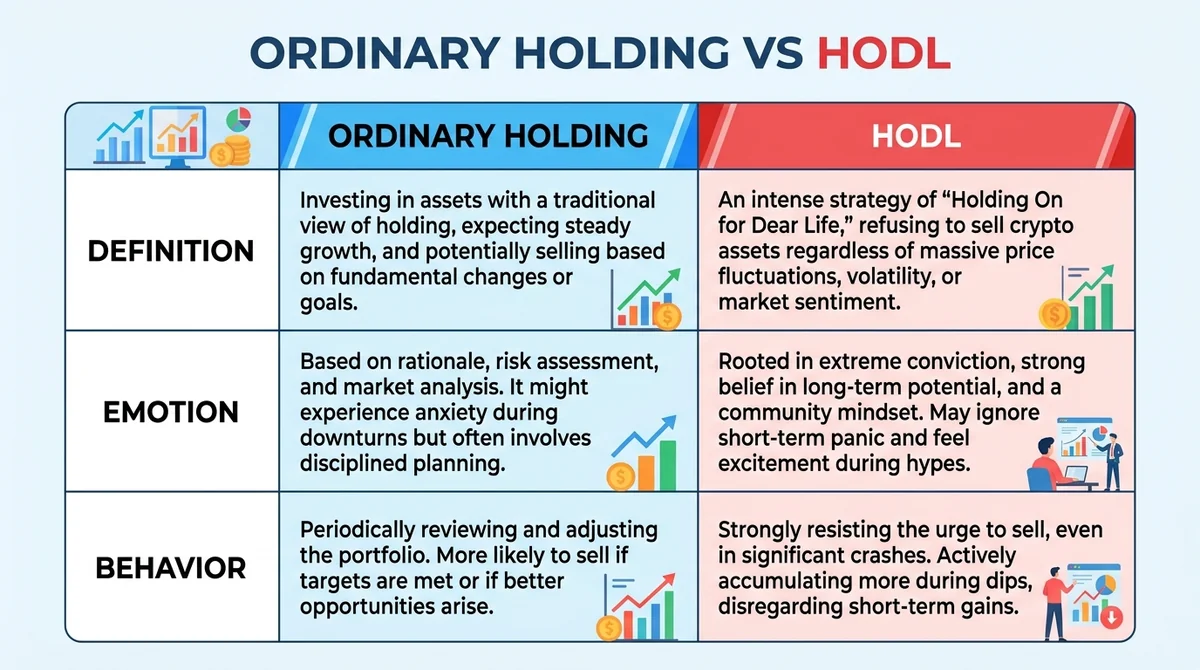
Ordinary holding is a state; HODL is a declaration with emotion behind it. By analogy: ordinary holding is like putting money in a drawer, while HODL is like sticking a note on the drawer saying "don't touch". In essence both mean holding without selling, but HODL carries explicit discipline and emotional weight.
#Where does the word HODL come from?
It comes from a spelling mistake in a forum post.
The poster meant to write hold, but in an emotional moment typed HODL.
(The exact publication date, author and original source of that post were not verified within the scope of this review.)
#What is the difference between HODL and ordinary holding?
Ordinary holding is a state; HODL is a declaration with emotion behind it.
By analogy: ordinary holding is like putting money in a drawer, while HODL is like sticking a note on the drawer saying "don't touch".
What it emphasizes is not the act of holding itself, but the discipline of "don't move no matter how the market goes".
#How did the term HODL become popular?
Because it is real. Many people have experienced the panic in that post during violent market swings, and the typo became a memorable hook that the community simply carried on using.
In other words, HODL spread not through promotion by some institution, but because it precisely describes the real psychology many people have during violent swings: wanting to sell, yet afraid of selling at the wrong time. Over time, it turned from a complaint into a symbol of long-term holding culture.
#Why do investors adopt a HODL strategy?
There are three common reasons:
- Frequent trading makes it easy to make wrong decisions and can also accumulate trading costs
- Watching the market less means being led by emotions less
- Focusing on long-term value rather than today's price
All three point to the same premise: investors admit they find it hard to judge short-term prices accurately, so they choose "act less" to reduce the chance of mistakes. It suits people willing to spend time researching fundamentals but who do not want to watch the market every day.
#What are the risks and limitations of a HODL strategy?
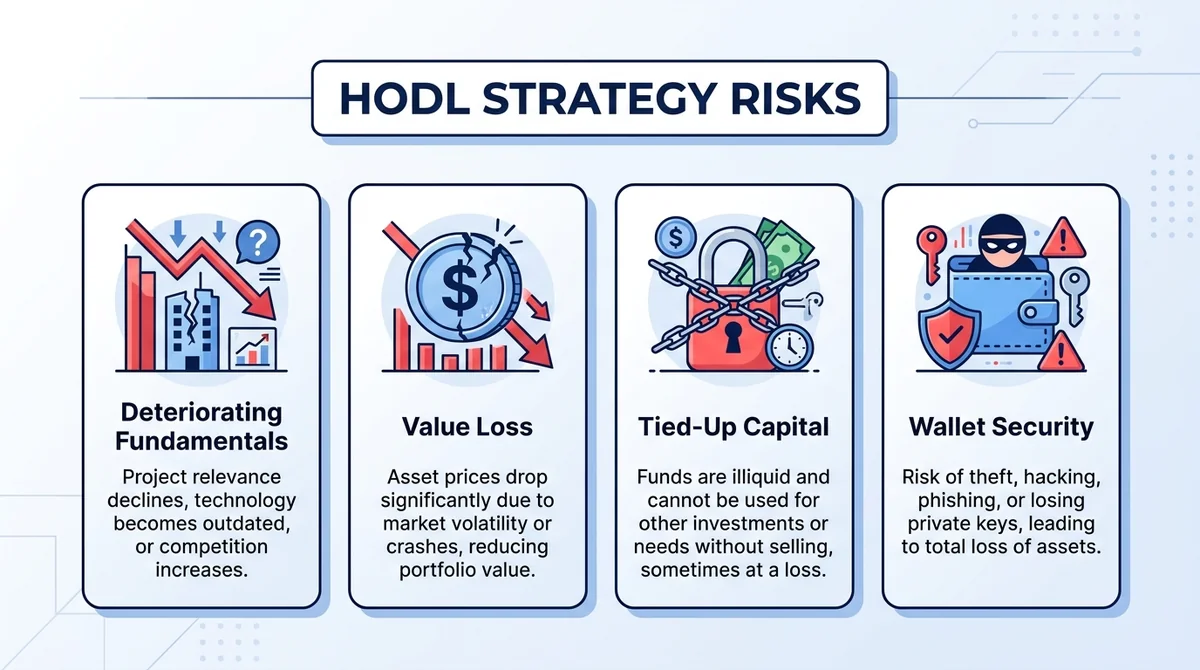
Long-term holding does not mean risk-free.
A project's fundamentals may deteriorate, and in extreme cases the value may shrink sharply or even go to zero.
"Don't sell" should not become an excuse to ignore risk.
Regular review is safer than ignoring things entirely.
Two more points are easily overlooked: first, long-term holding ties up capital, and if that money is needed in the short term, forced selling may disrupt your plans; second, "holding through it" requires secure storage, because once a wallet or account has problems, no holding period, however long, can help. See the notes on wallet security and self-custody risk.
#How can beginners practice long-term holding rationally?
- First understand what the asset is, then decide whether to hold it
- Secure your wallet and accounts, and back up your recovery information; see wallet security and the notes on self-custody risk
- Set a review cadence, such as checking fundamentals periodically
- Participate only with money that does not affect your life. ⚠️ Digital assets are highly volatile, so start with a small position
This article covers concepts only and does not recommend any specific asset or project any returns.
#FAQ
What does HODL mean?
HODL is the digital asset community's term for long-term holding, meaning buying and not trading frequently on short-term price swings. It comes from a forum post in which "hold" was mistyped as "HODL", and the community later adopted it as a symbol of long-term holding culture.
Where does the word HODL come from?
It originated from a forum user's post during a period of market volatility. The poster meant to write hold, but in an emotional moment typed HODL. The typo became a memorable hook and gradually evolved into a cultural symbol of the community. The exact date and original source of the post have not been verified.
Is there a difference between HODL and ordinary holding?
Ordinary holding is a state, while HODL is more a declaration of attitude that emphasizes not being disturbed by short-term volatility. In essence both mean holding without selling, but HODL carries explicit discipline and emotional weight.
Is long-term holding always safe?
No. Long-term holding does not mean risk-free; a project's fundamentals may deteriorate, and in extreme cases the value may shrink sharply. Review the fundamentals of the assets you hold regularly, rather than treating "don't sell" as an excuse to ignore risk.
How do beginners practice long-term holding?
Understand the asset you hold before deciding whether to hold it, secure your wallet and accounts and back up recovery information, set a regular review cadence, participate only with money that does not affect your life, and start with a small position. This is not investment advice.
Why do investors adopt a HODL strategy?
Because frequent trading makes it easy to make wrong decisions and accumulate costs, watching the market less reduces emotional interference, and it better fits a mindset focused on long-term value rather than the day's price.
Risk notice: The above content is conceptual education and does not constitute investment advice. Digital asset prices are highly volatile; please assess risks yourself. This article is part of the MSX Learn concept education series.
FAQ
What does HODL mean?
HODL is the digital asset community's term for long-term holding, meaning buying and not trading frequently on short-term price swings. It comes from a forum post in which "hold" was mistyped as "HODL", and the community later adopted it as a symbol of long-term holding culture.
Where does the word HODL come from?
It originated from a forum user's post during a period of market volatility. The poster meant to write hold, but in an emotional moment typed HODL. The typo became a memorable hook and gradually evolved into a cultural symbol of the community. The exact date and original source of the post have not been verified.
Is there a difference between HODL and ordinary holding?
Ordinary holding is a state, while HODL is more a declaration of attitude that emphasizes not being disturbed by short-term volatility. In essence both mean holding without selling, but HODL carries explicit discipline and emotional weight.
Is long-term holding always safe?
No. Long-term holding does not mean risk-free; a project's fundamentals may deteriorate, and in extreme cases the value may shrink sharply. Review the fundamentals of the assets you hold regularly, rather than treating "don't sell" as an excuse to ignore risk.
How do beginners practice long-term holding?
Understand the asset you hold before deciding whether to hold it, secure your wallet and accounts and back up recovery information, set a regular review cadence, participate only with money that does not affect your life, and start with a small position. This is not investment advice.
Related Terms
Want to see the real data for this concept?
After you sign up, you can view live prices, funding rates, and fees for the related assets.
View live prices and fees →