What Is Leverage in Crypto? Leverage Ratios, Margin and Liquidation Explained
Crypto leverage lets you control a larger position with less of your own capital (margin), amplifying both gains and losses. Learn leverage ratios, margin and liquidation.
Answer: Crypto leverage means using a smaller amount of your own capital (margin) to control a larger position, with both profits and losses amplified by the same multiple.
#What is leverage in crypto?
In trading, perpetual futures leverage does not amplify the price move itself — it amplifies your position size. How much the underlying asset rises or falls does not change because of leverage.
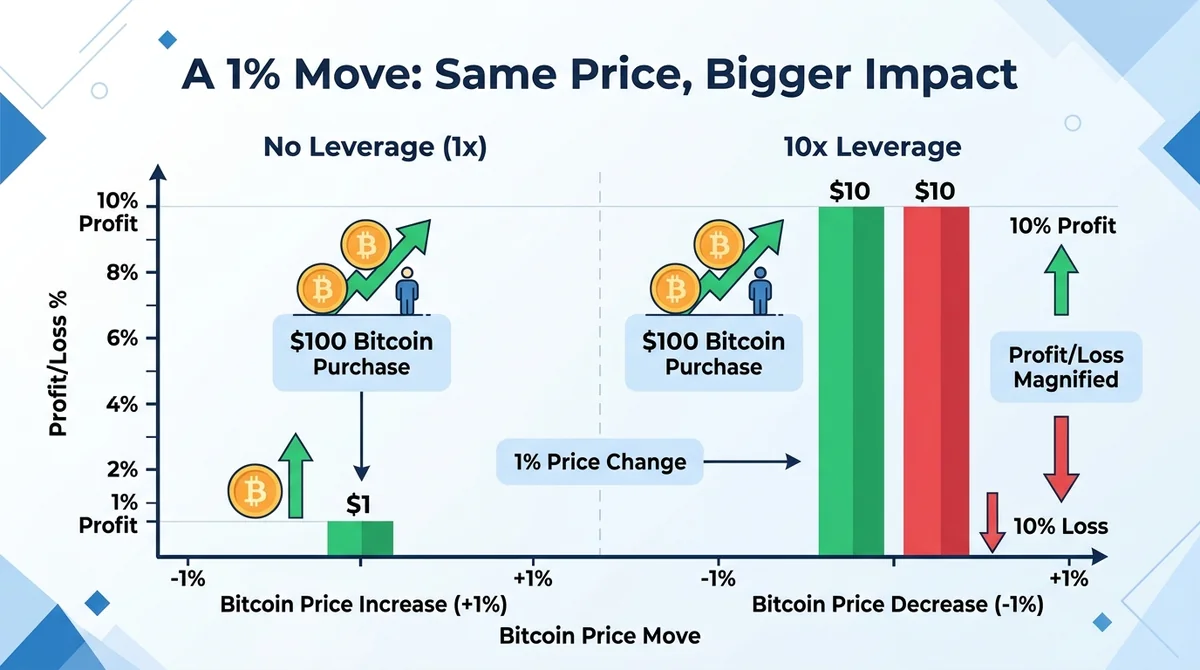
Example: you have $100. Without leverage, you can only buy $100 of Bitcoin. With 10x leverage, you can control a $1,000 position (provided the platform supports that multiple and applies the corresponding margin rules). If Bitcoin rises 1%, your profit is $10 (10% of your capital); if it falls 1%, your loss is also $10.
Is leverage the same as borrowing money to buy stocks? The logic is similar — both involve borrowing funds to magnify your exposure. But crypto leverage is usually provided by trading platforms, with rules, fees and liquidation mechanisms that differ from traditional brokers, and the risk is more concentrated.
#What does leverage ratio mean?
Leverage ratio = total position size ÷ your own margin. For example, a $1,000 position with $100 margin is 10x leverage.
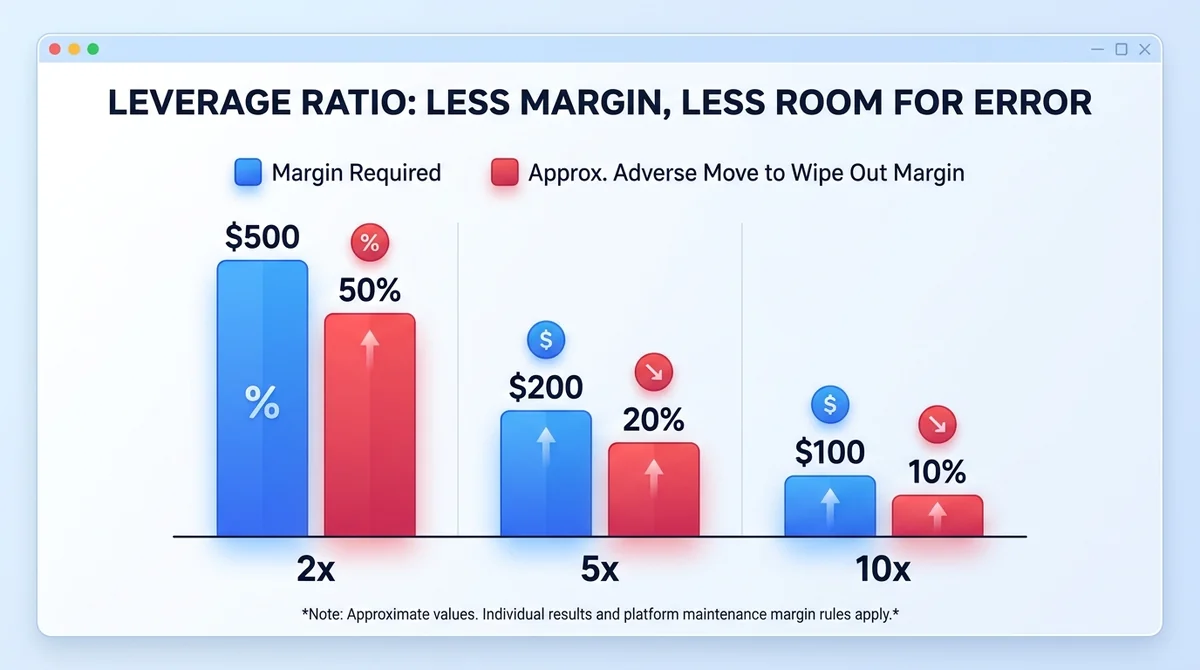
The higher the multiple, the less margin you need — but the bigger the impact of price swings on your margin. Theoretically, at 2x leverage, the price would need to move about 50% against you to wipe out your margin; at 10x leverage, a move of about 10% against you could trigger liquidation. The actual trigger point also depends on the platform's maintenance margin requirements and liquidation rules, so it is not a fixed number.
- 2x leverage: $1,000 position, $500 margin
- 10x leverage: $1,000 position, $100 margin
- The higher the multiple, the lower your tolerance for volatility
#How do margin and forced liquidation work?
Margin is the capital of your own that keeps your position open — essentially a deposit. When losses eat into your margin and it falls below the threshold required by the platform, the platform will force-close the position (liquidation) to control risk.
Liquidation is not a punishment; it is a risk-control mechanism. Analogy: when a rental deposit is nearly used up, the landlord asks you to top it up or move out to avoid unpaid rent.
Why do you get liquidated once losses reach a certain level? Because the platform needs to ensure losses do not exceed your margin and prevent a negative balance. Specific thresholds and execution methods vary by platform, so the platform's rules should prevail.
#Which products use leverage?
Leverage is a way of using capital, not a specific product. Perpetual futures, leveraged spot and delivery futures may all involve leverage, but their rules and risks differ.
- Perpetual futures: usually have built-in leverage — pay attention to how does perpetual futures funding rate work
- Leveraged spot: borrow coins to amplify a spot position, with borrowing interest
- Delivery futures: have an expiry date, with similar leverage rules
This article covers concepts only. To learn about specific trading tools, see the product documentation pages on the main MSX site.
#What risks should you understand before using leverage?
Leverage amplifies losses in step with gains, and you could lose your entire margin. During sharp price swings, liquidation risk rises quickly.
Beginners should first understand the mechanics, control their risk exposure, and not start with high multiples. ⚠️ Digital assets carry risk; this article is not investment advice.
To learn more about margin details, read What Is Margin? Initial Margin, Maintenance Margin and Available Margin Explained, or see How to Calculate Crypto Futures Margin and Leverage: Isolated vs how does cross margin work in perpetual futures trading in 2026.
FAQ
What is leverage in crypto?
Crypto leverage is a way of trading that uses a smaller amount of your own capital (margin) to control a larger position. Both profits and losses are amplified by the same leverage multiple, while the price move of the underlying asset itself does not change.
How is the leverage ratio calculated?
Leverage ratio = total position size ÷ your own margin. For example, using $100 of margin to control a $1,000 position is 10x leverage. The higher the multiple, the less margin required, but the lower your tolerance for volatility.
Why do leveraged trades get liquidated?
When losses eat into your margin and push it below the maintenance margin threshold required by the platform, the platform force-closes the position to control risk. This is a risk-control mechanism designed to prevent losses from exceeding your margin and causing a negative balance; the exact threshold depends on the platform's rules.
How much leverage should beginners use?
Beginners should first understand how leverage and liquidation work, start with low multiples, and control their risk exposure. High leverage amplifies losses and can quickly wipe out your entire margin. This article is not investment advice.
Related Terms
Want to see the real data for this concept?
After you sign up, you can view live prices, funding rates, and fees for the related assets.
View live prices and fees →