What Are Perpetual Futures in Crypto? A Beginner's Guide to Perpetual Contracts
Perpetual futures are crypto derivatives with no expiry that track spot prices via funding rates. Learn how they differ from spot and delivery contracts, plus leverage risk.
Answer: Perpetual futures are cryptocurrency derivative contracts with no expiry date. They track the underlying asset's price, let traders hold positions for as long as they want, and stay close to spot prices through the funding rate mechanism.
#What Are Crypto Perpetual Futures?
Perpetual futures are crypto derivative contracts with no expiry that track spot prices through funding rates. Traders only trade price movements and do not directly hold the underlying asset.
Perpetual futures are a contract, not the coin itself. You trade price movements and do not directly hold the asset.
They have no expiry date and can theoretically be held indefinitely. The price follows the spot price of the underlying asset (such as Bitcoin).
Analogy: Spot is like buying a house to live in yourself; perpetual futures are like betting with someone on that house's listing price — the house isn't yours, but you're on the hook for every price move.
They are derivatives. You can bet on prices rising (going long) or falling (going short).
#Why Do Perpetual Futures Have No Expiry Date?
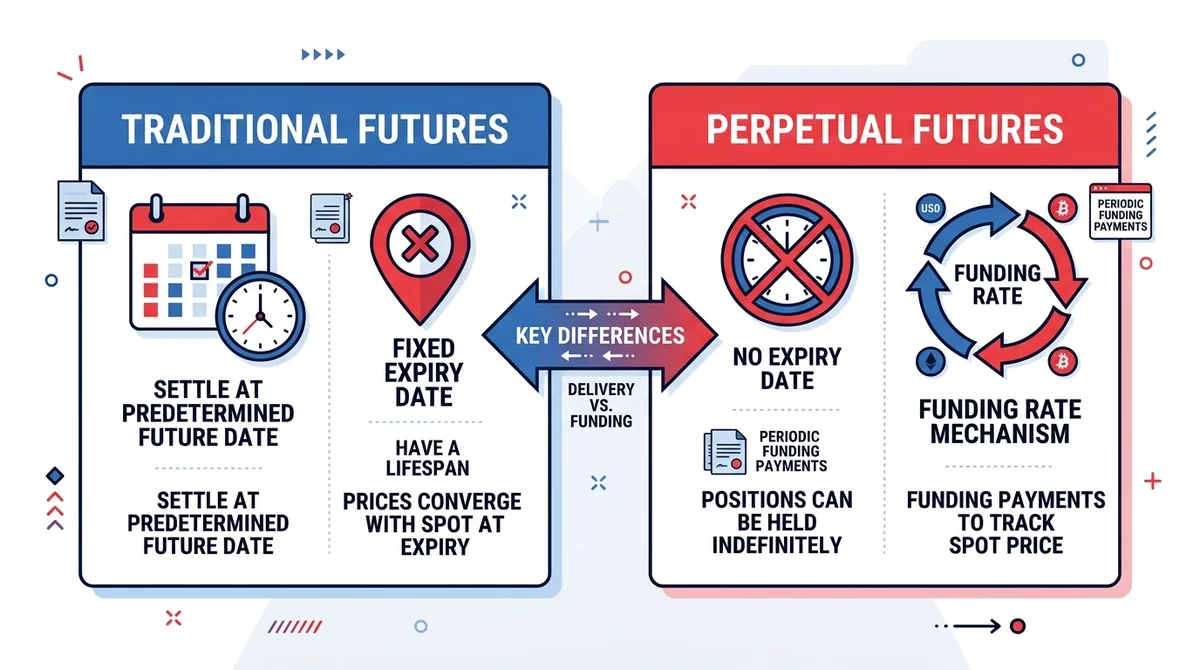
Perpetual futures remove the expiry date so traders are not forced to close positions on a fixed date, which supports long-term holding. Funding rates replace delivery settlement to anchor the contract price to spot.
Traditional futures contracts usually have a fixed delivery date, and positions must be settled or closed at expiry.
Perpetual futures eliminate the delivery date, so traders are not forced to close positions on a fixed date.
Without an expiry date, what keeps the price close to spot? The common mechanism is the funding rate, which partly replaces the anchoring role of delivery settlement.
Analogy: The funding rate is like a balancing fee when supply and demand for capital are out of sync — if longs are too crowded, longs periodically pay shorts.
#How Do Perpetual Futures Work?
Perpetual futures work by having longs and shorts periodically pay each other funding rates on a schedule set by the platform. The direction of the rate usually reflects long/short supply and demand, which helps pull the contract price back toward spot.
Longs and shorts periodically pay each other funding rates on the schedule set by the platform. The direction of the rate usually reflects long/short supply and demand.
When the contract price is above spot, the rate is usually positive and longs pay shorts. This raises the cost of holding long positions, discourages excessive long exposure, and helps the price move back toward spot.
- Going long: betting the price will rise
- Going short: betting the price will fall
- Funding rate: settled periodically under platform rules, with direction based on long/short imbalance
- Price anchoring: the rate mechanism pulls the price back toward spot
#What Is the Difference Between Perpetual Futures and Delivery Contracts?
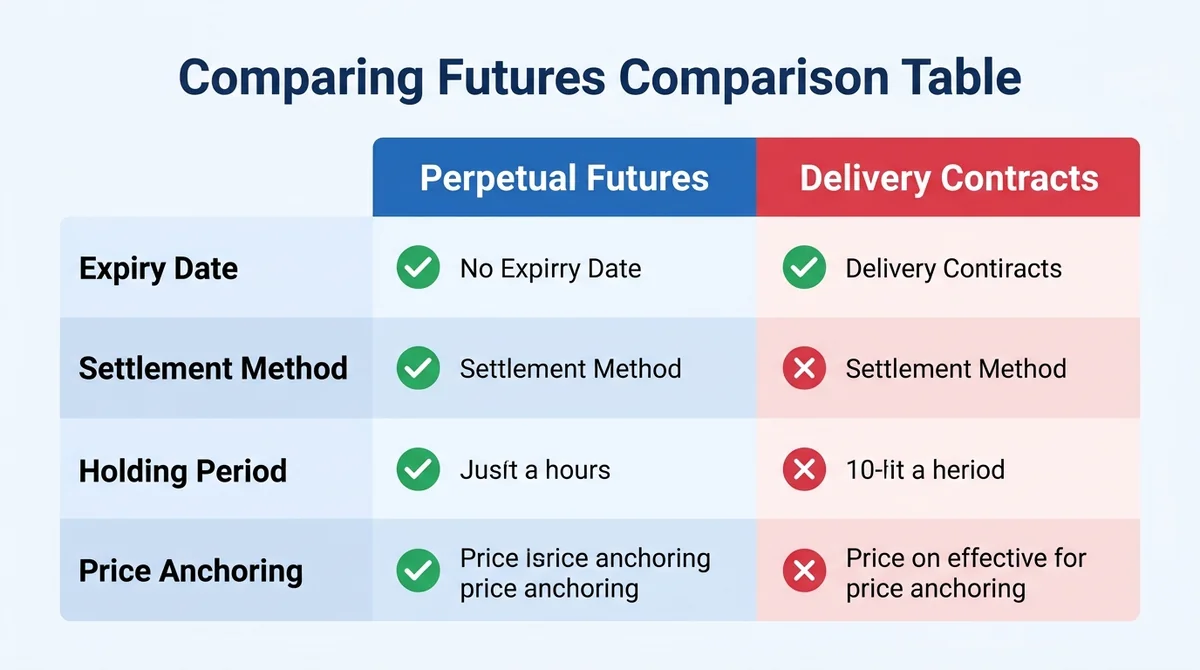
The core difference between perpetual futures and delivery contracts is expiry and settlement: perpetual futures have no expiry date and anchor to spot through funding rates, while delivery contracts have a fixed expiry date and settle through delivery at expiry.
Both are derivatives, and the core difference lies in expiry and settlement. An objective side-by-side comparison:
| Dimension | Perpetual Futures | Delivery Contracts |
|---|---|---|
| Expiry date | None | Fixed expiry date |
| Settlement method | Periodic funding rates | Delivery settlement at expiry |
| Holding period | Can be held long term | Must be handled before expiry |
| Price anchoring | Funding rates | Delivery mechanism |
#What Risks Should You Watch Out for With Perpetual Futures?
Perpetual futures usually involve perpetual futures leverage, which magnifies both profits and losses. When a position is too large, a small adverse price move can trigger liquidation.
When a position is too large, a small adverse price move can trigger liquidation.
Beginners should first understand the mechanics with small positions before deciding whether to use them.
This article only explains concepts and does not constitute investment advice.
To learn more about liquidation and margin principles, see MSX Learn's entries on mark price, margin, and liquidation price.
#FAQ
What is the difference between perpetual futures and spot? Spot means directly buying and holding an asset, and price moves reflect the asset's own value. Perpetual futures are derivatives: you do not directly hold the asset, you only trade price movements, you can go long or short, and they usually involve perpetual futures leverage — so the risk structure is different.
Why do perpetual futures have no expiry date? Removing the expiry date means traders are not forced to close positions on a fixed date, which supports long-term holding. Periodic funding rates replace delivery settlement and help keep the contract price close to spot.
What does how does perpetual futures funding rate work do? How does perpetual futures funding rate work: longs and shorts periodically pay each other under platform rules, and the direction usually reflects long/short supply and demand. When the contract price deviates from spot, the rate adjusts holding costs and guides the price back toward spot, providing a degree of anchoring.
What is the biggest difference between perpetual futures and delivery contracts? The core difference is the expiry date: delivery contracts have a fixed expiry date and require delivery at expiry, while perpetual futures have no expiry date and can be held long term. They use the delivery mechanism and funding rates, respectively, to stay close to spot prices.
What should beginners watch out for when using perpetual futures? Perpetual futures usually involve perpetual futures leverage, which magnifies both profits and losses, and oversized positions can easily trigger liquidation. Beginners should first understand the mechanics with small positions and only consider using them after understanding the risks. This article does not constitute investment advice.
What are perpetual futures in one sentence? Perpetual futures are crypto derivative contracts with no expiry date that track spot prices through funding rates; traders only trade price movements and do not directly hold the underlying asset.
FAQ
What is the difference between perpetual futures and spot?
Spot means directly buying and holding an asset, and price moves reflect the asset's own value. Perpetual futures are derivatives: you do not directly hold the asset, you only trade price movements, you can go long or short, and they usually involve perpetual futures leverage — so the risk structure is different.
Why do perpetual futures have no expiry date?
Removing the expiry date means traders are not forced to close positions on a fixed date, which supports long-term holding. Periodic funding rates replace delivery settlement and help keep the contract price close to spot.
What does how does perpetual futures funding rate work do?
How does perpetual futures funding rate work: longs and shorts periodically pay each other under platform rules, and the direction usually reflects long/short supply and demand. When the contract price deviates from spot, the rate adjusts holding costs and guides the price back toward spot, providing a degree of anchoring.
What is the biggest difference between perpetual futures and delivery contracts?
The core difference is the expiry date: delivery contracts have a fixed expiry date and require delivery at expiry, while perpetual futures have no expiry date and can be held long term. They use the delivery mechanism and funding rates, respectively, to stay close to spot prices.
What should beginners watch out for when using perpetual futures?
Perpetual futures usually involve perpetual futures leverage, which magnifies both profits and losses, and oversized positions can easily trigger liquidation. Beginners should first understand the mechanics with small positions and only consider using them after understanding the risks. This article does not constitute investment advice.
Related Terms
Want to see the real data for this concept?
After you sign up, you can view live prices, funding rates, and fees for the related assets.
View live prices and fees →