What Are Perpetual Futures?
Perpetual futures are derivatives with no expiry, anchored to spot prices by funding rates. Learn the mechanics, USDT-margined vs inverse contracts, and leverage risks.
Perpetual futures are derivative contracts with no expiry date. They track the price of an underlying asset and use the funding rate mechanism to anchor the contract price to the spot price, letting traders take positions on price movements without actually holding the asset.
#What are perpetual futures?
Perpetual futures are derivative contracts with no expiry date that use funding rates to anchor the contract price to the spot price. You are not trading the asset itself, but a contract that tracks the asset's price.
The core feature of a perpetual contract (Perp) is that it has no expiry date. Delivery futures must be settled at expiry, but perpetual futures can be held indefinitely, so there is no need to actually hold or deliver the asset.
Analogy: Delivery futures are like a fixed-term deposit that must be withdrawn at maturity; perpetual futures are like a demand deposit that you can keep for as long as you like.
Who trades perpetual futures? Mainly traders who want to hedge risk or take positions on price movements and who do not care whether they actually own the asset.
#Why do perpetual futures have no expiry date?
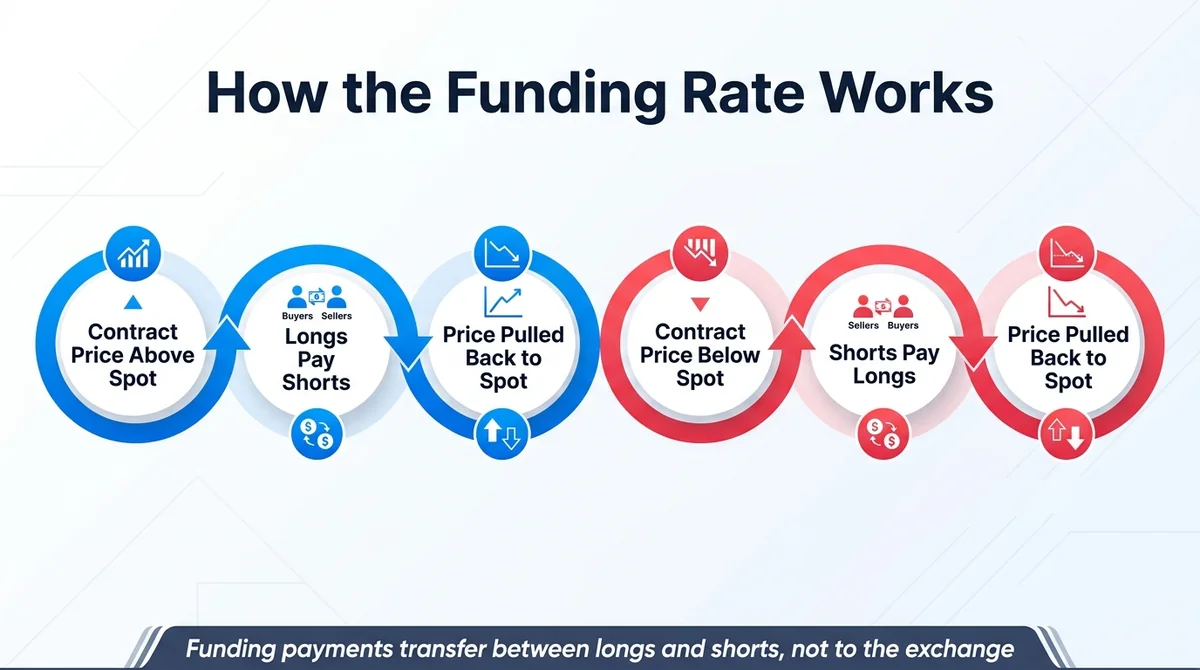
Perpetual futures have no expiry date because they remove the delivery step and instead use funding rates to pull the contract price back toward spot.
Without an expiry date, the contract price could drift away from the spot price. What mechanism prevents this? The answer is the funding rate.
How does perpetual futures funding rate work? The funding rate is a periodic payment between longs and shorts. When the contract price is above spot, longs pay shorts; when it is below, shorts pay longs.
Analogy: The funding rate is like a balancing fee when supply and demand for capital are out of balance—whoever is more "crowded" pays.
This pulls the contract price back toward spot. The funding rate does not go into the exchange's pocket; it is transferred between longs and shorts, so it acts more like a price-adjustment signal than a trading fee.
#What are USDT-margined perpetual futures?
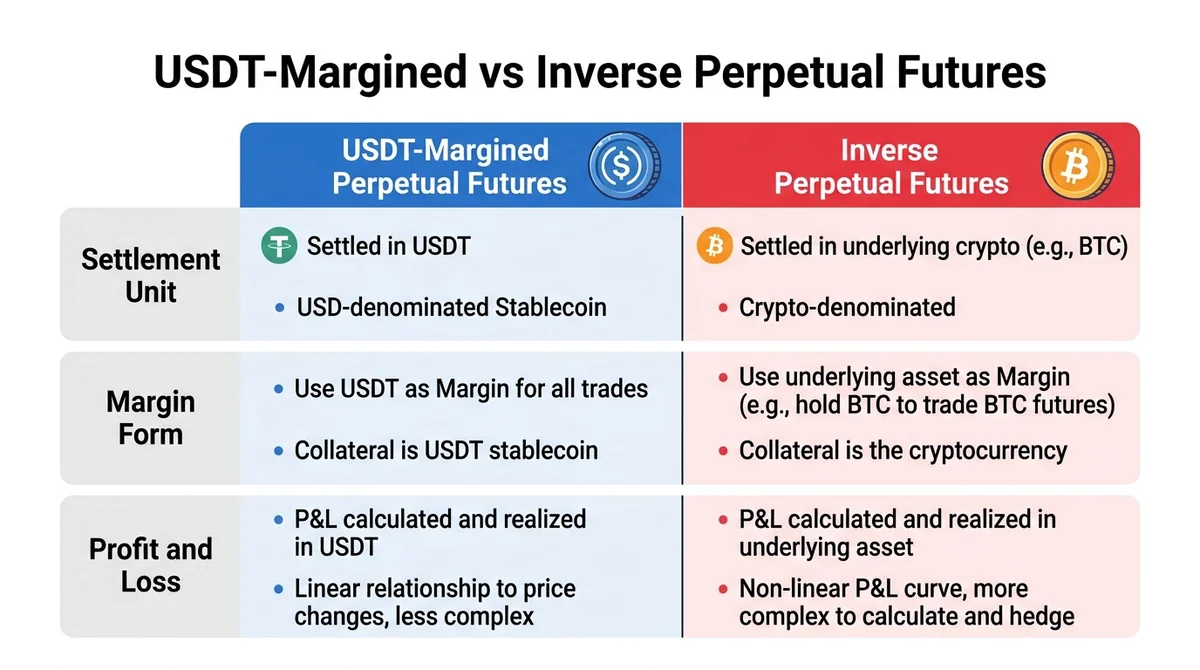
USDT-margined perpetual futures are perpetual contracts that use a stablecoin (such as USDT) as the margin and settlement unit, with profit and loss calculated in the stablecoin.
Analogy: It is like trading US stocks with US dollars—profits and losses are calculated in dollars, which is intuitive and easy to understand.
Beginners often encounter USDT-margined contracts because the pricing is simple: margin is in a stablecoin and profit and loss are also in a stablecoin, with no conversion needed.
#How do inverse perpetual futures work?
How do inverse perpetual futures work? Inverse perpetual futures are perpetual contracts that use the underlying asset itself (such as Bitcoin) as the margin and settlement unit, with profit and loss also denominated in that asset.
Analogy: It is like trading gold with gold—if you profit, you profit in gold.
Their profit and loss calculation differs from USDT-margined contracts: for inverse contracts, profit and loss are denominated in the coin, so the quantity changes. This design was popular on crypto exchanges early on because stablecoins were not widespread at the time.
#USDT-margined vs inverse perpetual futures
| Comparison | USDT-margined perpetual futures | Inverse perpetual futures |
|---|---|---|
| Pricing and settlement unit | Stablecoin (e.g., USDT) | Underlying asset (e.g., BTC) |
| Margin form | Stablecoin | Underlying asset |
| Profit and loss | Denominated in stablecoin, intuitive amounts | Denominated in the underlying asset, coin quantity changes |
| Suitable for | Traders who prefer stablecoin pricing and are new to contracts | Traders familiar with coin-margined contract pricing who hold the underlying asset |
#How are perpetual futures settled?
Perpetual futures do not deliver assets; profit and loss are settled through the margin account: at close, the difference between the entry price and the closing price is credited to or debited from the account in the settlement unit specified by the contract.
Specifically, USDT-margined contracts settle profit and loss in a stablecoin, while inverse contracts settle in the underlying asset. During the holding period, longs and shorts pay each other periodically according to the funding rate, and this is also included in account equity. Therefore, "settlement" for perpetual futures is not the delivery of assets but the increase or decrease of equity in the margin account.
#What is perpetual futures leverage?
Perpetual futures leverage is a mechanism that amplifies positions, magnifying both gains and losses proportionally.
When opening a position with leverage, a trader only needs to post a certain percentage of margin to establish a position larger than the margin. The larger the position, the higher the loss relative to margin when the price moves against you, and the faster the liquidation line is reached. Leverage itself does not change the underlying price; it only changes the ratio of profit and loss to margin.
#What is the difference between perpetual futures and spot?
Spot is buying and holding the asset directly—you own it; perpetual futures do not deliver assets, you only hold a contract.
- Spot: You directly hold the asset, risk is limited (you can lose at most your principal), and the purpose is long-term holding or payment.
- Perpetual futures: No asset delivery, usually with leverage, amplified risk, and the purpose is hedging or taking positions on price movements.
The two have different purposes and risk structures; neither is inherently better.
#What risks should I watch before using perpetual futures?
Perpetual futures usually involve leverage, which magnifies both gains and losses. The higher the leverage, the faster losses accumulate.
There is liquidation risk: when losses approach the margin, the position is forcibly closed.
On position sizing, understanding the mechanics matters more than chasing high leverage: first clarify the relationship between margin, the funding rate, and the liquidation line, then consider whether to participate.
⚠️ Digital assets carry risk. This article only explains concepts and does not constitute investment advice.
#FAQ
#What is the difference between perpetual futures and delivery futures?
Perpetual futures have no expiry date and use funding rates to anchor the contract price to the spot price; delivery futures have a fixed expiry date and must be settled at expiry. Perpetual futures can be held indefinitely, while delivery futures settle automatically at expiry.
#Is the funding rate paid to the exchange?
No. The funding rate is a direct payment between longs and shorts; the exchange does not collect this fee. When the funding rate is positive, longs pay shorts; when negative, shorts pay longs.
#Which is better, USDT-margined or inverse perpetual futures?
Neither is better—only more suitable. USDT-margined contracts are priced in a stablecoin with intuitive profit and loss, suitable for beginners; inverse contracts are priced in the underlying asset, suitable for traders familiar with coin-margined contract pricing. The two have different risk structures.
#Can perpetual futures be liquidated?
Yes. When losses cause insufficient margin, the position is forcibly closed. The higher the leverage, the greater the liquidation risk. Beginners should use low leverage and small positions.
#Are perpetual futures suitable for beginners?
Perpetual futures involve leverage and higher risk. Beginners should first understand spot and contract mechanics, then try with a very small position, and never invest funds they cannot afford to lose.
#How are perpetual futures settled?
Perpetual futures do not deliver assets; profit and loss are settled through the margin account: at close, the difference between the entry price and the closing price is credited to or debited from the account in the settlement unit specified by the contract, and funding rate payments during the holding period are also included in account equity.
#What is perpetual futures leverage?
Leverage is a mechanism that amplifies positions proportionally, magnifying both gains and losses. The higher the leverage, the larger the loss relative to margin when the price moves against you, and the closer you get to the liquidation line.
Further reading: To compare spot and perpetual futures in more detail, see perpetual futures vs spot trading pros and cons; to learn about leverage and liquidation mechanics, see leverage and liquidation risk.
This article was prepared by MSX Learn for conceptual education only and does not constitute investment advice.
FAQ
What is the difference between perpetual futures and delivery futures?
Perpetual futures have no expiry date and use funding rates to anchor the contract price to the spot price; delivery futures have a fixed expiry date and must be settled at expiry. Perpetual futures can be held indefinitely, while delivery futures settle automatically at expiry.
Is the funding rate paid to the exchange?
No. The funding rate is a direct payment between longs and shorts; the exchange does not collect this fee. When the funding rate is positive, longs pay shorts; when negative, shorts pay longs.
Which is better, USDT-margined or inverse perpetual futures?
Neither is better—only more suitable. USDT-margined contracts are priced in a stablecoin with intuitive profit and loss, suitable for beginners; inverse contracts are priced in the underlying asset, suitable for traders familiar with coin-margined contract pricing. The two have different risk structures.
Can perpetual futures be liquidated?
Yes. When losses cause insufficient margin, the position is forcibly closed. The higher the leverage, the greater the liquidation risk. Beginners should use low leverage and small positions.
Are perpetual futures suitable for beginners?
Perpetual futures involve leverage and higher risk. Beginners should first understand spot and contract mechanics, then try with a very small position, and never invest funds they cannot afford to lose.
Related Terms
Want to see the real data for this concept?
After you sign up, you can view live prices, funding rates, and fees for the related assets.
View live prices and fees →