What Is Pre-IPO?
Pre-IPO is financing or share transfers before a company's official IPO. Learn what Pre-IPO means, how it differs from an IPO, how to buy pre IPO stock, and key risks.
Pre-IPO refers to the financing or equity transfers a company carries out before its official public listing (IPO). Investors receive pre-listing rights rather than freely tradable shares at this stage; liquidity is usually restricted, and value changes depend on whether the company ultimately completes its listing.
#What Is Pre-IPO?
Pre-IPO literally means "before the listing." Before a company is listed on a public exchange, it raises funds through private placements or equity transfers.
Companies at this stage usually already have a certain scale but have not yet completed the listing process. What investors buy is a right to "a possible future listing," not already-listed, tradable stock.
Analogy: It is like a restaurant selling pre-opening cards before it opens. The price may be cheaper than after opening, but whether and when it will open successfully is uncertain.
The basic logic is: acquire rights before a company lists, hoping that improved liquidity after listing will change the value. It must be emphasized that this is only an explanation of the mechanism and does not represent any expectation of returns.
Participants in the Pre-IPO stage are usually institutional investors or qualified investors who meet local regulatory requirements; the general public typically cannot enter directly. For related basic concepts, see What Is an IPO and the comparison between IPO and Pre-IPO.
#What Is the Difference Between Pre-IPO and a Traditional IPO?
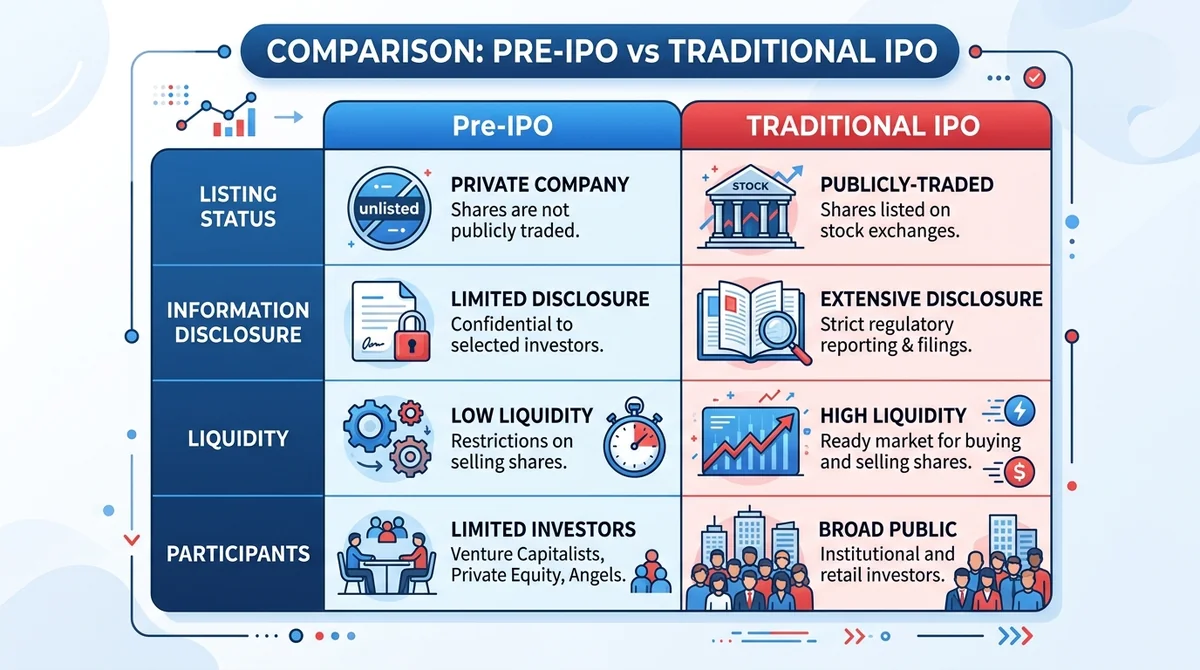
The core differences between Pre-IPO and an IPO lie in four points: listing status, level of disclosure, liquidity, and who can participate. The former occurs before listing, has less disclosure, usually has lock-up periods on shares, and targets specific investors; the latter occurs on a public exchange, has fuller disclosure, allows trading on the secondary market, and targets the public.
- Listing status: An IPO is an official public listing and offering; Pre-IPO occurs before listing.
- Information disclosure: Pre-IPO disclosure is usually more limited, making judgment harder.
- Liquidity: Pre-IPO shares usually have lock-up periods and are hard to exit early; after an IPO, shares can be traded on the public market.
- Participants: An IPO targets public investors; Pre-IPO mostly targets specific institutions or qualified investors.
#What Is Pre-IPO Subscription (Buying Pre-IPO Shares)?
"Subscription" (打新) means subscribing during the new-share issuance stage. IPO subscription means subscribing at the public listing offering, while Pre-IPO subscription means subscribing before listing; the two are at different stages.
Tokenized Pre-IPO subscription maps the relevant rights in token form for on-chain subscription and transfer. Note that tokenization does not change the risk attributes of the underlying rights, nor does it equal holding real shares. For the basic principles of tokenization, see What Is Tokenization.
#How to Buy Pre-IPO Stock
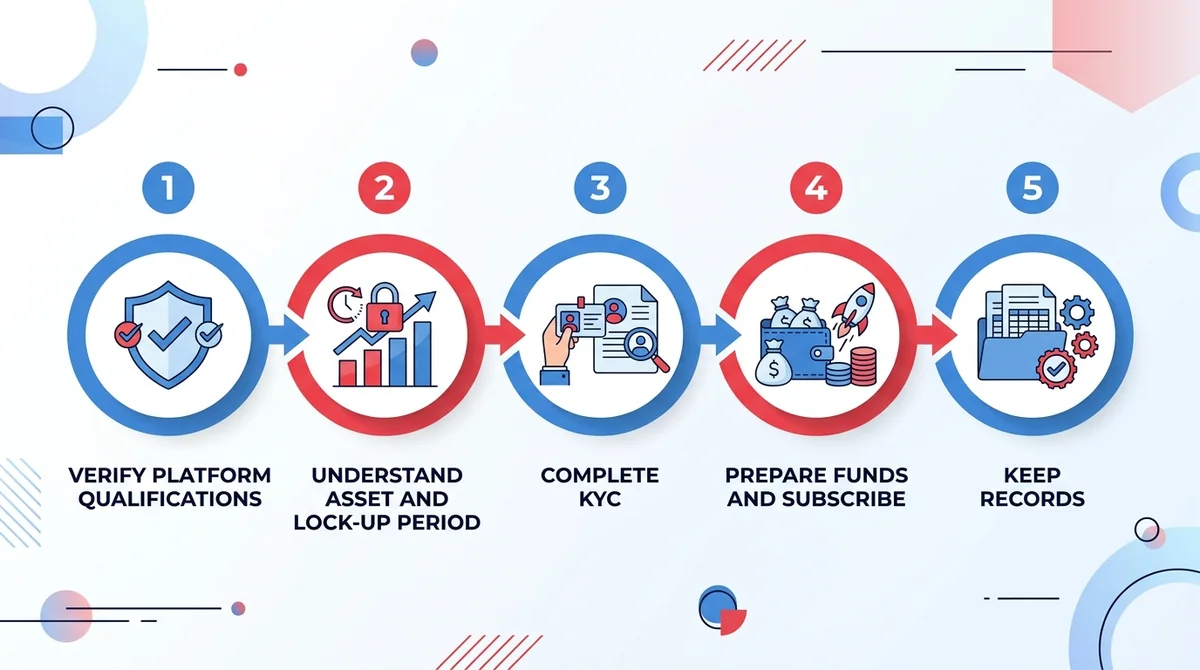
- Verify platform qualifications: Find out whether the platform is compliant and holds verifiable licenses or registrations.
- Understand the underlying asset and lock-up period: Clarify what you are subscribing to, how long it is locked, and how to exit.
- Complete identity verification: Submit KYC materials as required by the platform.
- Prepare funds and subscribe: Submit your subscription according to the process and keep all vouchers.
- Keep records: Save screenshots, contracts, and transfer records.
⚠️ Before participating, assess your own risk tolerance. Digital assets and tokenized rights are highly volatile, and this article does not constitute investment advice.
#What Risks Should You Watch for When Participating in Pre-IPO Subscription?
The main risks of Pre-IPO subscription fall into four categories: liquidity constraints from lock-up periods, information opacity due to limited disclosure, uncertainty in the listing process itself, and scams carried out under the name of Pre-IPO.
- Liquidity risk: Shares may have lock-up periods, so you cannot sell even if you want to.
- Information opacity: Limited disclosure makes misjudgment easy.
- Listing uncertainty: A company may delay or cancel its listing.
- Scam risk: Be highly wary of channels promising principal protection and high returns.
To identify common scam tactics, see Pre-IPO Scam Prevention.
#FAQ
What is Pre-IPO? Pre-IPO refers to financing or equity transfer arrangements a company carries out before its official IPO listing, where investors obtain equity or corresponding rights before the company is publicly listed.
What is the difference between Pre-IPO and an IPO? An IPO is when a company officially issues shares on a public exchange to public investors; Pre-IPO occurs before listing, usually with less information disclosure, shares that typically have lock-up periods, and poorer liquidity.
How to buy pre IPO stock? The general path is to first confirm platform compliance and underlying asset information, then complete identity verification, prepare funds, and submit the subscription, keeping all vouchers. Be wary of channels promising principal protection and high returns.
What are the risks of Pre-IPO subscription? Main risks include liquidity constraints due to share lock-up periods, difficulty judging due to limited disclosure, uncertainty around listing, and scams in the name of Pre-IPO.
What are tokenized Pre-IPO rights? Tokenized Pre-IPO maps pre-listing rights in token form for on-chain subscription and transfer, but it does not change the risk attributes of the underlying rights and does not equal holding real shares.
This article only explains concepts and does not constitute investment advice. This article was compiled by MSX Learn for conceptual education only.
References: U.S. SEC website (Investor.gov investor education section) and Hong Kong Exchanges and Clearing (HKEX) listing rules pages; you can review public disclosure requirements and listing process explanations yourself.
FAQ
What is Pre-IPO?
Pre-IPO refers to financing or equity transfer arrangements a company carries out before its official IPO listing, where investors obtain equity or corresponding rights before the company is publicly listed.
What is the difference between Pre-IPO and an IPO?
An IPO is when a company officially issues shares on a public exchange to public investors; Pre-IPO occurs before listing, usually with less information disclosure, shares that typically have lock-up periods, and poorer liquidity.
How to buy pre IPO stock?
The general path is to first confirm platform compliance and underlying asset information, then complete identity verification, prepare funds, and submit the subscription, keeping all vouchers. Be wary of channels promising principal protection and high returns.
What are the risks of Pre-IPO subscription?
Main risks include liquidity constraints due to share lock-up periods, difficulty judging due to limited disclosure, uncertainty around listing, and scams in the name of Pre-IPO.
Related Terms
Want to see the real data for this concept?
After you sign up, you can view live prices, funding rates, and fees for the related assets.
View live prices and fees →