What Is Short Selling
Short selling means borrowing and selling an asset expecting a price drop, then buying back cheaper to profit. Long buys first; short sells first, with different risk profiles.
Short selling is selling first, then buying back: you expect the price to fall, so you borrow the asset and sell it, then buy it back with less money after the price drops and return it to the lender. The difference is your profit.
#What Is Short Selling?
Short selling is a trading method where you borrow an asset and sell it, expecting the price to decline, then buy it back at a lower price to return it, profiting from the difference.
Analogy: You borrow a bicycle from your neighbor and immediately sell it for 1,000 yuan. A week later, the same new bike costs only 800 yuan, so you buy it back and return it to your neighbor. You made 200 yuan.
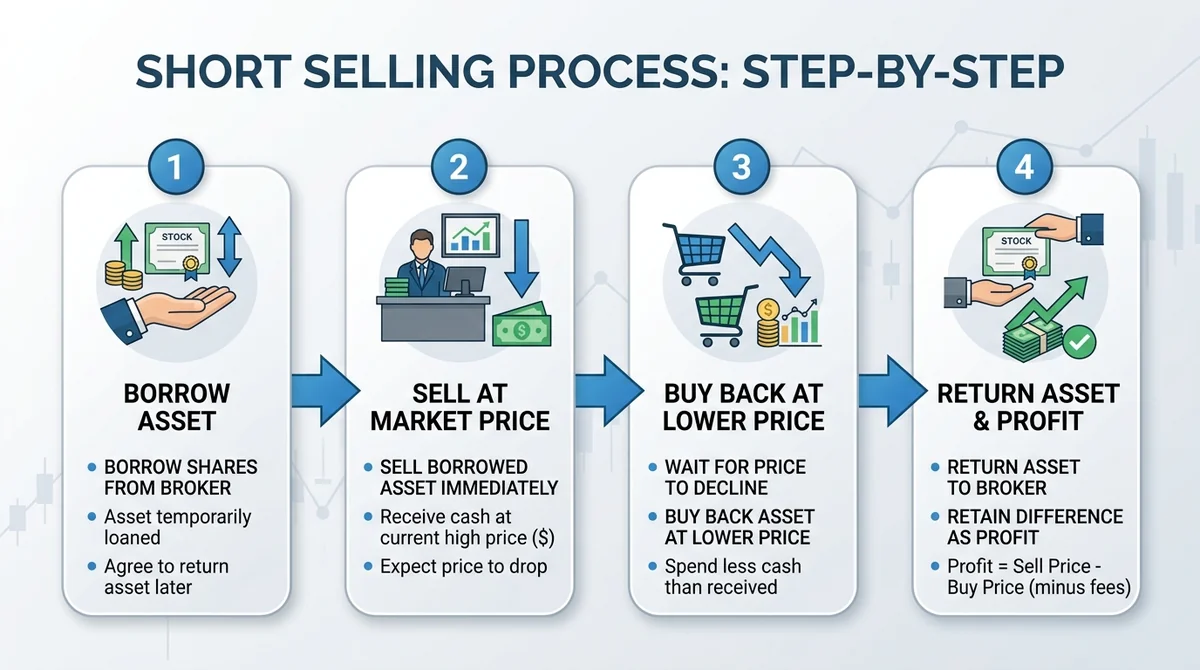
Basic steps of short selling:
- Borrow the asset from a platform or another party.
- Sell the borrowed asset at the current market price.
- After the price drops, buy back the same amount of the asset at a lower price.
- Return the asset and keep the difference as profit.
Core logic of short selling: The essence of short selling is "sell first, buy later" to profit from a price decline. You don't need to own the asset beforehand; you just borrow and sell it, then buy it back at a lower price.
⚠️ Digital assets are risky. Start with a small position.
#What Is the Difference Between Short Selling and Long Buying?
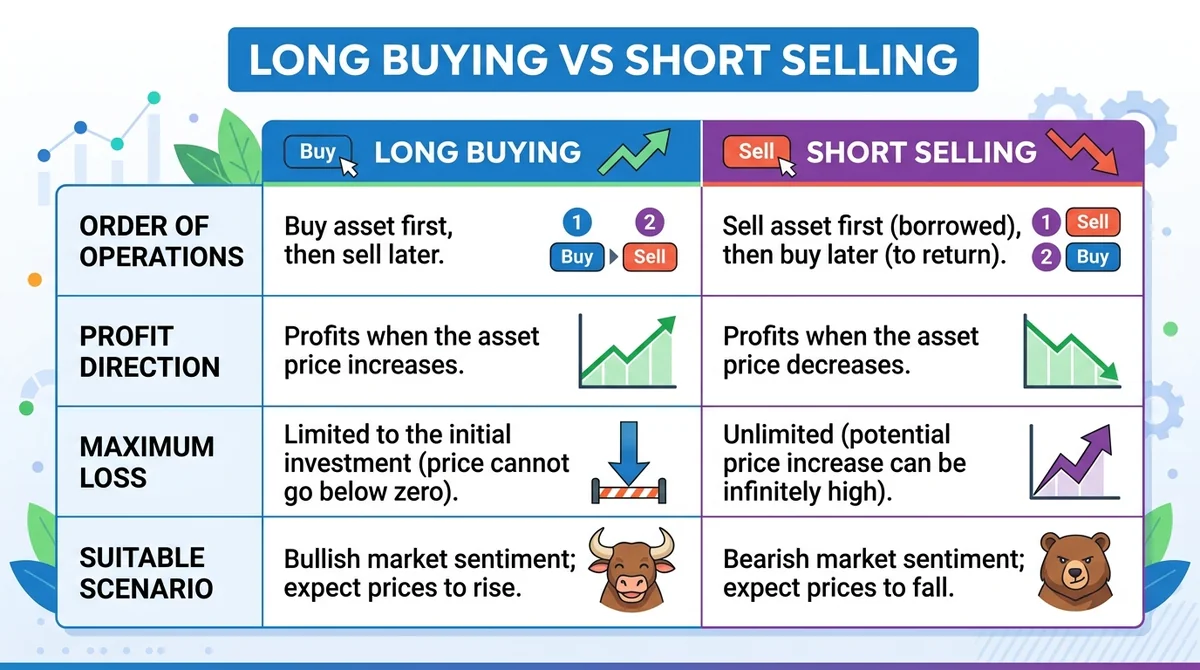
Long buying is buying first and selling later; short selling is selling first and buying later. Long buying expects the price to rise; short selling expects the price to fall.
How long buying makes a profit: Buy low, sell high. For example, buy at 100 yuan, sell at 150 yuan, profit 50 yuan.
How short selling makes a profit: Sell high, buy back low. For example, borrow and sell at 100 yuan, buy back at 60 yuan, profit 40 yuan.
How do their risks differ?
- The maximum loss for long buying is the capital invested, as the price can only fall to zero.
- The theoretical loss for short selling is unlimited because the price can rise indefinitely.
Comparison of long buying and short selling:
| Dimension | Long Buying | Short Selling |
|---|---|---|
| Order of operations | Buy first, sell later | Sell first, buy later |
| Profit direction | Price rises | Price falls |
| Maximum loss | Capital invested | Theoretically unlimited |
| Suitable scenario | Bullish on long-term trend | Expecting short-term decline or hedging |
#What Is the Difference Between Long Positions and Short Positions?
A long position is a bullish position held after buying an asset. A short position is a bearish position held after selling borrowed assets. Their profit and loss directions are opposite.
What is a long position: You buy and hold an asset, expecting to sell it at a higher price later.
What is a short position: You borrow and sell an asset, expecting to buy it back at a lower price later.
How position direction affects profit and loss:
- Long position: profit when price rises, loss when price falls.
- Short position: profit when price falls, loss when price rises.
Key points for position management:
- Long positions are suitable to hold in an uptrend, but watch for pullback risks.
- Short positions are suitable to hold in a downtrend, but watch for rebound risks.
- Whether long or short, always set a stop-loss to limit per-trade losses.
#What Are the Risks of Short Selling?
The main risk of short selling is that losses are theoretically unlimited when the price rises. You also need to pay interest on the borrowed asset and may face forced liquidation.
Why short selling can lead to unlimited losses: The price can keep rising without a cap, so your cost to buy back can be infinitely high.
What fees does short selling involve? Borrowing an asset usually requires paying interest, and the rate varies with market supply and demand.
What should beginners watch out for when short selling?
- Avoid high leverage; leverage amplifies losses.
- Set stop-losses to limit per-trade losses.
- Use only a small portion of your funds; don't go all in.
Other risks of short selling:
- Forced liquidation risk: When market moves against you and margin becomes insufficient, the platform may force-liquidate your position, causing actual losses.
- Liquidity risk: Some small-cap assets may be hard to borrow or hard to buy back at a low price.
- Regulatory risk: Different markets have different restrictions on short selling; understand local rules.
#How to Short Sell in the Digital Asset Market?
In the digital asset market, you can short sell through perpetual futures, delivery futures, or leveraged tokens. You need to open a futures account, transfer margin, and then place a short order.
Specific steps:
- Open futures trading permissions on a compliant platform.
- Transfer margin (such as USDT or other stablecoins).
- Choose the short direction and set the leverage multiple.
- Enter the short quantity and confirm the order.
- Close the position to take profit after the price drops, or set a stop-loss to close automatically.
Difference from spot short selling: Traditional spot market short selling requires borrowing the asset. Digital asset futures short selling does not require actual borrowing; you only need margin to open a position, but the risks are similar.
#FAQ
Do I need to own the asset before short selling?
No. The core of short selling is borrowing the asset to sell; you don't need to own it beforehand. Borrow and sell, then buy back after the price drops and return it.
Which is more suitable for beginners, short selling or long buying?
Long buying is more intuitive, but both carry risks. Short selling has theoretically unlimited losses. Beginners should use small positions and set strict stop-losses if they try it; high leverage is not recommended.
How to short sell in the digital asset market?
In the digital asset market, you can short sell through perpetual futures, delivery futures, or leveraged tokens. You need to open a futures account, transfer margin, and then place a short order.
Do I need to pay interest when short selling?
Yes, borrowing an asset to short sell usually requires paying interest, and the rate is determined by market supply and demand. Digital asset futures short selling may involve how does perpetual futures funding rate work, depending on platform rules.
Can short selling lead to forced liquidation?
Yes. When margin is insufficient or the price moves against you beyond a certain threshold, the platform may force-liquidate your position, causing actual losses. Therefore, you must set stop-losses and manage your position size when short selling.
If you want to practice, you can use a demo account to familiarize yourself with the process.
FAQ
Do I need to own the asset before short selling?
No. The core of short selling is borrowing the asset to sell; you don't need to own it beforehand. Borrow and sell, then buy back after the price drops and return it.
Which is more suitable for beginners, short selling or long buying?
Long buying is more intuitive, but both carry risks. Short selling has theoretically unlimited losses. Beginners should use small positions and set strict stop-losses if they try it; high leverage is not recommended.
How to short sell in the digital asset market?
In the digital asset market, you can short sell through perpetual futures, delivery futures, or leveraged tokens. You need to open a futures account, transfer margin, and then place a short order.
Related Terms
Want to see the real data for this concept?
After you sign up, you can view live prices, funding rates, and fees for the related assets.
View live prices and fees →