what is tokenized treasury
Tokenized treasuries put traditional government bond ownership on blockchain as tradable digital tokens. Learn definition, benefits, risks & how to buy.
Tokenized treasuries are traditional government bonds "sliced" and placed on the blockchain, turning them into digital tokens that can be bought and sold. Buying one token means owning a small fraction of the corresponding bond.
#What Is a Tokenized Treasury?
In simple terms: it's like an electronic version of a government bond, but it can be broken into very small pieces for trading.
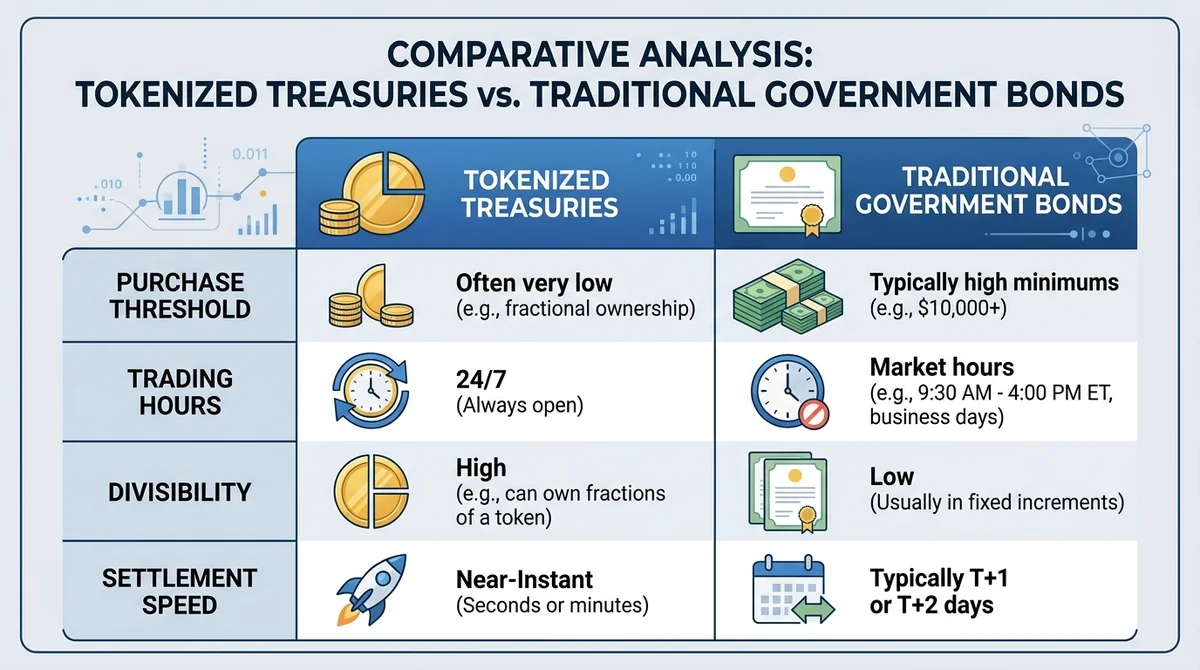
Traditional government bonds usually have high purchase thresholds, while tokenized treasuries use blockchain to split bond shares into smaller units, allowing more people to participate. Each token represents ownership of the underlying bond and can be transferred on-chain just like cryptocurrencies.
Analogy: imagine a whole gold bar is hard to divide, but if you mint it into many small gold coins, everyone can buy a few. Tokenized treasuries turn the "gold bar" into "gold coins."
#What's the Difference Between Tokenized Treasuries and Traditional Government Bonds?
- Traditional government bonds: purchased through banks or brokers, usually have minimum amounts and limited trading hours.
- Tokenized treasuries: issued on blockchain, divisible into extremely small shares, theoretically tradable 24/7.
#How Are Tokenized Treasuries Created?
Issuers first purchase real government bonds, then map their ownership to tokens on the blockchain. Each token corresponds to a certain proportion of the underlying asset and is recorded in smart contracts.
#What Are the Potential Advantages of Tokenized Treasuries?
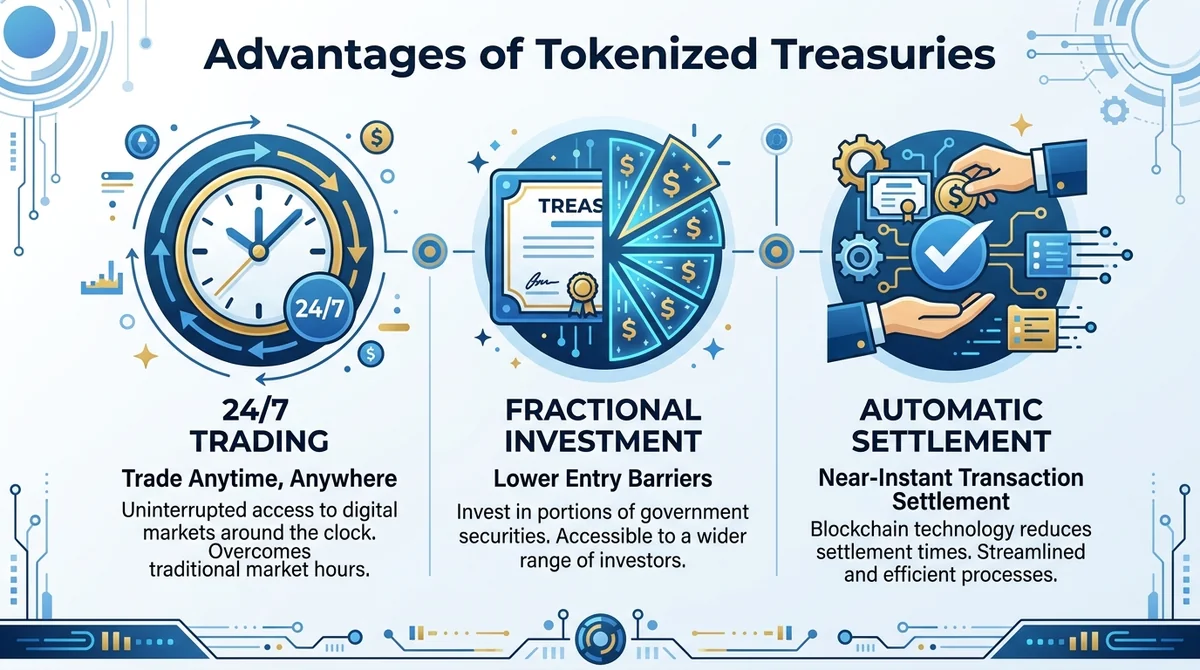
Core advantages: 24/7 trading, fractional investment, automatic settlement.
- 24/7 Trading: unlike traditional markets with fixed opening hours, tokenized treasuries can be bought and sold at any time.
- Fractional Investment: you can buy only a very small portion, such as a $10 share, lowering the entry barrier.
- Automatic Settlement: blockchain automatically completes ownership transfer without waiting for bank clearing.
Analogy: it's like splitting a large certificate of deposit into many small CDs that can be transferred on your phone anytime.
#Why Can Tokenized Treasuries Improve Liquidity?
Because trading is no longer restricted by traditional market hours, and shares are smaller, making it easier to find counterparties for buying and selling.
#How Do Tokenized Treasuries Lower Investment Barriers?
They allow small purchases, enabling people who couldn't afford a whole bond to participate.
#What Risks Should You Understand Before Investing in Tokenized Treasuries?
Tokenized treasuries are not guaranteed profits. Main risks include regulatory uncertainty, smart contract vulnerabilities, and custodian risk.
- Regulatory Uncertainty: rules for tokenized assets may change across countries, affecting trading or redemption.
- Smart Contract Vulnerabilities: code may have bugs, leading to loss of funds.
- Custodian Risk: underlying government bonds are held by third-party custodians; if the custodian has problems, token value may be impaired.
Risk warning: all investments carry risk, and tokenized treasuries are no exception. Only invest funds you can afford to lose.
#What Compliance Risks Do Tokenized Treasuries Have?
Regulatory frameworks are still evolving, and some regions may restrict or prohibit such assets.
#What Are Technical Risks and Counterparty Risks?
Technical risk refers to smart contracts being hacked or malfunctioning; counterparty risk refers to issuer or custodian default.
#How to Buy Tokenized Treasuries?
- Choose a compliant platform: find a regulated platform with a good track record.
- Complete KYC: submit identity documents and pass verification.
- Prepare stablecoins: most platforms require stablecoins like USDC for purchase.
- Buy tokens: exchange stablecoins for tokenized treasuries on the platform.
- Store securely: transfer tokens to your own non-custodial wallet (optional).
⚠️ Digital assets are risky; start with a small position.
#What Preparations Are Needed to Buy Tokenized Treasuries?
You need a cryptocurrency wallet, some stablecoins, and completion of the platform's identity verification.
#Which Platforms Offer Tokenized Treasuries?
Currently mainly Ondo Finance, Backed Finance, etc., but please verify their compliance and security yourself.
#FAQ
Which yields more, tokenized treasuries or traditional government bonds? Yield depends on the underlying bond's interest rate; tokenization itself does not change the rate. But tokenization may bring additional liquidity premium or risk.
Are tokenized treasuries safe? Safety depends on the issuer, custodian, and smart contracts. Choosing a compliant platform and understanding risks is important.
Can I redeem tokenized treasuries anytime? Rules vary by platform; some support redemption anytime, others have lock-up periods. Be sure to read the terms before buying.
How much starting capital do I need to buy tokenized treasuries? Usually very low; some platforms allow starting from $10, but it depends on platform requirements.
Are tokenized treasuries suitable for beginners? You can try, but it's recommended to learn basic concepts first and practice with small amounts.
This article only covers concepts; when you're ready to try, check out the live tools on the main site MSX.
FAQ
What's the difference between tokenized treasuries and traditional government bonds?
Traditional government bonds are purchased through banks or brokers, with minimum amounts and trading hour restrictions. Tokenized treasuries are issued on blockchain, divisible into extremely small shares, theoretically tradable 24/7, and settle faster.
What are the risks of investing in tokenized treasuries?
Main risks include regulatory uncertainty, smart contract vulnerabilities, and custodian risk. Regulatory changes may affect trading, code bugs may cause loss of funds, and custodian problems can also affect token value.
How to buy tokenized treasuries?
First choose a compliant platform, complete KYC identity verification, prepare stablecoins, then exchange stablecoins for tokens on the platform. After purchase, you can transfer tokens to your own non-custodial wallet.
Can tokenized treasuries improve liquidity?
Yes. Tokenized treasuries are not limited by traditional market hours, have smaller shares, and make it easier to find counterparties, so liquidity is usually higher.
Are tokenized treasuries suitable for beginner investors?
You can try, but it's recommended to learn basic concepts first and practice with small amounts. All investments carry risk; don't invest funds you cannot afford to lose.
Related Terms
Want to see the real data for this concept?
After you sign up, you can view live prices, funding rates, and fees for the related assets.
View live prices and fees →