What Is a Linear Contract? Linear vs. Inverse vs. Perpetual Futures Explained (2026)
A linear contract's PnL moves in proportion to the underlying's price and is usually settled in stablecoins. We compare linear, inverse and perpetual futures and flag perpetual futures leverage risk.
Linear contract: a derivative contract whose profit and loss moves in proportion to changes in the underlying asset's price, typically priced and settled in a stablecoin.
#What does linear contract mean?
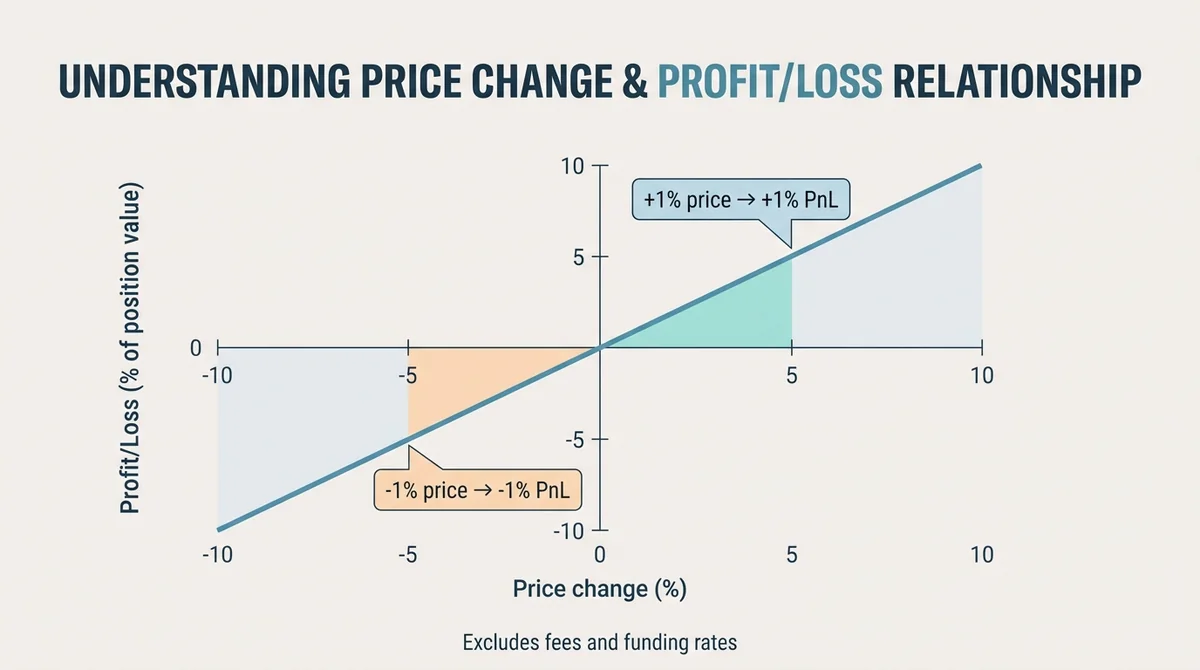
With a linear contract, profit and loss rise and fall proportionally with price changes: whatever percentage the price moves, profit and loss move by roughly the same percentage of position value (excluding costs such as fees and how does perpetual futures funding rate work). This matters because it lets you estimate profit and loss directly from the percentage price move when your position is denominated in a stablecoin, making it easier to gauge risk exposure and position size.
For example, if the price moves 1%, profit and loss change by roughly 1% of position value (excluding costs such as fees and funding rates).
It works like buying vegetables by weight: double the unit price and the total price doubles too.
Why is it called "linear"? Because the relationship between profit and loss and price change is approximately a straight line.
A linear contract is usually priced and settled in a stablecoin such as USDT.
#What is the difference between a forward contract and an inverse contract?
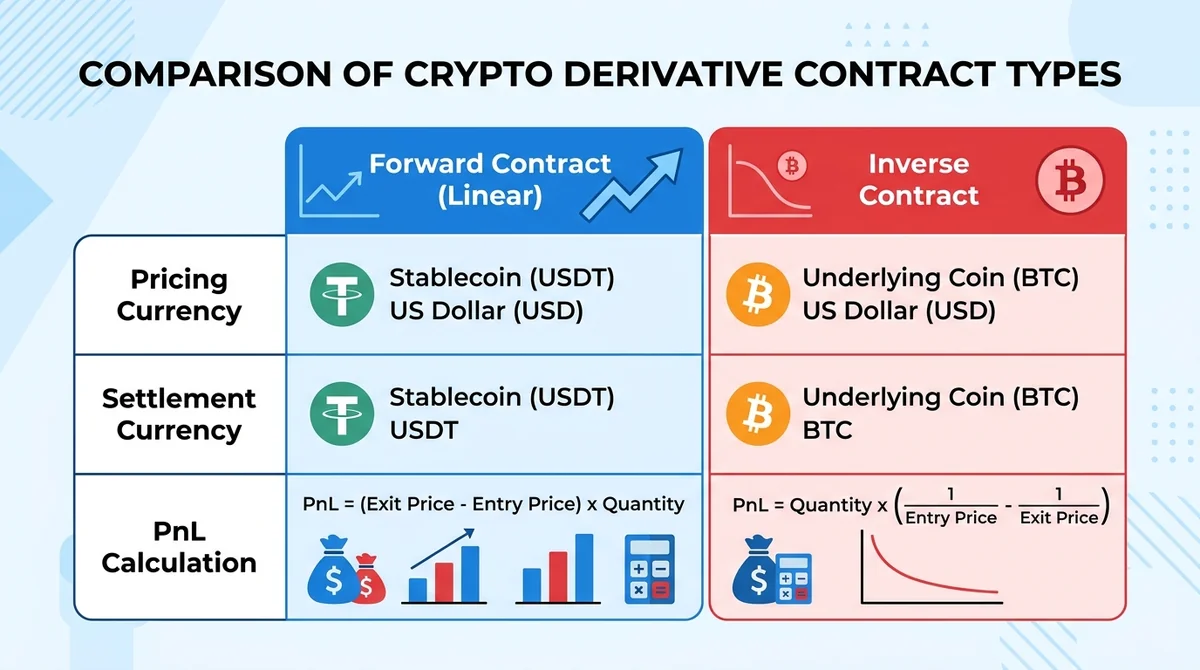
The difference between a forward contract and an inverse contract comes down mainly to the pricing and settlement currency: a forward contract is generally priced and settled in a stablecoin and is usually a linear contract, while an inverse contract is priced and settled in the underlying coin (such as BTC), with profit and loss expressed in units of the coin and calculated differently from a forward contract.
| Dimension | Forward contract (usually linear) | Inverse contract |
|---|---|---|
| Pricing currency | Stablecoin (e.g. USDT) | Underlying coin (e.g. BTC) |
| Settlement currency | Stablecoin | Underlying coin |
| PnL calculation | Proportional to price change | Expressed in coin units, calculated differently |
Neither is better than the other; they simply price and settle differently.
#How do linear contracts relate to perpetual futures?
Linear contracts and perpetual futures belong to different classification dimensions: perpetual futures are defined by whether there is an expiry date (there is none), while linear and inverse are defined by how the contract is priced and settled. The two sets of concepts can therefore be combined but not substituted for one another.
So a "linear perpetual contract" is a contract with no expiry date that is priced and settled in a stablecoin.
How do inverse perpetual futures work? An inverse perpetual contract is priced and settled in the underlying coin and has no expiry date.
These are different dimensions, and they are easy to confuse because they often appear together.
#What other common contract classification dimensions are there?
There are three main classification dimensions: by expiry date, by pricing and settlement currency, and the specific contract types that combine them; a single contract can belong to several categories at once.
- By expiry date: delivery contract (with an expiry date) versus perpetual contract (no expiry date).
- By pricing and settlement currency: coin-margined contract (priced and settled in the coin) versus U-margined contract (priced and settled in a stablecoin).
- A single contract can belong to several categories at once, such as a "U-margined perpetual contract."
#What risks should you watch for when learning these concepts?
Getting the pricing currency right matters because it shapes how you understand profit and loss.
Contract trading generally involves perpetual futures leverage, which magnifies both gains and losses and can trigger forced liquidation.
Perpetual futures also typically involve mechanisms such as funding rates; the exact rules are subject to what each platform publishes.
⚠️ Digital assets are highly volatile. This article explains concepts only and is not investment advice.
Beginners should first understand margin, liquidation and perpetual futures leverage risk, and how funding rates work before deciding whether to trade. For more foundational concepts, see MSX Learn.
FAQ
What does linear contract mean?
A linear contract is a derivative contract whose profit and loss is proportional to changes in the underlying asset's price and is typically priced and settled in a stablecoin. Whatever percentage the price moves, profit and loss move by roughly the same percentage of position value.
What is the difference between a forward contract and an inverse contract?
A forward contract is generally priced and settled in a stablecoin and is usually a linear contract, while an inverse contract is priced and settled in the underlying coin, with profit and loss expressed in units of the coin. They differ only in how they are priced and settled; neither is superior.
How do linear contracts relate to perpetual futures?
Perpetual futures are defined by the absence of an expiry date, while linear and inverse are defined by how a contract is priced and settled. These are different classification dimensions, and a linear perpetual contract is one that meets both conditions.
What do coin-margined and U-margined contracts mean?
A coin-margined contract is priced and settled in the underlying coin (such as BTC) and is usually an inverse contract; a U-margined contract is priced and settled in a stablecoin (such as USDT) and is usually a linear contract.
What risks are common to contract trading?
Contract trading generally involves perpetual futures leverage, which magnifies both gains and losses and can lead to rapid liquidation. Beginners should first understand margin, liquidation and funding rate mechanisms before deciding whether to trade, and should manage position size carefully.
Related Terms
Want to see the real data for this concept?
After you sign up, you can view live prices, funding rates, and fees for the related assets.
View live prices and fees →