Stablecoin
Stablecoins are cryptocurrencies pegged to fiat like USD or assets, with low volatility. This guide explains what stablecoins are, how they work, risks and uses.
Answer: A stablecoin is a cryptocurrency whose price is pegged to a fiat currency like the US dollar or another asset, with much lower volatility than Bitcoin.
#What Is a Stablecoin?
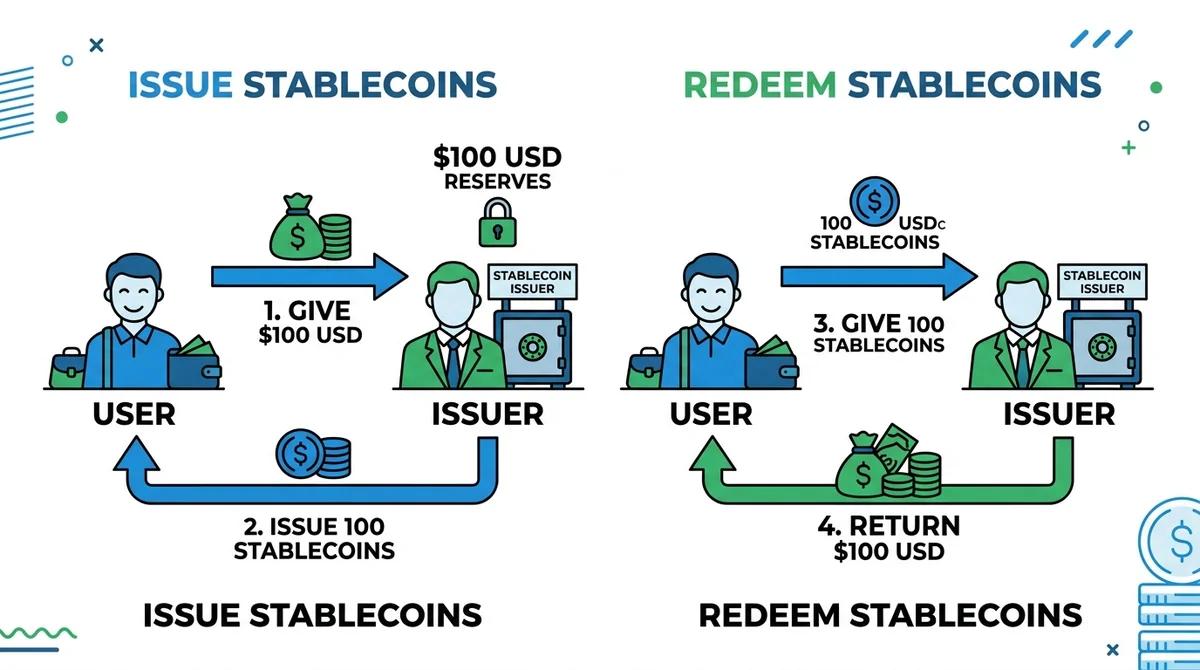
A stablecoin is like a digital version of the US dollar. You give the issuer 1 dollar, and it gives you 1 stablecoin. You can redeem 1 stablecoin for 1 dollar at any time.
The biggest difference from ordinary cryptocurrencies is price stability. Bitcoin can rise or fall 10% in a day, while stablecoins barely move.
Common types:
- Fiat-collateralized: For every coin issued, 1 dollar is held in a bank.
- Crypto-collateralized: Uses more cryptocurrency as collateral to absorb price volatility.
- Algorithmic stablecoins: Rely on programs to automatically adjust supply and demand, with no actual asset backing.
#How Do Stablecoins Work?
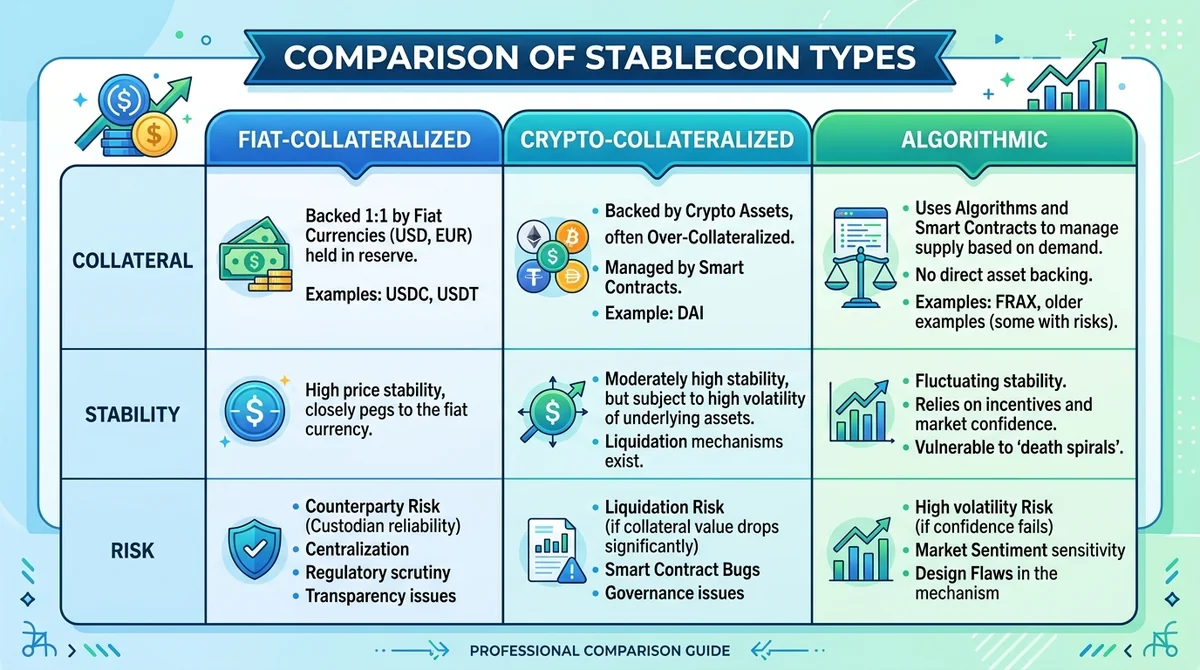
Fiat-collateralized stablecoins are the easiest to understand. When the issuer receives 100 dollars, it issues 100 stablecoins. If you want to redeem them for dollars, you return 100 stablecoins and it gives you back 100 dollars. Reserves are audited by third parties to ensure real money is held.
Crypto-collateralized stablecoins are like taking out a mortgage using a house as collateral. If the house is worth 1 million, you can only borrow 500,000. Even if the house price drops a bit, the loan remains safe. Algorithmic stablecoins are like a self-regulating pool: when the water level is high, water is released; when low, water is added. But in extreme conditions, they can fail.
#Why Are Stablecoins Important in the Crypto World?
You need stable money when trading. If you use Bitcoin to buy something, the price can change from moment to moment. Stablecoins keep the price fixed, making buying and selling convenient.
Cross-border transfers with stablecoins are also fast. Traditional bank cross-border transfers take days and have high fees. Stablecoins arrive in minutes with low costs.
Main uses:
- Medium of exchange: The "cash" for buying and selling other cryptocurrencies.
- Store of value: When you don't want to bear volatility, convert assets into stablecoins.
- Cross-border payments: Fast, low-cost international transfers.
#What Are the Advantages of Stablecoins?
Price stability: Suitable for everyday payments and storing value, without worrying about big price swings.
Fast transfers, low cost: On-chain transfers are completed in minutes, with fees far lower than traditional cross-border remittances.
Global accessibility: As long as you have internet and a wallet, anyone can use them, with no bank account restrictions.
#What Are the Risks and Limitations of Stablecoins?
Depegging risk: If the issuer has insufficient reserves or there is market panic, the stablecoin price may fall below 1 dollar.
Opaque reserves: Some stablecoins do not have public audits, so you don't know whether they truly have enough dollar reserves.
Algorithmic stablecoins are riskier: When the algorithm fails, they may enter a "death spiral" and the price can go to zero.
Stablecoins are not equivalent to bank deposits and are not protected by deposit insurance. Please do your own research before investing. This article does not constitute investment advice.
#A Simple Example: Completing a Payment with a Stablecoin
Suppose you buy goods worth 100 dollars. Paying with USDT, the recipient gets exactly 100 dollars. Paying with Bitcoin, it might be worth 100 dollars when sent, but only 95 dollars when received.
Steps to pay with a stablecoin:
- Open your wallet and select USDT.
- Enter the recipient's address and the amount 100.
- Confirm the transaction and wait a few minutes for it to arrive.
The entire process has a clear price, with no difference caused by volatility.
#FAQ
What is the difference between stablecoins and ordinary cryptocurrencies?
Ordinary cryptocurrencies have high price volatility and are suitable for investment or speculation. Stablecoins are pegged to fiat or other assets, have stable prices, and are mainly used as a medium of exchange and store of value.
Can stablecoins depeg?
Yes. If the issuer has insufficient reserves, faces a run, or there is market panic, the stablecoin price may fall below its peg. There have been multiple depegging events in history.
Why are algorithmic stablecoins riskier?
Algorithmic stablecoins do not have full asset backing and rely on programs to adjust supply and demand. Once market confidence collapses, the algorithm may fail, and the price can spiral downward, even to zero.
Are stablecoins suitable for everyday payments?
Yes. They have stable prices, fast transfers, and low fees, especially suitable for cross-border payments. But be aware of acceptance and compliance risks.
Do stablecoins have deposit insurance?
No. Stablecoins are not bank deposits and are not protected by deposit insurance. If the issuer goes bankrupt or has insufficient reserves, you may lose funds.
FAQ
What is the difference between stablecoins and ordinary cryptocurrencies?
Ordinary cryptocurrencies have high price volatility and are suitable for investment or speculation. Stablecoins are pegged to fiat or other assets, have stable prices, and are mainly used as a medium of exchange and store of value.
Can stablecoins depeg?
Yes. If the issuer has insufficient reserves, faces a run, or there is market panic, the stablecoin price may fall below its peg. There have been multiple depegging events in history.
Why are algorithmic stablecoins riskier?
Algorithmic stablecoins do not have full asset backing and rely on programs to adjust supply and demand. Once market confidence collapses, the algorithm may fail, and the price can spiral downward, even to zero.
Are stablecoins suitable for everyday payments?
Yes. They have stable prices, fast transfers, and low fees, especially suitable for cross-border payments. But be aware of acceptance and compliance risks.
Do stablecoins have deposit insurance?
No. Stablecoins are not bank deposits and are not protected by deposit insurance. If the issuer goes bankrupt or has insufficient reserves, you may lose funds.
Related Terms
Want to see the real data for this concept?
After you sign up, you can view live prices, funding rates, and fees for the related assets.
View live prices and fees →